Testosterone Levels by Age: 2026 Data and Lab Ranges
By TRT Provider Guide
Published: September 1, 2026 · Last verified: September 2, 2026
Testosterone levels by age do not fit one universal chart. A lab range, a diagnosis cutoff, and a treatment goal are three different things.
Headline finding: Four U.S. laboratory catalogs checked on September 2, 2026 published adult male lower limits from 193 to 264 ng/dL—a 71 ng/dL spread. In a separate harmonized study, the central 95% interval was 264–916 ng/dL among 1,185 healthy, non-obese men ages 19–39.
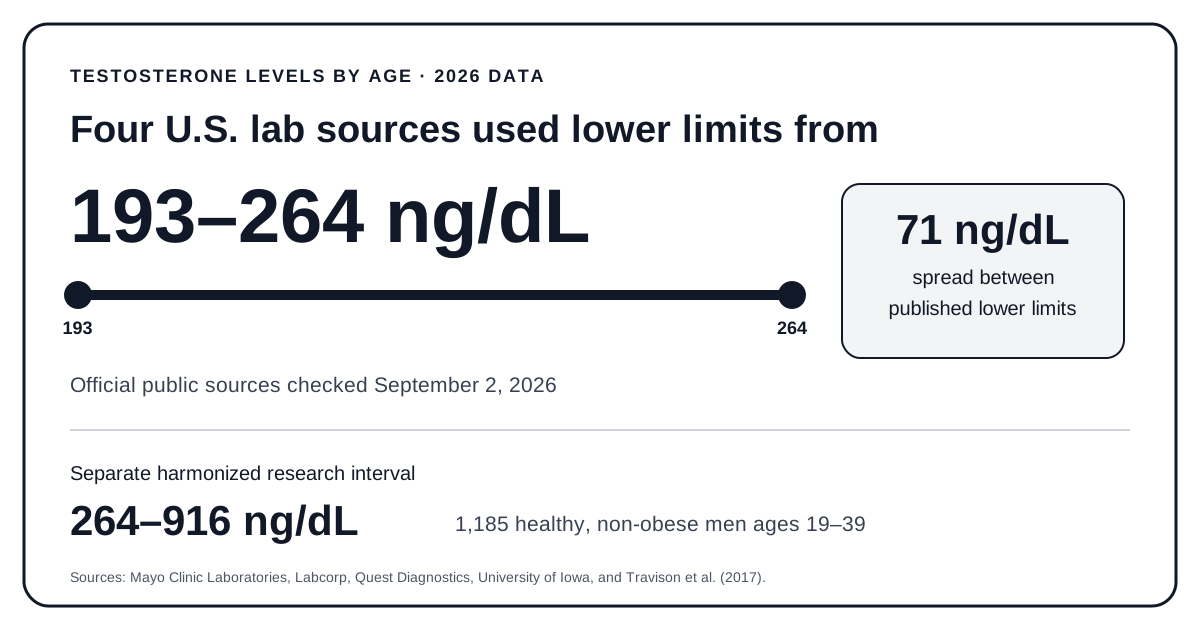
Source: TRT Provider Guide comparison of official Mayo Clinic Laboratories, Labcorp, Quest Diagnostics, and University of Iowa pages checked September 2, 2026, plus Travison et al. (2017). The 71 ng/dL spread is 264 − 193.
A total testosterone result cannot diagnose low testosterone by itself. The American Urological Association uses below 300 ng/dL as a reasonable cutoff that can support a diagnosis, but the person also needs symptoms or signs and two early-morning tests on separate days.
Download the four-lab source data as CSV
Scope: This page covers total testosterone in adult men. It does not give a personal diagnosis or say whether testosterone treatment is right for someone.
Testosterone levels by age: the clearest published age bands
A 2022 study by Zhu and colleagues used data from 1,486 U.S. men ages 20–44 in the 2011–2016 National Health and Nutrition Examination Survey. The table below shows the middle third of results in each age group.
That phrase matters. The middle third is not the full normal range. It is not a treatment target. The study authors used the lower edge of that middle third to propose age-based cutoffs for younger men.
Middle-third total testosterone values in U.S. men ages 20–44
| Age | Middle third of total testosterone | Lower edge proposed by the study |
|---|---|---|
| 20–24 | 409–558 ng/dL | 409 ng/dL |
| 25–29 | 413–575 ng/dL | 413 ng/dL |
| 30–34 | 359–498 ng/dL | 359 ng/dL |
| 35–39 | 352–478 ng/dL | 352 ng/dL |
| 40–44 | 350–473 ng/dL | 350 ng/dL |
Source: Zhu et al., “What Is a Normal Testosterone Level for Young Men? Rethinking the 300 ng/dL Cutoff for Testosterone Deficiency in Men 20–44 Years Old,” The Journal of Urology (2022). Values are the study's reported middle tertiles and proposed lower cutoffs.
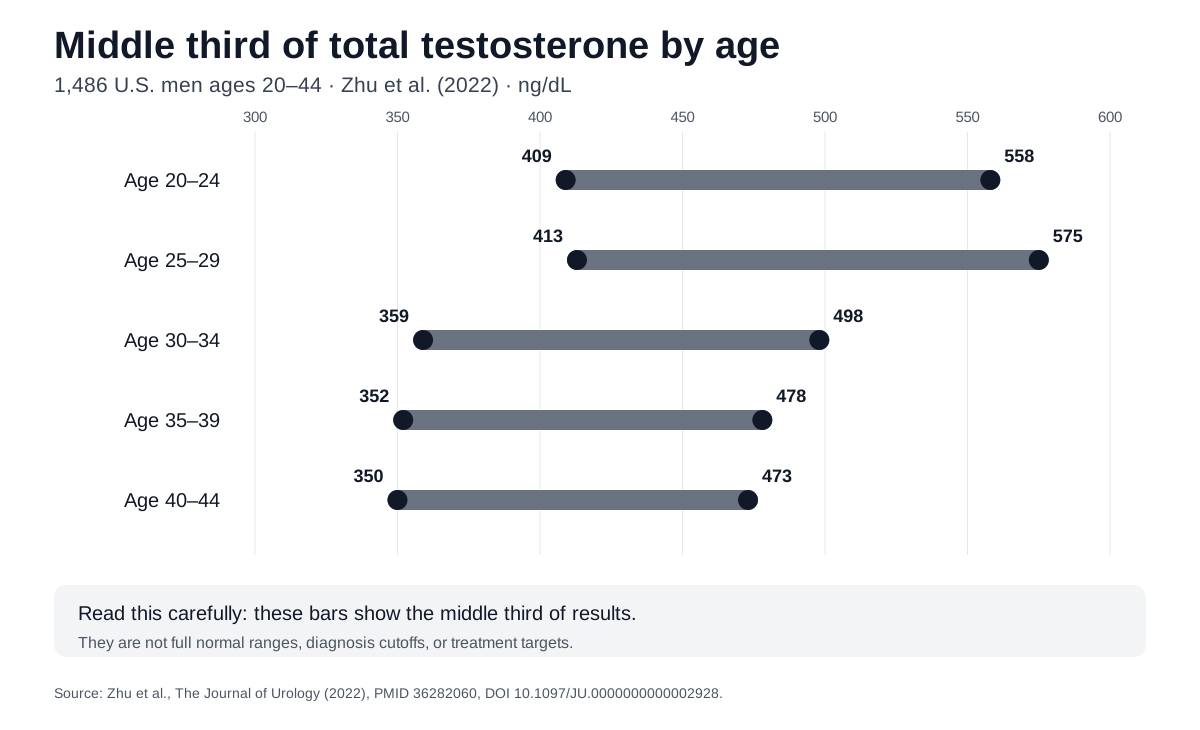
Source: Zhu et al., The Journal of Urology (2022). The chart shows the study's middle tertiles. It does not show full normal ranges or treatment targets.
The study does not supply age bands for men 45 and older. Its proposed cutoffs also have not replaced the AUA's general 300 ng/dL cutoff.
What the 264–916 ng/dL range really means
The 264–916 ng/dL figure comes from a different study. Travison and colleagues harmonized testosterone measurements from four large cohorts. The full project included 9,054 men. The reference interval came from a smaller group of 1,185 healthy, non-obese men ages 19–39.
“Harmonized” means the study brought results from different assays onto a common measurement standard.
Harmonized total testosterone percentiles in healthy, non-obese men ages 19–39
| Percentile | Total testosterone |
|---|---|
| 2.5th | 264 ng/dL |
| 5th | 303 ng/dL |
| 50th, or median | 531 ng/dL |
| 95th | 852 ng/dL |
| 97.5th | 916 ng/dL |
The percentile table and the harmonized interval are separate results
The paper also reports a separate age-banded percentile table. In its first study column for men ages 19–39, the 2.5th-percentile value is 267 ng/dL and the 97.5th-percentile value is 929 ng/dL. The paper's separate harmonized summary interval is 264–916 ng/dL. Those two results should not be spliced together.
Total testosterone percentile table reproduced from Travison et al.
| Percentile | 19–39 | 40–49 | 50–59 | 60–69 | 70–79 | 80–99 |
|---|---|---|---|---|---|---|
| 2.5th (bottom of the range) | 267 | 235 | 219 | 218 | 218 | 157 |
| 5th | 304 | 273 | 256 | 254 | 252 | 218 |
| 10th | 344 | 310 | 297 | 296 | 292 | 278 |
| 25th | 424 | 386 | 374 | 374 | 372 | 362 |
| 50th (the middle man) | 531 | 481 | 477 | 477 | 477 | 476 |
| 75th | 643 | 608 | 605 | 604 | 604 | 604 |
| 90th | 774 | 749 | 749 | 749 | 749 | 749 |
| 95th | 850 | 839 | 839 | 839 | 839 | 839 |
| 97.5th (top of the range) | 929 | 929 | 929 | 929 | 926 | 913 |
Source: Travison et al.. This table reproduces the study's reported age-banded values. The source's harmonized 264–916 ng/dL summary interval is reported separately above.
The 264–916 range is the span from the 2.5th to the 97.5th percentile in that young, healthy reference group. It is not:
- an age-by-age chart for every adult man;
- proof that 263 ng/dL always means disease;
- proof that 916 ng/dL is an ideal target; or
- the range every laboratory must use.
2026 U.S. laboratory testosterone reference range data
We checked four official U.S. laboratory sources named in the original dataset. They were included because their public catalogs could be checked directly. This page does not call them the four largest laboratories.
Adult male total testosterone values published by four U.S. laboratory sources
| Official source | Adult male age band shown | Published value | What the source gives |
|---|---|---|---|
| Mayo Clinic Laboratories | One adult male band | 240–950 ng/dL | Full interval |
| Labcorp | One adult male band | 264–916 ng/dL | Full interval |
| Quest Diagnostics | One public adult male lower limit | 250 ng/dL | Lower limit only; no upper limit inferred |
| University of Iowa | 20–49 years | 249–836 ng/dL | Full interval |
| University of Iowa | 50 years and older | 193–740 ng/dL | Full interval |
Source: Mayo Clinic Laboratories; Labcorp; Quest Diagnostics; and the University of Iowa Pathology Handbook. Official pages checked September 2, 2026.
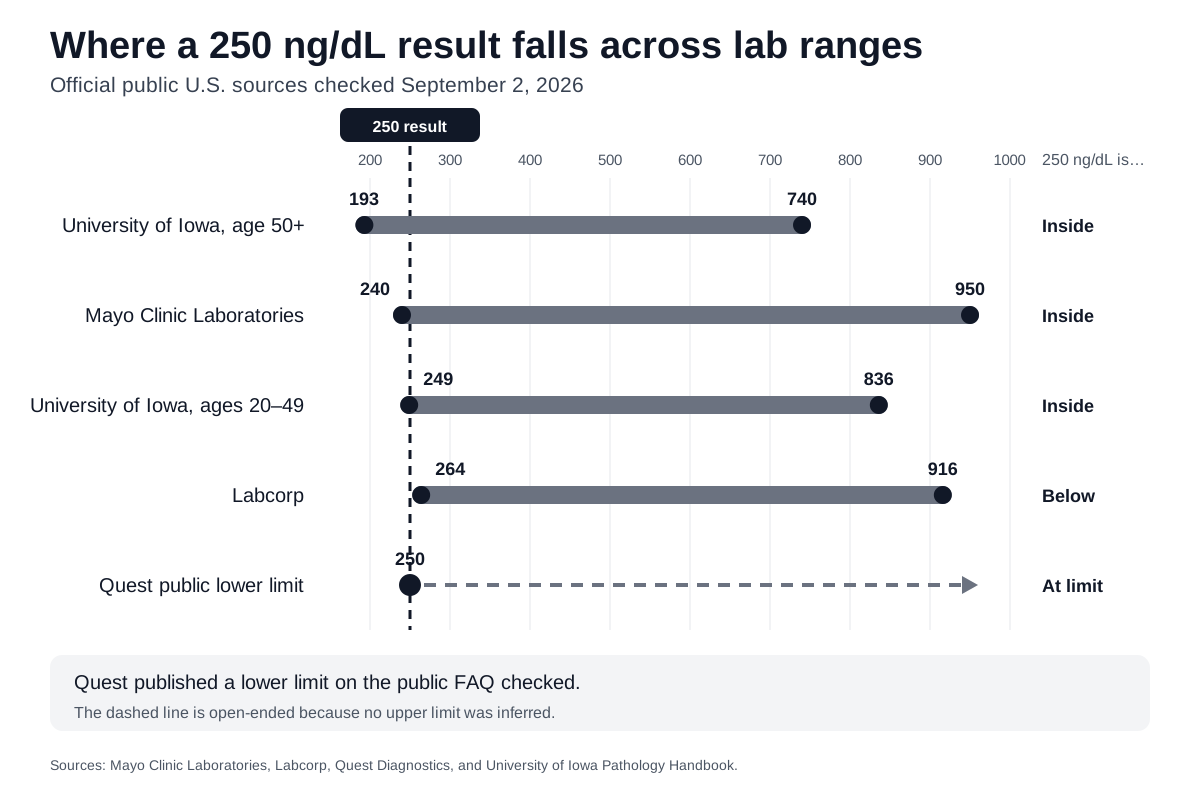
Source: The same four official laboratory pages listed above. Source data: U.S. Laboratory Total Testosterone Reference Range Snapshot, version 1.1. Quest's checked public FAQ listed a lower limit but no upper limit, so the chart does not invent one.
The clearest way to see the difference
Take a made-up result of 250 ng/dL:
| Source | Where 250 ng/dL sits |
|---|---|
| Labcorp | Below its 264 ng/dL lower limit |
| Mayo Clinic Laboratories | Inside its 240–950 ng/dL interval |
| Quest Diagnostics | At its public 250 ng/dL lower limit |
| University of Iowa, ages 20–49 | Inside its 249–836 ng/dL interval |
| University of Iowa, age 50+ | Inside its 193–740 ng/dL interval |
Source: Same four official laboratory pages listed under Table 3. This is a direct comparison of published limits, not a claim that different assays would return the exact same result from the same blood sample.
This does not mean one source is right and another is wrong. Labs can use different assays, source groups, and age bands. Use the reference range printed on the actual report.
Reference range, diagnosis cutoff, and treatment target are not the same
These numbers answer different questions.
The main testosterone numbers and what each one means
| Number or range | Type | What it means | What it does not mean |
|---|---|---|---|
| 193–950 ng/dL across the lab rows above | Laboratory reference interval | Values published for a lab, age band, and method | A universal diagnosis rule |
| 264–916 ng/dL | Harmonized research interval | Central 95% of a healthy, non-obese 19–39 reference group | An “optimal” range for every age |
| Below 300 ng/dL | AUA diagnostic support cutoff | A reasonable cutoff used with symptoms and repeat early-morning tests | A diagnosis from one number |
| 350–413 ng/dL, depending on age 20–44 | Research proposal | Lower edges proposed by the Zhu study | A current national guideline |
| 450–600 ng/dL | AUA treatment target | The AUA's stated physiologic target during treatment | A threshold used to diagnose low testosterone |
Source: American Urological Association Testosterone Deficiency Guideline; Endocrine Society testosterone therapy guideline; Travison et al.; and Zhu et al..
The AUA says the diagnosis should be made only after two total testosterone tests on separate days, with both tests taken in the early morning. The person must also have symptoms or signs that fit testosterone deficiency.
The Endocrine Society also calls for symptoms plus consistently low values. It recommends a repeat fasting morning total testosterone test. When total testosterone is close to the lower limit, or when sex hormone-binding globulin may be abnormal, it recommends checking free testosterone with a sound method.
What should testosterone be at age 50, 60, or 70?
There is no one national U.S. diagnosis cutoff for each decade.
The AUA's general cutoff remains below 300 ng/dL as support for a diagnosis. The lab may still use an age-based reference interval. In this audit, the University of Iowa changed its adult male interval at age 50, from 249–836 ng/dL for ages 20–49 to 193–740 ng/dL for age 50 and older.
That lower lab limit does not mean 193 ng/dL is a treatment goal. It does not erase symptoms. It does not replace repeat morning testing.
For a man age 50, 60, or 70, the useful answer is:
- Read the range printed next to the result.
- Check whether the test was total or free testosterone.
- Confirm a low total result with another early-morning test.
- Judge the number with symptoms, health history, medicines, and any reason SHBG may be unusual.
How to read your testosterone result
1. Check the test name
“Total testosterone” and “free testosterone” are not the same test. They use different units and different reference ranges.
2. Check the units
U.S. total testosterone reports often use ng/dL. Many other countries use nmol/L.
To convert total testosterone:
ng/dL × 0.0347 = nmol/L
| ng/dL | Approximate nmol/L |
|---|---|
| 193 | 6.7 |
| 250 | 8.7 |
| 264 | 9.2 |
| 300 | 10.4 |
| 450 | 15.6 |
| 600 | 20.8 |
| 916 | 31.8 |
Source: Calculated from testosterone's molecular weight, 288.42 g/mol, as listed by NIH PubChem. Values are rounded to one decimal place.
3. Check the time of the blood draw
Guidelines call for morning testing because total testosterone can change during the day.
4. Repeat a low result
One low result is not enough for an AUA diagnosis. The second test should be on a separate day and in the early morning.
5. Add symptoms and signs
A number alone does not tell whether a person has testosterone deficiency. Symptoms, medical history, medicines, fertility plans, and other causes matter.
6. Ask whether SHBG could change the picture
SHBG is a protein that carries testosterone in the blood. When SHBG is unusually high or low, total testosterone may not show the full picture. That is when a sound free testosterone measurement or calculation can help.
Total testosterone versus free testosterone
Total testosterone counts testosterone that is bound to proteins plus the small amount that is unbound.
Free testosterone estimates or measures the unbound portion.
Do not compare a free testosterone result in pg/mL with a total testosterone range in ng/dL. They are different measurements. Free testosterone ranges also vary more by method.
The Endocrine Society recommends free testosterone when total testosterone is near the lower limit or when a condition may change SHBG. It does not recommend replacing every total testosterone test with a free testosterone test.
Methodology
This page publishes an original, dated comparison of official laboratory reference information and a direct transcription of two primary studies.
Laboratory catalog audit
- We used the four U.S. laboratory sources in the underlying dataset: Mayo Clinic Laboratories, Labcorp, Quest Diagnostics, and the University of Iowa.
- We checked each official public catalog or FAQ page on September 2, 2026.
- We recorded adult male total testosterone values in ng/dL, the age band shown, and whether the source gave a full interval or only a lower limit.
- We did not fill in a missing Quest upper limit.
- We did not rank the laboratories by size, quality, or market share.
- We calculated the lower-limit spread as 264 − 193 = 71 ng/dL.
- We kept separate rows when one source used more than one adult age band.
Study data
- The Travison values were transcribed as harmonized percentiles for the healthy, non-obese 19–39 reference group. The 264–916 ng/dL interval is kept separate from age-band tables and clinical cutoffs.
- The Zhu values were transcribed as the reported middle tertile for each five-year age group from 20 through 44. They are not relabeled as central 95% reference intervals.
- Guideline thresholds and treatment targets are shown in their own table so a reader cannot mistake one for another.
Dataset fields
The CSV includes source name, source type, test name, population, age band, lower limit, upper limit, what the source published, verification date, dataset version, and official source URL.
Dataset version: 1.1
Data verified: September 2, 2026
Download: us-lab-testosterone-reference-ranges-2026.csv
Limits of this data
- This is a snapshot of four public laboratory sources, not every U.S. laboratory.
- The four sources were not chosen or labeled by market share.
- Reference intervals can change when a lab changes its assay, method, source population, or catalog.
- A range from one lab should not be pasted onto a result from another lab.
- The Travison reference subset was limited to healthy, non-obese men ages 19–39.
- The Zhu age bands stop at age 44.
- Reference data do not show who will benefit from treatment.
- The range printed on the current lab report takes priority over this dated snapshot.
Frequently asked questions
Is 300 ng/dL low testosterone?
The American Urological Association uses total testosterone below 300 ng/dL as a reasonable cutoff that can support a diagnosis. The number is not enough by itself. The person also needs symptoms or signs, plus two early-morning tests on separate days.
Is 264 ng/dL normal?
264 ng/dL is the lower end of the harmonized 19–39 research interval and Labcorp's adult male interval on the page checked. Another lab may print a different range. A diagnosis still needs symptoms and repeat morning testing.
What is a normal testosterone level at age 40?
In the Zhu study, the middle third for men ages 40–44 was 350–473 ng/dL. That is a study distribution, not a universal normal range or treatment goal. Use the reference range on the actual lab report.
What is a normal testosterone level at age 50, 60, or 70?
No major U.S. guideline gives one separate diagnostic cutoff for each of those ages. In this audit, the University of Iowa catalog used 193–740 ng/dL for men age 50 and older. That is one lab's reference interval, not a national diagnosis rule.
Why is my lab's testosterone range different?
Labs may use different assays, source populations, and age bands. That is why the range printed on your own report matters. Do not compare a result with a range taken from a different lab as if the methods were identical.
When should free testosterone be checked?
The Endocrine Society recommends checking free testosterone when total testosterone is near the lower limit or when a condition may change sex hormone-binding globulin, called SHBG. Free and total testosterone use different units and cannot be compared as the same number.
How to cite this page
Page citation
TRT Provider Guide. “Testosterone Levels by Age: 2026 Data and Lab Ranges.” Published September 1, 2026. Last verified September 2, 2026. https://trtproviderguide.com/research/testosterone-levels-by-age/
Dataset citation
TRT Provider Guide. U.S. Laboratory Total Testosterone Reference Range Snapshot, 2026. Version 1.1. Verified September 2, 2026. https://trtproviderguide.com/research/data/us-lab-testosterone-reference-ranges-2026.csv
Related research
- Low testosterone statistics
- TRT statistics
Primary sources
- Travison TG, Vesper HW, Orwoll E, et al. “Harmonized Reference Ranges for Circulating Testosterone Levels in Men of Four Cohort Studies in the United States and Europe.” The Journal of Clinical Endocrinology & Metabolism. 2017.
- Zhu A, et al. “What Is a Normal Testosterone Level for Young Men? Rethinking the 300 ng/dL Cutoff for Testosterone Deficiency in Men 20–44 Years Old.” The Journal of Urology. 2022.
- American Urological Association. Testosterone Deficiency Guideline.
- Endocrine Society. Testosterone Therapy in Men With Hypogonadism: Clinical Practice Guideline.
- Mayo Clinic Laboratories. Total Testosterone test catalog.
- Labcorp. Testosterone, Total test catalog.
- Quest Diagnostics. Testosterone testing FAQ.
- University of Iowa Pathology Handbook. Total Testosterone.