Sperm Recovery After Testosterone: 2026 Study Data
By TRT Provider Guide
Published: September 3, 2026 · Last verified: September 3, 2026
Editorial status: Editorial research; not clinician-reviewed
Sperm recovery after testosterone often takes months, and there is no one recovery rate for every man. In a controlled-study analysis of 1,549 healthy men, the modeled chance of reaching at least 20 million sperm per milliliter was 67% by 6 months and 90% by 12 months after the hormone regimen stopped. In a separate treated TRT-clinic cohort of 66 men, 70% reached a different target: total motile sperm count above 5 million within 12 months. The groups and measures were different, so the rates cannot be combined.
Key finding, verified September 3, 2026: “There is no single proven sperm recovery rate after testosterone. In a 1,549-man controlled-study analysis, the modeled chance of reaching at least 20 million sperm/mL was 67% by 6 months and 90% by 12 months. In a separate treated TRT-clinic cohort of 66 men, 70% crossed a different target: total motile sperm count above 5 million within 12 months. These were semen-test results, not pregnancy rates.”
The catch is simple: “recovery” did not mean the same thing in every study. One paper counted sperm in each milliliter. Another counted moving sperm in the full sample. Others counted a better category, a return from zero, or a pregnancy. None of the 11 anchor publications used live birth as its main recovery result.
| Evidence group | Men studied | What counted as recovery | Main result | Biggest limit |
|---|---|---|---|---|
| Controlled male hormonal-contraception studies | 1,549 | Sperm concentration reached at least 20 million/mL | Modeled 67% by 6 months; 90% by 12; 96% by 16; 100% by 24 | Healthy volunteers in planned, time-limited research regimens; not typical long-term TRT patients; no pregnancy endpoint |
| Testosterone-associated infertility clinic | 66 | Total motile sperm count rose above 5 million | 46 of 66, or 70%, within 12 months | Everyone stopped testosterone and received specialist care; no untreated control |
Source: Liu et al., The Lancet (2006) and Kohn et al., Fertility and Sterility (2017).
Evidence map: 73 finding-level records from 11 anchor human publications · 28 fields per record · Version 2.0 · Verified September 3, 2026
Dataset files: CSV · JSON · Recovery-curve CSV
Scope: This page compares three different settings: controlled male hormonal-contraception studies, prescribed or prior-testosterone studies, and non-prescribed anabolic-androgenic steroid studies. Those settings stay separate. A sperm threshold is not treated as proof of pregnancy, live birth, or return to one person’s old baseline.
Method note: This is a transparent anchor-study evidence map, not an exhaustive systematic review or meta-analysis. It includes the largest recovery model, four direct prescribed or prior-testosterone publications, and six modern human steroid-recovery publications that add a distinct endpoint or comparison.
Medical note: This page is for education. It is not a treatment plan. Do not stop or change prescribed testosterone or fertility medicine because of this page. A prescriber and a reproductive urologist can use semen tests, blood tests, medical history, and both partners’ timelines to plan care.
On this page: recovery time · what the numbers mean · 11-study evidence map · methodology · prescribed testosterone · staying on testosterone · anabolic steroids · recovery factors · testing · fertility · guidelines · limits · FAQ
Sperm recovery after testosterone: what the 6-, 12-, and 24-month data show
There is no one proven deadline. The largest recovery analysis found a modeled median of 3.4 months to reach 20 million sperm/mL. It estimated that 67% reached that mark by 6 months and 90% by 12 months. Those results came from healthy men in controlled, time-limited hormone studies—not from a typical group of men after years of testosterone replacement therapy, or TRT.
The 2006 analysis combined participant data from 30 male hormonal-contraception studies. It included 1,549 healthy men ages 18 to 51. The researchers modeled the time it took for sperm concentration to reach at least 20 million sperm in each milliliter of semen.
| Time after the study regimen stopped | Modeled share reaching the threshold | 95% confidence interval |
|---|---|---|
| 6 months | 67% | 61%–72% |
| 12 months | 90% | 85%–93% |
| 16 months | 96% | 92%–98% |
| 24 months | 100%* | Not stated in the PubMed abstract |
Source: Liu et al., “Rate, extent, and modifiers of spermatogenic recovery after hormonal male contraception” (2006).
*The 24-month value was modeled for the study group. It is not a promise that every man will recover by 24 months.
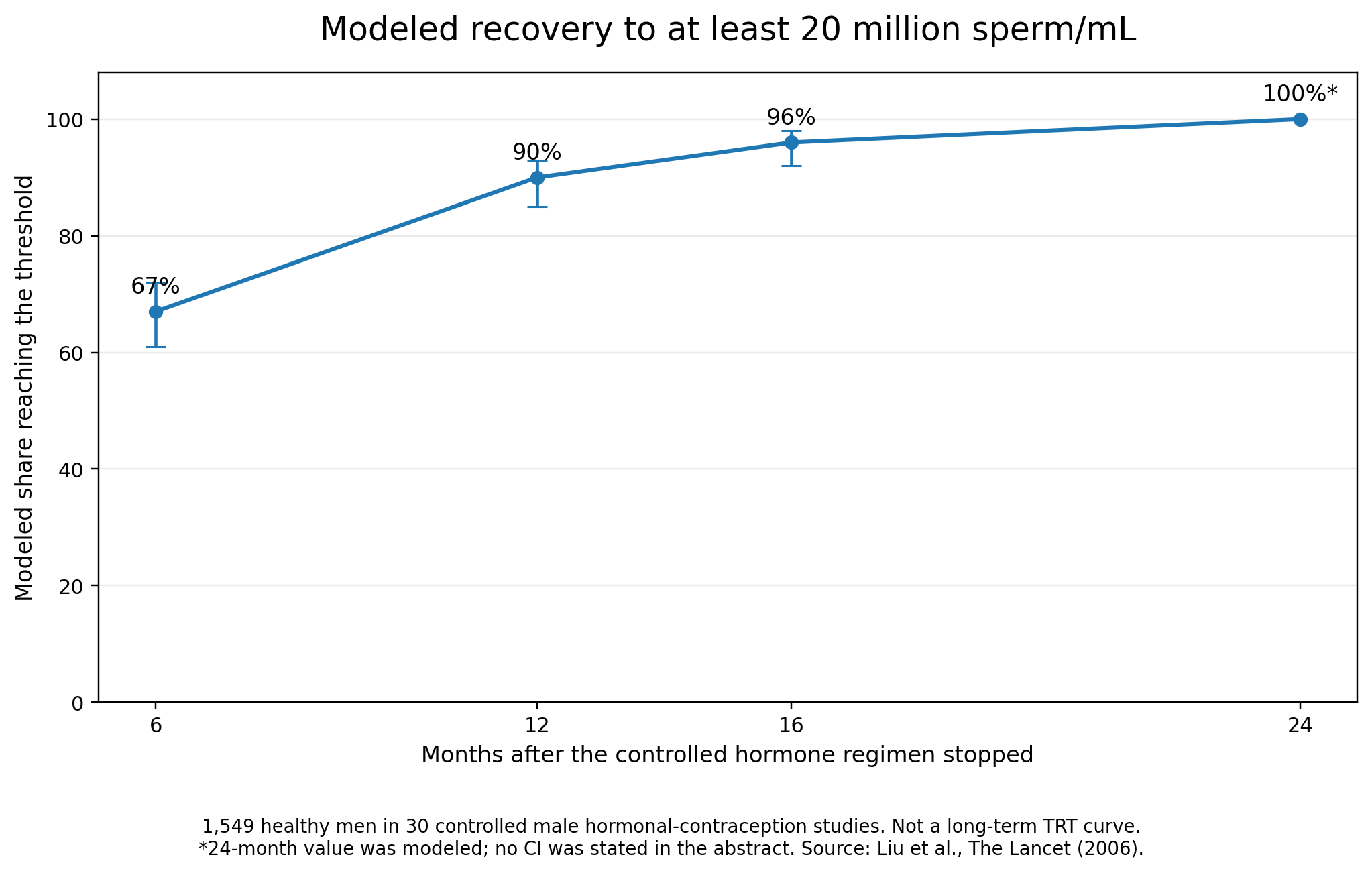
Figure 1. Modeled recovery to at least 20 million sperm/mL. Error bars show the reported 95% confidence intervals at 6, 12, and 16 months. The PubMed abstract did not state a confidence interval for the modeled 24-month value. This is a controlled male-contraception curve, not a long-term TRT curve.
Source: Liu et al., The Lancet (2006). Chart data.
The same analysis reported the modeled median time to three sperm-concentration marks. Median means half of the modeled group reached the mark sooner and half reached it later.
| Recovery mark | Median time after the regimen stopped | 95% confidence interval |
|---|---|---|
| At least 3 million sperm/mL | 2.5 months | 2.4–2.7 months |
| At least 10 million sperm/mL | 3.0 months | 2.9–3.1 months |
| At least 20 million sperm/mL | 3.4 months | 3.2–3.5 months |
Source: Liu et al., The Lancet (2006).
These tables answer a narrow question: how long it took healthy research volunteers to cross a lab threshold after a planned hormone regimen ended. They do not show when a person returned to his own starting count. They do not show pregnancy. They do not prove that recovery after years of TRT follows the same curve.
The more direct TRT evidence is smaller and treated. In the 66-man Kohn clinic cohort, 46 men reached a total motile sperm count above 5 million within 12 months. Total motile sperm count means the estimated number of moving sperm in the whole semen sample. It is not the same as sperm concentration per milliliter.
Plain answer: Many men have sperm return or improve within several months. Some take a year or longer. No symptom, semen appearance, or blood testosterone result can replace a semen analysis.
What do the sperm recovery numbers show—and what do they not show?
The studies show that sperm production can restart or improve after external hormones stop and during specialist care. They do not give one universal recovery rate, one proven best treatment, or one pregnancy forecast.
A study result is only as clear as its endpoint. An endpoint is the exact result the researchers chose to count. Calling every endpoint “fertility recovery” hides big differences.
The seven-level sperm-recovery map
We use seven levels to keep unlike results apart. This is a language and evidence check, not a treatment scale.
| Level | What a study may count | What the result can tell us | What it cannot prove by itself |
|---|---|---|---|
| 1 | Any sperm is found | Sperm production was detected in that sample | A useful count, normal movement, pregnancy, or full recovery |
| 2 | Sperm concentration crosses a threshold | The number in each milliliter reached a stated mark | Total sperm in the sample, return to baseline, or pregnancy |
| 3 | Total motile sperm count crosses a threshold | The full sample contains a stated number of moving sperm | Normal fertility or a sure chance of conception |
| 4 | The result moves into a better category | The later semen category was better than the earlier one | A normal result, personal baseline, pregnancy, or live birth |
| 5 | A result reaches a study’s “normal” category | The sample crossed that study’s stated reference rule | That the man is fertile or that pregnancy will occur |
| 6 | The result returns toward a known baseline | The measured value moved back toward a pre-exposure level | Pregnancy or live birth |
| 7 | Pregnancy or live birth occurs | A direct reproductive outcome happened | That one medicine caused it or that another couple will have the same result |
Source: TRT Provider Guide Sperm Recovery After Testosterone Evidence Map, version 2.0; framework derived from the endpoints used in the 11 anchor publications.
Why 20 million/mL is not a fertility cutoff
The Liu analysis used 20 million sperm/mL as its recovery threshold. The current WHO lower reference value for sperm concentration is 16 million/mL. Neither number is a hard line between fertile and infertile men.
| Number | What it is | What it is not |
|---|---|---|
| 20 million sperm/mL | The recovery threshold chosen for the 2006 Liu model | A current WHO fertility cutoff or proof of pregnancy |
| 16 million sperm/mL | The 2021 WHO lower fifth-centile reference value for concentration | A line that separates all fertile and infertile men |
| 39 million sperm per ejaculate | The 2021 WHO lower fifth-centile reference value for total sperm number | The same measure as concentration per milliliter |
Source: Liu et al. (2006), the WHO semen manual, 6th edition, and the EAU male infertility guideline. The EAU states that the lower fifth-centile values do not mark a border between fertile and infertile men.
What each headline number actually means
| Number | Exact meaning | It does not mean |
|---|---|---|
| 67% by 6 months | Modeled share of 1,549 healthy men reaching at least 20 million sperm/mL after controlled hormone regimens ended | 67% returned to baseline or caused a pregnancy |
| 90% by 12 months | Modeled share of the same controlled-study group reaching the same concentration mark | 90% of long-term TRT users recover by one year |
| 70% by 12 months | 46 of 66 treated TRT-clinic patients reached total motile sperm count above 5 million | 70% recovered without treatment or had normal fertility |
| 95.9% | 47 of 49 men in a treated case series had sperm return or a very low count improve under one combined endpoint | A 95.9% cure rate or a proven treatment effect |
| 74% | Share of a treated 77-man retrospective cohort whose sperm-concentration category improved | Return to baseline, pregnancy, or proof that continuing testosterone is safe for fertility |
| About 1 year | Authors’ broad summary of sperm-production recovery after an AAS cycle in the HAARLEM cohort | The same timeline after prescribed TRT |
| 58.6%, 69.2%, and 87.5% | Twelve-month normozoospermia rates in three nonrandomized groups of 79 short-term AAS users | A randomized treatment effect or a TRT recovery rate |
Source: Liu 2006, Kohn 2017, Wenker 2015, Stocks 2025, Smit 2021, and İbis 2026.
What do the 11 anchor studies show?
The evidence map now includes 11 anchor publications, not five. The original five-study set missed direct prior-testosterone evidence from 2013 and several modern steroid-recovery cohorts. It also missed a 79-man paper published online on October 28, 2025 and in the January 2026 issue of BJU International.
| Study | People | Exposure and design | Main result kept in the map | Main limit |
|---|---|---|---|---|
| Liu 2006 | 1,549 | Integrated analysis of 30 controlled male hormonal-contraception studies | Modeled 67% at 6 months and 90% at 12 months to at least 20 million/mL | Healthy volunteers and planned regimens; not typical long-term TRT |
| Kaminetsky 2013 | 12 | Small randomized open-label active-control study after prior topical testosterone | Enclomiphene arm: elevated sperm counts in 7 of 7 at 3 months and 6 of 6 at 6 months; testosterone-gel arm: 0 of 5 and 2 of 5 above 20 million/mL | Only 12 men; no untreated arm; not an infertility-clinic cohort |
| Wenker 2015 | 49 | Retrospective treated infertility-clinic case series | 47 of 49 had sperm return or a very low count improve; mean 4.6 months | Broad combined endpoint; mixed medicines; no control |
| Kohn 2017 | 66 | Retrospective treated infertility-clinic cohort | 46 of 66 reached total motile sperm count above 5 million within 12 months | No untreated control; selected clinic patients |
| Stocks 2025 | 77 | Retrospective treated fertility cohort | 74% moved into a better sperm-concentration category; median 4.7 months to highest recorded concentration | No randomization or untreated control; category endpoint |
| Shankara-Narayana 2020 | 93 | Cross-sectional current users, past users, and non-users | Modeled mean sperm-output recovery was 14.1 months after androgen abuse | Modeled from different groups, not repeated semen tests in the same men |
| Smit 2021, HAARLEM | 100 | Prospective naturalistic AAS cohort | Blood testosterone recovered in about 3 months; sperm production took about 1 year | AAS exposure differs from TRT; incomplete semen follow-up |
| Al Hashimi 2022 | 520 total; 94 with infertility | Prospective clinic study after AAS use | 14 of 94 infertility patients reported pregnancy within 12 months; all 94 received treatment | No untreated comparison in the infertility subgroup; pregnancy was not live birth |
| Ledesma 2023 | 45; 36 with semen follow-up | Retrospective treated infertility cohort after testosterone/AAS use | 17 of 36 moved into a better sperm category; 6 of 36 reached normozoospermia | Nine lost to semen follow-up; no untreated control |
| Smit 2025 | 19 | Retrospective harm-reduction cohort that continued non-prescribed androgens | Mean total sperm count rose from 18.0 million to 146.9 million during hCG care | Very small selected group; no control; non-prescribed exposure continued |
| İbis 2026 | 79 | Retrospective nonrandomized short-term AAS cohort with known normal pre-cycle tests | Twelve-month normozoospermia: 58.6% with no treatment, 69.2% with clomiphene, 87.5% with clomiphene plus hCG | Nonrandomized groups; short AAS exposure; wide confidence intervals |
Source: The 11 primary publications listed in the source section below and the TRT Provider Guide Evidence Map, version 2.0.
What the evidence audit found
| Audit question | Finding |
|---|---|
| Anchor human publications | 11 |
| Finding-level records in the public evidence map | 73 |
| Fields kept with each record | 28 |
| Prescribed or prior-testosterone publications | 4 |
| Direct fertility-clinic TRT cohorts | 3 |
| Randomized active-control prior-testosterone studies | 1 of 4 |
| Retrospective direct fertility-clinic cohorts | 3 of 3 |
| Direct prior-testosterone publications with an untreated group | 0 of 4 |
| AAS or non-prescribed androgen publications | 6 |
| Anchor publications using live birth as the main endpoint | 0 of 11 |
Source: TRT Provider Guide Sperm Recovery After Testosterone Evidence Map, version 2.0, verified September 3, 2026.
The main evidence problem is still the same. The cleanest recovery curve is the least direct for long-term TRT. The most direct TRT evidence is small, treated, and uses different endpoints.
That is why we did not average 67%, 70%, 74%, 90%, 95.9%, or the three 2026 AAS percentages into one number. An average would look exact while mixing different people, treatments, exposures, time points, and meanings of recovery.
How did we build the Sperm Recovery After Testosterone Evidence Map?
We read the primary publications and built one row for each useful finding. Version 2.0 contains 73 finding-level records from 11 anchor human publications, with 28 fields in each row. Study setting, recovery rule, time point, result, treatment status, interpretation, and the largest limit stay together so a number is harder to copy without its meaning.
What we included
A publication could enter the anchor map when it added a distinct, checkable answer to the page’s main question and met these rules:
- It reported human data.
- The exposure involved prescribed or prior external testosterone, a controlled androgen-based male-contraception regimen, or non-prescribed anabolic-androgenic steroid use.
- It reported a semen, sperm, hormone, pregnancy, or recovery result after exposure stopped or during a stated recovery approach.
- It gave a time point, numerator and denominator, threshold, change, model result, or other finding that could be checked in the primary source.
- The study setting was clear enough to label as controlled research, prescribed/prior-testosterone care, or non-prescribed androgen use.
- The publication added a major recovery curve, direct testosterone evidence, a prospective recovery timeline, a treatment comparison, a known pre-exposure baseline, or a reproductive outcome.
This is an anchor-study map, not a count of every case report, conference abstract, male-contraception trial, or old steroid series ever published. We used reviews to find primary sources, but reviews were not entered as recovery data. We excluded animal studies, single-patient reports, marketing pages, treatment sales pages, conference-only claims that could not be checked in a full publication, and claims that could not be traced to a primary source.
Medical guidelines were checked separately. They are not counted as study rows.
How we searched and checked the sources
The source check was completed on September 3, 2026. We searched PubMed and journal sites for combinations of these ideas: testosterone therapy, exogenous testosterone, anabolic-androgenic steroids, sperm, semen, spermatogenesis, azoospermia, recovery, return, restoration, hCG, FSH, clomiphene, and post-cycle therapy. We also checked references from major reviews to find older primary papers.
For current guidance, we checked the official AUA/ASRM, Endocrine Society, EAU, and WHO pages. A source did not enter the recovery dataset merely because another article cited it. The result had to be checked in the primary publication.
What each row records
| Field group | Examples kept in the dataset |
|---|---|
| Source identity | Record ID, authors, year, publication title, DOI, PMID, and source URL |
| Study setting | Design, population, exposure, sample size, and clinical or research setting |
| Recovery setting | Whether testosterone or androgens stopped, continued, or were mixed, plus the recovery care used |
| Endpoint | Sperm concentration, total sperm count, total motile sperm count, category change, modeled recovery, pregnancy, or another named result |
| Result | Time point, numerator, denominator, reported value, confidence interval, or change |
| Interpretation | What the number can support in plain language |
| Limit | The largest reason the finding should not be treated as a universal rate or treatment effect |
| Audit data | Verification date, dataset version, evidence group, and stable record ID |
Source: TRT Provider Guide Sperm Recovery After Testosterone Evidence Map, version 2.0.
What we calculated—and what we did not
We preserved reported values when the paper gave them. When a paper gave a numerator and denominator, we checked the simple percentage.
- 46 divided by 66 is 69.7%, which rounds to 70%.
- 47 divided by 49 is 95.9%.
- 25 divided by 73 is 34.2%.
- 14 divided by 94 is 14.9%, which rounds to 15%.
One primary paper has two printed percentages that do not match its own counts. Ledesma et al. reports 11 of 36 men progressing to oligospermia and prints 30.1%; 11 divided by 36 is 30.6%. It reports 19 of 36 remaining azoospermic or severely oligospermic and prints 52.3%; 19 divided by 36 is 52.8%. The evidence map keeps the published counts, shows the calculated percentages, and notes the paper’s printed figures.
We did not:
- add every study sample into one person count;
- treat repeated finding rows as different people;
- fill in missing values;
- turn a semen threshold into a pregnancy rate;
- average unlike endpoints;
- treat a nonrandomized association as proof that a medicine caused recovery;
- treat non-prescribed steroid recovery as a TRT recovery curve; or
- build a personal recovery calculator from group data.
This is a structured evidence map, not a meta-analysis. The values remain separate because the studies are too different for one pooled recovery rate to be honest.
Dataset files
- Sperm Recovery After Testosterone Evidence Map, version 2.0 — CSV
- Sperm Recovery After Testosterone Evidence Map, version 2.0 — JSON
- Liu recovery-curve data — CSV
The public files use stable record IDs. A future version should keep an old ID when the finding is unchanged. Any correction should be stated in the dataset history.
How to cite this page
Page: TRT Provider Guide. “Sperm Recovery After Testosterone: 2026 Study Data.” Published and last verified September 3, 2026. https://trtproviderguide.com/research/sperm-recovery-after-testosterone/
Dataset: TRT Provider Guide. “Sperm Recovery After Testosterone Evidence Map.” Version 2.0. Verified September 3, 2026. https://trtproviderguide.com/research/data/sperm-recovery-after-testosterone-evidence-map-v2.csv
This block gives neutral source details. It is not a request for a citation or link.
What do studies after prescribed or prior testosterone show?
Four publications in the map directly involved men who had used prescribed or prior topical testosterone. Three were retrospective fertility-clinic cohorts. One was a tiny randomized active-control trial in men with low testosterone who had previously used topical testosterone.
| Primary study | Men | Testosterone during the study or recovery period | Care or comparator | Main sperm endpoint | Main result | Main limit |
|---|---|---|---|---|---|---|
| Kaminetsky et al., 2013 | 12 | Prior topical testosterone stopped; one active-control group then used testosterone gel | Enclomiphene versus testosterone gel | Elevated sperm count or more than 20 million/mL | Enclomiphene: 7/7 at 3 months and 6/6 at 6 months; gel: 0/5 and 2/5 above 20 million/mL | Very small, open-label, active-control study; no untreated group; not an infertility-clinic cohort |
| Wenker et al., 2015 | 49 | Withdrawn in the reported recovery approach | hCG-based combination care | Sperm returned in azoospermia or a very low count improved | 47 of 49, or 95.9%; mean 4.6 months | Retrospective case series; mixed medicines; combined endpoint; no control |
| Kohn et al., 2017 | 66 | Stopped | hCG plus a selective estrogen receptor modulator | Total motile sperm count above 5 million within 12 months | 46 of 66, or 70% | Retrospective selected treated cohort; no untreated control |
| Stocks et al., 2025 | 77 | Mixed; 50 without concurrent testosterone and 27 with it | hCG plus FSH | Sperm concentration moved into a better category | 74% improved; median 4.7 months to highest recorded concentration | Retrospective selected cohort; no randomization, untreated control, or pregnancy endpoint |
Source: Kaminetsky et al. (2013), Wenker et al. (2015), Kohn et al. (2017), and Stocks et al. (2025).
hCG means human chorionic gonadotropin. FSH means follicle-stimulating hormone. A selective estrogen receptor modulator, or SERM, changes hormone feedback. These are clinician-managed medicines. These studies do not support copying a dose or building a self-treatment plan.
Kaminetsky et al.: the one randomized direct study was tiny
The draft said none of the direct testosterone studies was randomized. The 2013 Kaminetsky paper changes that count.
It included 12 men with secondary hypogonadism who had used topical testosterone. After that treatment stopped, they were assigned to enclomiphene or testosterone gel. At 3 months, sperm counts were elevated in 7 of 7 men measured in the enclomiphene group. At 6 months, the result was 6 of 6. The testosterone-gel group had 0 of 5 above 20 million/mL at 3 months and 2 of 5 at 6 months.
That is real randomized active-control evidence. It is also only 12 men. It was open-label, had no untreated group, and was not a study of men seeking pregnancy after years of TRT. It fixes the study-design count, but it does not create a general recovery rate.
Kohn et al.: the starting semen result mattered
The Kohn cohort began with either azoospermia, meaning no sperm were found in the tested semen, or cryptozoospermia, meaning only a very small number were found after detailed lab review.
| Starting result | Share reaching total motile sperm count above 5 million within 12 months |
|---|---|
| Azoospermia | 64.8% |
| Cryptozoospermia | 91.7% |
Source: Kohn et al., Fertility and Sterility (2017).
The study also found that older age and longer testosterone use predicted a slower return to its sperm-count target. That does not create a precise personal timeline. It does show why a fixed “three-month recovery” promise is too simple.
Wenker et al.: a high percentage used a broad endpoint
The Wenker case series reported that 47 of 49 men had sperm return or had a very low count improve. Those are two different outcomes joined into one result. A man moving from no detectable sperm to a small amount and a man with a much larger count increase both counted as improvement.
The mean time was 4.6 months. That mean does not show the full range. The cohort was small, everyone received hCG-based combination care, and there was no untreated group. The study shows that recovery or improvement occurred during specialist care. It does not prove that one medicine caused the result or that untreated recovery would match it.
Stocks et al.: newer data, but the same core limits
The 2025 Stocks cohort is the newest direct fertility-clinic publication in this map. It reported sperm-concentration category improvement in 74% of 77 patients. The median time to the highest recorded sperm concentration was 4.7 months.
Some men continued testosterone and some did not while receiving hCG plus FSH. The reported improvement rate was 74% in both groups. That makes the paper useful for an important question, but it does not prove the two choices are equal. The groups were not randomized. The study had no untreated comparison and no pregnancy or live-birth endpoint.
The direct-study bottom line
The four direct publications show that sperm can return or improve after prior testosterone and during specialist care. They do not give a clean untreated recovery rate. They do not show which drug, drug mix, or testosterone decision caused the result.
| Design check | Result |
|---|---|
| Randomized active-control study | 1 of 4 |
| Retrospective fertility-clinic cohort | 3 of 4 |
| Specialist treatment or active medicine used | 4 of 4 |
| Untreated comparison group | 0 of 4 |
| Live birth used as the main endpoint | 0 of 4 |
Source: TRT Provider Guide Sperm Recovery After Testosterone Evidence Map, version 2.0; primary publications listed above.
Can sperm improve while testosterone or other androgens continue?
Two retrospective publications reported sperm improvement while an androgen exposure continued. They involved different people and different exposures.
| Study | Men continuing an androgen | What else they received | Main semen result | What the study cannot prove |
|---|---|---|---|---|
| Stocks 2025 | 27 continued prescribed testosterone | hCG plus FSH | 74% moved into a better sperm-concentration category | That continuing testosterone is equal to stopping it, or that pregnancy chances improved |
| Smit 2025 | 19 continued non-prescribed androgens | hCG | Mean total sperm count rose from 18.0 million to 146.9 million; mean TMSC rose from 1.1 million to 66.9 million | That continuing non-prescribed androgens is safe, that hCG caused all change, or that the result applies to TRT |
Source: Stocks et al. (2025) and Smit et al. (2025).
These are not permission slips to stay on testosterone or steroids when fertility matters. Both reports were retrospective and treated. Neither had a matched untreated group. Neither used pregnancy or live birth as its main result.
External testosterone can raise testosterone in the blood while lowering the pituitary signals that the testes need for sperm production. Those signals include luteinizing hormone, or LH, and FSH. This is why a normal or high blood testosterone result does not prove that sperm production is normal.
Current AUA/ASRM guidance, updated in 2024, says clinicians should not prescribe exogenous testosterone therapy to a man interested in current or future fertility. One retrospective cohort does not replace that guidance. A man already using testosterone should discuss fertility with the prescriber and a reproductive urologist rather than copy a study regimen.
Source: AUA/ASRM Male Infertility Guideline, Stocks et al. (2025), and Smit et al. (2025).
Does sperm recovery after anabolic steroids match recovery after TRT?
No single study shows that the two settings share one recovery curve. Anabolic-androgenic steroid use can show how testicular recovery may lag behind blood-hormone recovery, but it is not the same exposure as prescribed TRT. Drug mixes, doses, cycle lengths, product quality, and the health of the people using them can differ greatly.
| Study | Design and people | Main result | What makes it useful | Biggest limit |
|---|---|---|---|---|
| Shankara-Narayana 2020 | Cross-sectional: 41 current users, 31 past users, 21 non-users | Modeled mean sperm-output recovery: 14.1 months | Separates hormone recovery from sperm-output recovery | Recovery was modeled from different groups, not followed in the same men |
| Smit 2021, HAARLEM | Prospective cohort of 100 men planning an AAS cycle | Blood testosterone about 3 months; sperm production about 1 year; 25 of 73 final samples below 40 million total sperm | Prospective data with a pre-cycle baseline | AAS exposure differs from TRT; 27 men lacked a final semen result |
| Al Hashimi 2022 | Prospective clinic study of 520 men; 94 with infertility | 14 of 94 reported pregnancy by 12 months; all 94 infertility patients received treatment | Large clinic series and a pregnancy outcome | No untreated comparison in the infertility subgroup; no live birth |
| Ledesma 2023 | Retrospective treated cohort of 45; 36 with semen follow-up | 17 of 36 moved into a better category; 6 of 36 reached normozoospermia | Gives category transitions and pregnancy follow-up | Nine lost to semen follow-up; no untreated control |
| Smit 2025 | Retrospective cohort of 19 who continued non-prescribed androgens | Mean TSC 18.0 to 146.9 million; mean TMSC 1.1 to 66.9 million | Direct before-and-after semen values while exposure continued | Very small, selected, uncontrolled harm-reduction cohort |
| İbis 2026 | Retrospective nonrandomized cohort of 79 short-term users with normal pre-cycle tests | Twelve-month normozoospermia: 58.6% no treatment, 69.2% clomiphene, 87.5% clomiphene plus hCG | Known pre-cycle baseline and a no-treatment group | Treatment was not randomized; only short-term AAS use; wide confidence intervals |
Source: Shankara-Narayana et al. (2020), Smit et al. (2021), Al Hashimi (2022), Ledesma et al. (2023), Smit et al. (2025), and İbis et al. (2026).
The strongest timing lesson from the HAARLEM study
The HAARLEM study followed 100 amateur athletes who planned an AAS cycle. Blood testosterone generally recovered faster than sperm production. Testosterone concentrations returned toward baseline within about 3 months, while sperm production took about 1 year.
| Finding | Reported result |
|---|---|
| Men enrolled | 100 |
| Total sperm count below 40 million during AAS use | 77% |
| Approximate time for blood testosterone to return toward baseline | 3 months |
| Authors’ broad summary of sperm-production recovery | About 1 year |
| Men with a final semen result still below 40 million total sperm | 25 of 73, or 34.2% |
The 40-million result was a total sperm-count mark. It was not a pregnancy rate. It also does not mean every man below that mark was infertile.
The useful lesson is narrow: blood hormones and sperm production can recover on different clocks. The HAARLEM numbers should not be pooled with the TRT clinic cohorts.
What the 2026 study adds
The İbis study is the newest publication in the map. It followed 79 recreational bodybuilders who had used AAS for no more than 6 months and had normal pre-cycle reproductive tests. That known baseline is valuable.
At 12 months, normozoospermia was reported in 58.6% of the no-treatment group, 69.2% of the clomiphene group, and 87.5% of the clomiphene-plus-hCG group. The adjusted odds ratio for normozoospermia with combined therapy was 6.23, but its 95% confidence interval was wide: 1.32 to 29.4.
The study was retrospective. Treatment was not randomized. The groups may have differed before treatment. It studied short AAS cycles, not years of prescribed TRT. The numbers are useful, but they do not prove one treatment works better than another.
What the Ledesma study adds—and the arithmetic it gets wrong
Ledesma et al. followed 45 men with prior testosterone or AAS use and very low or zero sperm counts. Thirty-six had a follow-up semen result after treatment.
- 11 of 36 moved to oligospermia.
- 6 of 36 reached normozoospermia.
- 19 of 36 remained azoospermic or severely oligospermic.
The paper prints 30.1% for 11 of 36 and 52.3% for 19 of 36. Those fractions equal 30.6% and 52.8%. The evidence map keeps the counts first and labels the recalculated percentages.
Among 18 men who began with azoospermia and had follow-up, 13 had sperm return into a nonzero category. Only 1 of the 18 reached normozoospermia. Among 24 couples who answered a later call, 9 reported pregnancy: 6 without assisted reproduction and 3 with it. That was pregnancy follow-up, not live birth, and only 24 couples answered.
Source: Ledesma et al., Fertility and Sterility (2023).
Why these settings must stay separate
| Feature | Prescribed TRT | Non-prescribed AAS cohorts |
|---|---|---|
| Usual reason for exposure | Treat symptoms and confirmed low testosterone under medical care | Performance, physique, or other nonmedical goals in the observed cohorts |
| Product and schedule | Clinician-selected prescription product and dose | Variable products, stacks, cycles, and source quality |
| Baseline semen test | Often missing in the clinic recovery cohorts | Known in HAARLEM and İbis; missing or mixed in others |
| Best use of the evidence | Direct clinical context, though recovery studies are small | Shows recovery after a different and often more variable exposure |
| Safe conclusion | Sperm may return or improve, but no universal rate exists | Hormones and sperm may recover on different clocks; do not apply the timeline to TRT |
Source: Study-setting classification from the TRT Provider Guide Evidence Map, version 2.0; primary studies listed above.
What may slow or change sperm recovery after testosterone?
The evidence points to several factors. It does not support a precise personal calculator.
Age points in opposite directions in two major analyses
This is one reason not to pull one “age effect” out of context. In the Liu controlled-study model, older age within the 18-to-51 study range was linked with faster modeled recovery. In the Kohn treated TRT-clinic cohort, older age predicted slower recovery to total motile sperm count above 5 million.
Those results are not proof that either direction applies to every man. The populations, exposures, treatments, and endpoints were different.
| Factor | What the evidence shows | What it does not show |
|---|---|---|
| Starting with azoospermia | In Kohn’s treated cohort, 64.8% crossed the TMC target by 12 months, versus 91.7% starting with cryptozoospermia | That every person with azoospermia has the same chance |
| Age | Liu linked older age with faster modeled recovery; Kohn linked older age with slower treated-clinic recovery | One universal age direction or a cutoff after which recovery cannot happen |
| Length of testosterone or androgen use | Longer use predicted slower recovery in Kohn and slower modeled sperm-output recovery in Shankara-Narayana | An exact number of extra months for one person |
| Starting sperm count | Higher baseline sperm concentration was linked with faster recovery in Liu | That a person without a baseline test can know what his old count was |
| Exposure and regimen | Liu found recovery varied by treatment length and testosterone preparation; AAS cohorts used very different cycles | That one controlled-regimen curve can predict long-term TRT or AAS recovery |
| Specialist treatment | All three direct fertility-clinic TRT cohorts used treatment during follow-up | How quickly the same patients would recover without treatment |
| Known pre-exposure baseline | HAARLEM and İbis could compare with a known pre-cycle result | That a later “normal” result equals the person’s old level when no baseline exists |
Source: Liu 2006, Kohn 2017, Shankara-Narayana 2020, Smit 2021, and İbis 2026.
A low count after testosterone may also uncover a problem that existed before treatment. Without a pre-treatment semen analysis, no study can rebuild that personal baseline. This is another reason a group percentage should not become a promise.
How can you tell whether sperm has recovered?
A semen analysis is the direct way to measure sperm recovery. A blood test can show testosterone and other hormones, but it cannot count sperm.
Semen results also change from sample to sample. The AUA/ASRM guideline says at least two semen analyses are important, especially when the first is abnormal. The two samples should ideally be about one month apart.
| Semen measure | Plain meaning | Why it matters here |
|---|---|---|
| Semen volume | Amount of fluid in the sample | Helps calculate total sperm in the full sample |
| Sperm concentration | Number of sperm in each milliliter | Liu used a 20 million/mL recovery threshold |
| Total sperm number | Estimated sperm in the full sample | HAARLEM used a 40-million total-count mark |
| Motility | Share of sperm that move | Movement is part of total motile sperm count |
| Total motile sperm count | Estimated moving sperm in the whole sample | Kohn used a target above 5 million |
| Azoospermia | No sperm found in the tested sample | Starting state in several clinic cohorts |
| Cryptozoospermia | Only a very small number found after detailed lab review | Different starting state in Kohn 2017 |
| Normozoospermia | A study or reference-based “normal” semen category | Not proof that pregnancy will occur |
Source: Study definitions from the primary publications and testing guidance from the AUA/ASRM Male Infertility Guideline, the EAU guideline, and the WHO semen manual.
Why a blood testosterone result is not enough
The HAARLEM study shows the problem clearly. Blood testosterone moved toward baseline in about 3 months, while sperm production took about 1 year. Feeling better or seeing a normal testosterone number does not prove sperm has returned.
A clinician may also check LH, FSH, testicular size, medical history, medicines, and other causes of a low count. Those checks help explain the result. They do not replace the semen test.
Does sperm recovery mean fertility is fully back?
No. Sperm recovery and fertility are related, but they are not the same result. A semen number can show that sperm returned or improved. It cannot, by itself, prove that natural pregnancy or live birth will occur.
Across the 11 anchor publications:
- none used live birth as the main recovery endpoint;
- the largest study measured a sperm-concentration threshold, not pregnancy;
- the direct TRT cohorts used TMC thresholds, sperm return, or category change;
- some AAS studies reported pregnancies, but they did not prove that one treatment caused them; and
- no common pregnancy endpoint lets the studies be pooled.
| Reported result | What can be said accurately | What should not be claimed |
|---|---|---|
| Any sperm appears | Sperm production was detected in that sample | Fertility is normal |
| Concentration reaches 20 million/mL | The Liu study threshold was reached | The person returned to baseline or will cause a pregnancy |
| TMC rises above 5 million | The sample crossed that moving-sperm threshold | Natural conception is assured |
| Sperm category improves | The later category was better | The result is normal or treatment caused the change |
| Normozoospermia is reached | The sample met that study’s normal category | The man is fertile or pregnancy will occur |
| Pregnancy occurs | A pregnancy was reported | A medicine caused it unless the design can support that claim |
| Live birth occurs | A live birth was reported | The same outcome is likely for another couple |
Source: Endpoint interpretation from the evidence map and the WHO Laboratory Manual for the Examination and Processing of Human Semen, 6th edition.
Pregnancy also depends on timing, sperm movement and shape, sexual function, the health and age of both partners, and chance. A reproductive urologist and fertility clinician can place a semen result in that larger picture.
What do current medical guidelines say?
The current guidelines checked for this page point in the same direction: external testosterone can suppress sperm production, so fertility goals should be discussed before treatment starts. Their exact wording is not identical.
| Authority | Guidance relevant to sperm recovery and fertility | Exact point preserved |
|---|---|---|
| AUA/ASRM Male Infertility Guideline, amended 2024 | Clinicians should not prescribe exogenous testosterone therapy to a man interested in current or future fertility; repeat semen testing matters because results vary | The current amendment says exogenous testosterone therapy. It does not say sperm suppression is always permanent |
| Endocrine Society | Recommends against starting testosterone therapy in men planning fertility in the near term | Applies to starting testosterone when near-term fertility is planned |
| European Association of Urology | Testosterone therapy is contraindicated in infertile males and should not be used to treat male infertility; after AAS, withdrawal for 6–12 months is advised before considering certain hormone treatments | The AAS withdrawal advice is a weak recommendation and is not a personal treatment plan |
| World Health Organization | Standardizes semen testing; lower reference values are not stand-alone proof of fertility or infertility | A reference value is not a yes-or-no fertility line |
Source: AUA/ASRM Male Infertility Guideline, Endocrine Society Testosterone Therapy Guideline, EAU Male Infertility Guideline, and WHO semen laboratory manual.
These guidelines do not say every man will remain infertile after testosterone. They also do not promise recovery. Their shared point is that testosterone can work against sperm production and that fertility should not be treated as an afterthought.
For someone already using testosterone, the next step depends on medical history, symptoms, fertility timing, semen results, and why testosterone was prescribed. That decision belongs with the prescriber and a reproductive urologist.
Why does this evidence matter before testosterone starts?
The most useful time to discuss fertility is before the first dose. A baseline semen analysis can show where sperm production started. Without it, a later low result cannot prove how far the count fell or whether it returned to the person’s old level.
The evidence gap is concrete: none of the four direct prescribed or prior-testosterone publications had an untreated recovery group, and none of the 11 anchor publications used live birth as its main endpoint. The literature cannot give one person a clean promise about time, treatment, pregnancy, or live birth.
| Question | Why it matters |
|---|---|
| Do I want a child now, soon, or later? | The major guidelines change the testosterone discussion when current or future fertility matters |
| Should semen be tested before treatment? | A baseline is the only direct record of the starting semen result |
| What will be checked if sperm falls? | Blood testosterone alone cannot measure sperm recovery |
| Who will manage fertility if there is a problem? | The direct recovery evidence comes mainly from specialist fertility care |
| How would a change in testosterone affect symptoms and health? | Stopping or changing treatment can also need medical care |
Source: Guidance context from the AUA/ASRM guideline and Endocrine Society guideline; evidence-gap counts from the TRT Provider Guide Evidence Map, version 2.0.
This planning does not guarantee fertility. It makes later results easier to understand and lowers the chance that a major goal is discovered too late.
What are the limits of the sperm recovery data?
The evidence supports a broad message—sperm often returns or improves—but not a universal promise. The largest curve is indirect for long-term TRT. The direct TRT studies are small, treated, and use different endpoints. Pregnancy and live-birth data are weak.
| Limitation | Why it matters |
|---|---|
| The 1,549-man curve came from controlled male-contraception studies | Healthy volunteers and time-limited regimens may recover differently from older men after years of prescribed TRT |
| The three direct fertility-clinic TRT cohorts were retrospective | Researchers looked back at care instead of assigning a clean comparison in advance |
| The randomized direct study had only 12 men | It fixes the design count but cannot supply a stable population recovery rate |
| All four direct prior-testosterone publications used an active medicine or care plan | Natural recovery cannot be separated cleanly from time, stopping testosterone, treatment, or patient selection |
| No direct prior-testosterone publication had an untreated group | There is no clean estimate of what the same patients would have done without recovery treatment |
| The studies used different endpoints | Concentration, TMC, sperm return, category improvement, normozoospermia, and pregnancy are not interchangeable |
| Baseline semen data were often missing | Return to a personal baseline cannot be proved when the starting level is unknown |
| Live birth was not a main endpoint | Semen improvement cannot be presented as a live-birth rate |
| The 24-month Liu value was modeled | “100%” is not a guarantee for every participant or every TRT patient |
| Several large or newer studies involved AAS, not prescribed TRT | Their timelines and treatment comparisons should not be used as a TRT curve |
| Some studies lost people to semen follow-up | Missing results can make recovery look better or worse than it was |
| Semen results vary between samples | One test may not show the stable level |
| This is an anchor-study evidence map, not a formal systematic review | It is built for transparent comparison, not a pooled effect estimate or claim that every paper has been captured |
Source: TRT Provider Guide Evidence Map, version 2.0; primary studies and guidelines listed on this page.
What this page can support
It can support a clear statement that many men in human studies had sperm return or improve over several months, with some taking a year or longer. It can show the exact source, population, endpoint, time point, and limit behind each number.
What this page cannot support
It cannot tell one man when his sperm will return. It cannot prove that one medicine is best. It cannot promise pregnancy. It cannot say azoospermia is always temporary. It cannot turn group data into a safe self-treatment plan.
Update standard
The evidence map was last checked on September 3, 2026. It should be reviewed when a new human recovery cohort, randomized trial, major guideline update, or correction to an included paper appears. Any changed number should update the dataset version, page date, source note, chart data, and structured data together.
What are the most common questions about sperm recovery after testosterone?
These answers keep the population and endpoint attached to each number. They are general education, not personal medical advice.
Does sperm come back after TRT?
Often, sperm returns or improves after external testosterone is stopped, but recovery is not guaranteed. The time and final sperm level vary. A semen analysis is needed to know what happened in one person.
How long after stopping testosterone will sperm return?
There is no one deadline. In controlled hormone studies, the modeled median time to reach 20 million sperm/mL was 3.4 months, and 90% reached that study threshold by 12 months. Those men were healthy research volunteers, not a typical long-term TRT group. Clinic and steroid-use studies include men who took a year or longer.
What percentage of men recover sperm by 12 months?
There is no valid percentage for every TRT user. The largest controlled-study model estimated that 90% reached at least 20 million sperm/mL by 12 months. A separate treated TRT-clinic cohort found that 70% reached total motile sperm count above 5 million. The groups and endpoints were different.
Can sperm recover while a man stays on testosterone?
One retrospective clinic cohort reported the same 74% sperm-category improvement rate in selected men who continued testosterone and men who did not while both groups received hCG plus FSH. The study was not randomized and did not measure pregnancy or live birth. It does not prove that staying on testosterone is the right plan when fertility matters.
Is azoospermia after TRT permanent?
Not always. Azoospermia means no sperm were found in the tested semen. Human clinic studies have documented sperm returning in many men, but recovery is not certain. Other causes of azoospermia also need to be checked.
Can a blood test show that sperm has recovered?
No. Blood tests can show testosterone and other hormone levels, but they do not count sperm. A semen analysis is needed to check sperm recovery.
Does 20 million sperm per milliliter mean fertility is normal?
No. It was the recovery threshold used in the 2006 model. The current WHO lower reference value is 16 million/mL, and even that is not a line between fertile and infertile men. A semen number alone cannot promise pregnancy.
Should I stop testosterone to get sperm back?
Do not stop or change prescribed testosterone on your own. Tell the prescriber that fertility matters. A reproductive urologist can review semen tests, hormones, health history, and both partners’ timelines.
Which primary sources support this page?
The evidence map uses primary human publications for every recovery row and official medical bodies for guideline statements. Reviews, clinic marketing pages, and provider claims were not used as recovery data.
- Liu PY, Swerdloff RS, Christenson PD, Handelsman DJ, Wang C. “Rate, extent, and modifiers of spermatogenic recovery after hormonal male contraception: an integrated analysis.” The Lancet. 2006;367(9520):1412–1420. PubMed. DOI.
- Kaminetsky J, Werner M, Fontenot G, Wiehle RD. “Oral enclomiphene citrate stimulates the endogenous production of testosterone and sperm counts in men with low testosterone: comparison with testosterone gel.” The Journal of Sexual Medicine. 2013;10(6):1628–1635. PubMed. DOI.
- Wenker EP, Dupree JM, Langille GM, et al. “The use of HCG-based combination therapy for recovery of spermatogenesis after testosterone use.” The Journal of Sexual Medicine. 2015;12(6):1334–1337. PubMed. DOI.
- Kohn TP, Louis MR, Pickett SM, et al. “Age and duration of testosterone therapy predict time to return of sperm count after human chorionic gonadotropin therapy.” Fertility and Sterility. 2017;107(2):351–357.e1. PubMed. DOI.
- Shankara-Narayana N, Yu C, Savkovic S, et al. “Rate and Extent of Recovery from Reproductive and Cardiac Dysfunction Due to Androgen Abuse in Men.” The Journal of Clinical Endocrinology & Metabolism. 2020;105(6):dgz324. PubMed. DOI.
- Smit DL, Buijs MM, de Hon O, den Heijer M, de Ronde W. “Disruption and recovery of testicular function during and after androgen abuse: the HAARLEM study.” Human Reproduction. 2021;36(4):880–890. Full article. DOI.
- Al Hashimi M. “The deleterious effects of anabolic androgenic steroid abuse on sexual and reproductive health and comparison of recovery between treated and untreated patients: Single-center prospective randomized study.” Andrologia. 2022;54(11):e14576. PubMed. DOI.
- Ledesma BR, Weber A, Venigalla G, et al. “Fertility outcomes in men with prior history of anabolic steroid use.” Fertility and Sterility. 2023. PubMed. DOI.
- Stocks BT, Oppenheimer AG, Campbell KJ, et al. “Optimal restoration of spermatogenesis after testosterone therapy using human chorionic gonadotropin and follicle-stimulating hormone.” Fertility and Sterility. 2025;123:607–615. PubMed. DOI.
- Smit DL, Verdegaal T, Bond P. “Efficacy of human chorionic gonadotropin hormone in restoring spermatogenesis in men using non-prescribed androgens: a retrospective analysis of real-world data.” F&S Reports. 2025;6(2):120–126. PubMed. DOI.
- İbis MA, Yap T, Satchi M, et al. “Post-cycle therapy after short-term anabolic-androgenic steroid use: comparative outcomes in recreational bodybuilders.” BJU International. 2026;137(1):154–165. PubMed. DOI.
- American Urological Association and American Society for Reproductive Medicine. “Diagnosis and Treatment of Infertility in Men: AUA/ASRM Guideline,” amended 2024. Official guideline. 2024 amendment.
- Bhasin S, Brito JP, Cunningham GR, et al. “Testosterone Therapy in Men With Hypogonadism: An Endocrine Society Clinical Practice Guideline.” The Journal of Clinical Endocrinology & Metabolism. 2018;103(5):1715–1744. Official guideline page. PubMed.
- European Association of Urology. “Male Infertility.” EAU Guidelines on Sexual and Reproductive Health. Official guideline.
- World Health Organization. WHO Laboratory Manual for the Examination and Processing of Human Semen. 6th edition. 2021. Official publication.