Testosterone Cardiovascular Risk: 11 Trials, 9,249 Men
By TRT Provider Guide
Last verified: September 2, 2026
Dataset version: 2.0
Testosterone cardiovascular risk is often reduced to one yes-or-no claim. The full long-term trial record is more useful. Under the rules below, 11 randomized, placebo-controlled trials assigned 9,249 men to testosterone or placebo for at least six months, with a stated 182-day period counted as six months.
Across 11 qualifying trials, 9,249 men were randomized. TRAVERSE alone enrolled 5,246 men—56.7% of the full dataset and 1,243 more men than the other 10 trials combined. In TRAVERSE, major cardiovascular events occurred in 7.0% of the testosterone group and 7.3% of the placebo group.
Source: Original calculations from the 11 primary trial reports listed below. TRAVERSE result from Lincoff et al., 2023.
The clean answer is this: TRAVERSE found that testosterone gel was noninferior to placebo for major cardiovascular events in the men it studied. That does not make every testosterone product risk-free. It does not cover every kind of patient. It also does not erase the higher rates of atrial fibrillation, acute kidney injury, and pulmonary embolism observed in the testosterone group.
Data files: Trial ledger (CSV) · Trial ledger (JSON) · Outcome matrix (CSV) · Source manifest (CSV)
Testosterone cardiovascular risk statistics
| Measure | Result | How it was calculated |
|---|---|---|
| Qualifying trials | 11 | Each randomized population counted once |
| Men randomized | 9,249 | Sum of the randomized sample in all 11 trials |
| TRAVERSE enrollment | 5,246 | Randomized sample in the TRAVERSE primary report |
| Share from TRAVERSE | 56.7% | 5,246 ÷ 9,249 |
| All other 10 trials combined | 4,003 | 9,249 − 5,246 |
| Three largest trials | 7,043 men (76.1%) | TRAVERSE + T4DM + Testosterone Trials |
Source: Primary trial reports in the 11-trial ledger. Percentages were calculated from randomized sample sizes, not the number who finished treatment.
Three facts matter most:
- TRAVERSE is larger than the other 10 trials combined. It enrolled 5,246 men. The other trials enrolled 4,003.
- The three largest trials hold 76.1% of all participants. Those trials are TRAVERSE, T4DM, and the Testosterone Trials.
- Only TRAVERSE was built and powered as a clinical cardiovascular outcomes safety trial. Most of the other studies were built to test function, symptoms, metabolism, product efficacy, or artery imaging.
This is why counting trials without counting people can mislead. Eleven trials do not give eleven equal answers.
The 11 randomized testosterone trials
| Trial | Randomized | Assigned duration | Population | Formulation | Main question | Primary source |
|---|---|---|---|---|---|---|
| TRAVERSE 2023 |
5,246 | Mean treatment duration: 21.7 months; mean follow-up: 33.0 months. | Men age 45–80 with symptoms, two fasting testosterone results below 300 ng/dL, and existing or high cardiovascular risk | Transdermal 1.62% testosterone gel | Major cardiovascular event safety | Lincoff et al., 2023 |
| T4DM 2021 |
1,007 | 2 years | Men age 50–74 with overweight or obesity, low to low-normal testosterone, and impaired glucose tolerance or newly diagnosed type 2 diabetes, all in a lifestyle program | Intramuscular testosterone undecanoate | Prevention or reversal of type 2 diabetes alongside a lifestyle program | Wittert et al., 2021 |
| Testosterone Trials (TTrials) 2016 |
790 | 1 year | Men age 65 or older with consistently low testosterone | Transdermal testosterone gel | Sexual function, physical function, vitality, and linked efficacy outcomes | Snyder et al., 2016; Budoff et al., 2017 Cardiovascular ancillary report |
| Behre et al. 2012 |
362 | 6 months | Men with hypogonadism | Transdermal 2% testosterone gel | Dose, testosterone normalization, efficacy, and safety | Behre et al., 2012 |
| Legros et al. 2009 |
322 | 12 months | Symptomatic older men with late-onset hypogonadism eligibility | Oral testosterone undecanoate | Symptoms and sexual function across oral doses | Legros et al., 2009 |
| TEAAM 2015 |
308 | 3 years | Men age 60 or older with low or low-normal testosterone | Transdermal testosterone gel | Carotid artery wall thickness and coronary artery calcium | Basaria et al., 2015 |
| Kaufman et al. 2011 |
274 | 182 days | Men with hypogonadism | Transdermal 1.62% testosterone gel | Testosterone normalization, efficacy, and safety | Kaufman et al., 2011 |
| Srinivas-Shankar et al. 2010 |
274 | 6 months | Intermediate-frail and frail older men with low testosterone | Transdermal testosterone gel | Muscle strength, physical function, body composition, and quality of life | Srinivas-Shankar et al., 2010 |
| Emmelot-Vonk et al. 2008 |
237 | 6 months | Men age 60–80 with low testosterone | Oral testosterone undecanoate | Functional mobility, cognition, body composition, metabolic measures, and quality of life | Emmelot-Vonk et al., 2008 |
| TIMES2 2011 |
220 | 12 months | Hypogonadal men with type 2 diabetes, metabolic syndrome, or both | Transdermal 2% testosterone gel | Insulin resistance and metabolic control | Jones et al., 2011 |
| TOM 2010 |
209 | 6 months planned; trial stopped early | Men age 65 or older with low testosterone and mobility limits | Transdermal testosterone gel | Muscle strength and physical function | Basaria et al., 2010 |
Source: Each row links to its primary report. The Testosterone Trials are counted once as one randomized parent population. Linked substudies do not add the same men a second time.
The draft ledger had eight rows and 8,291 men. That total was incomplete. Three published trials already met the same inclusion rules:
- Legros et al., 2009: 322 men, 12 months.
- Kaufman et al., 2011: 274 men, 182 days.
- Behre et al., 2012: 362 men, 6 months.
Those three trials add 958 men. The corrected total is 11 trials and 9,249 randomized men.
One trial carries more than half of the evidence
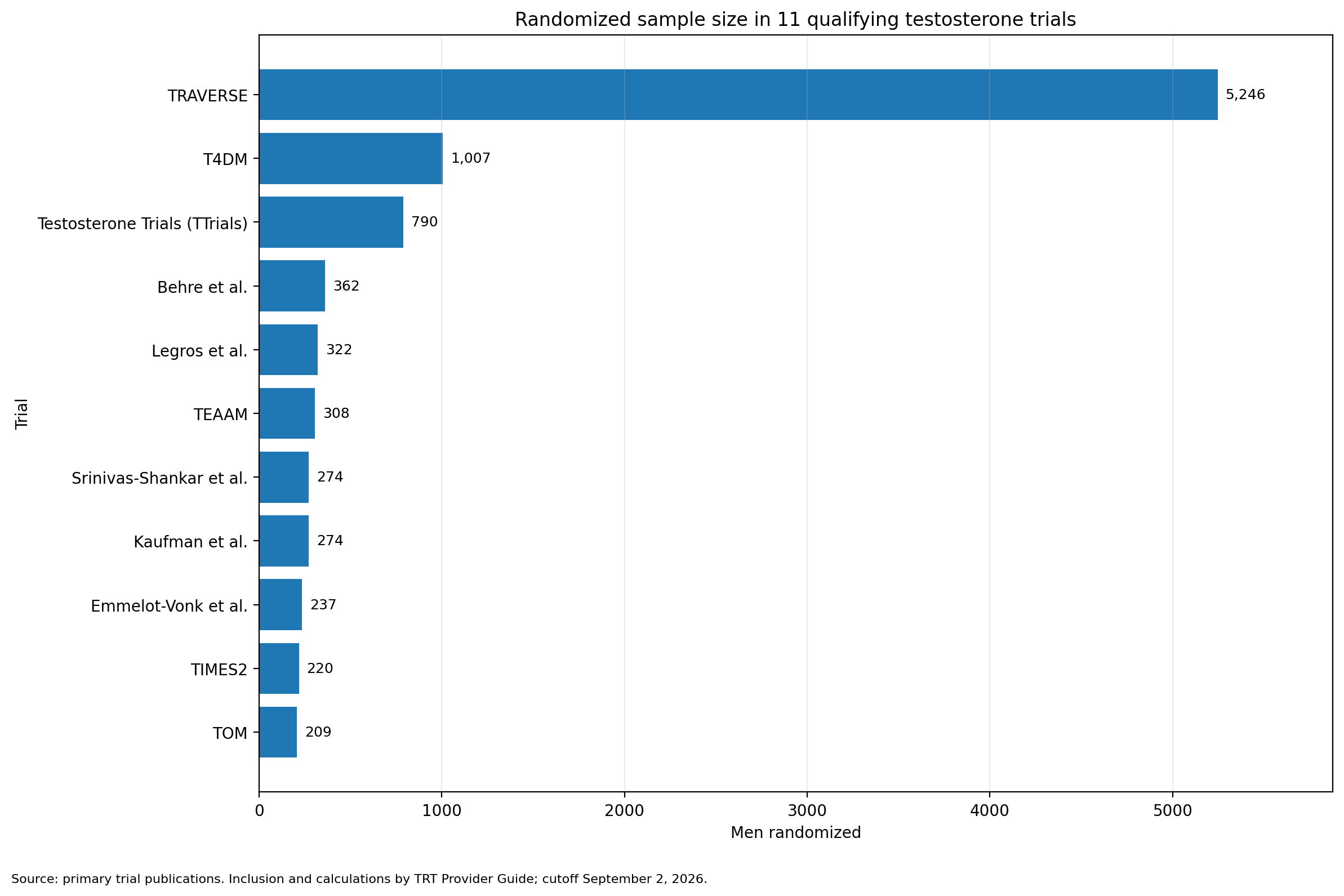
Figure source: Primary publications listed in the trial ledger. Analysis cutoff: September 2, 2026. Download PNG · Download SVG
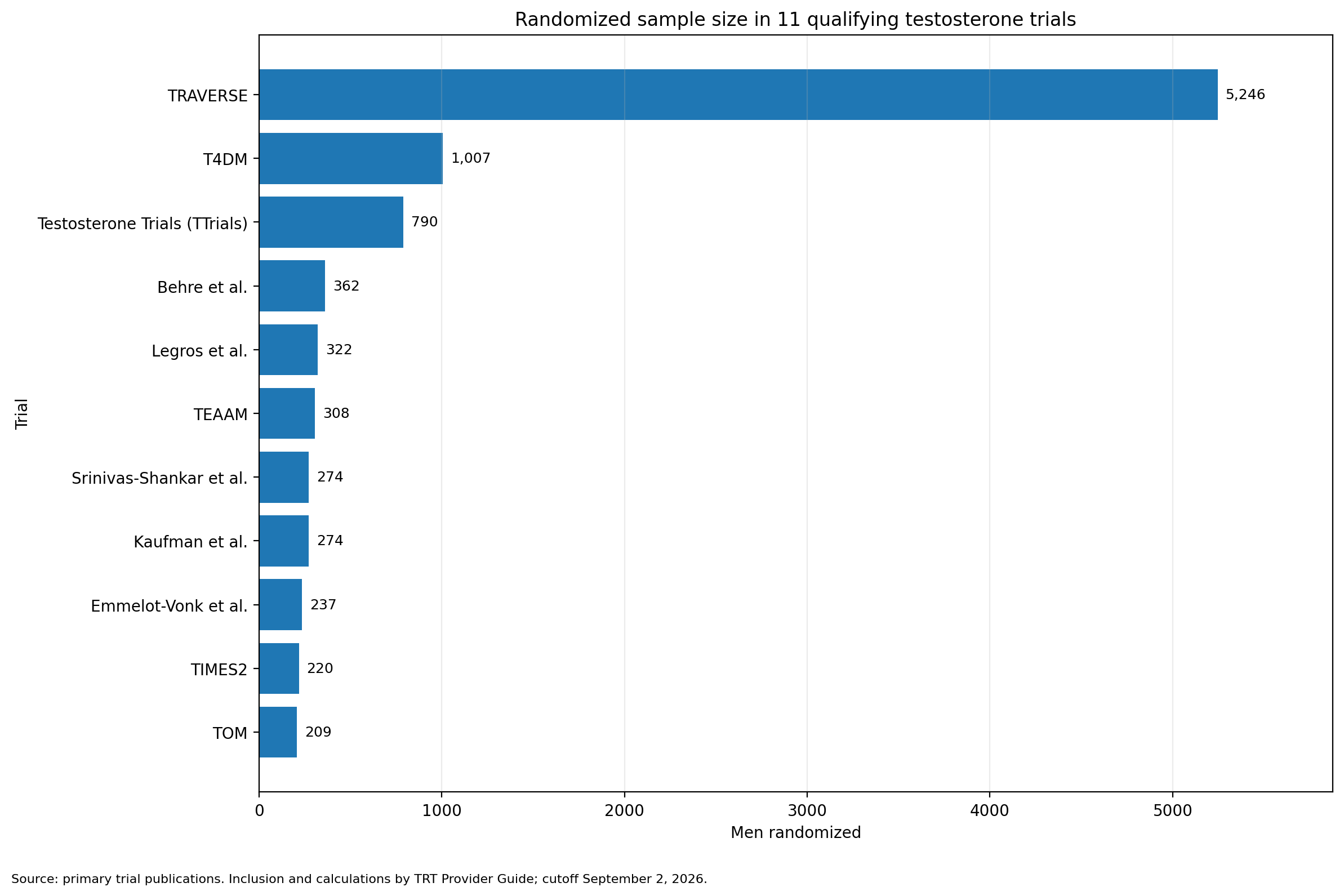
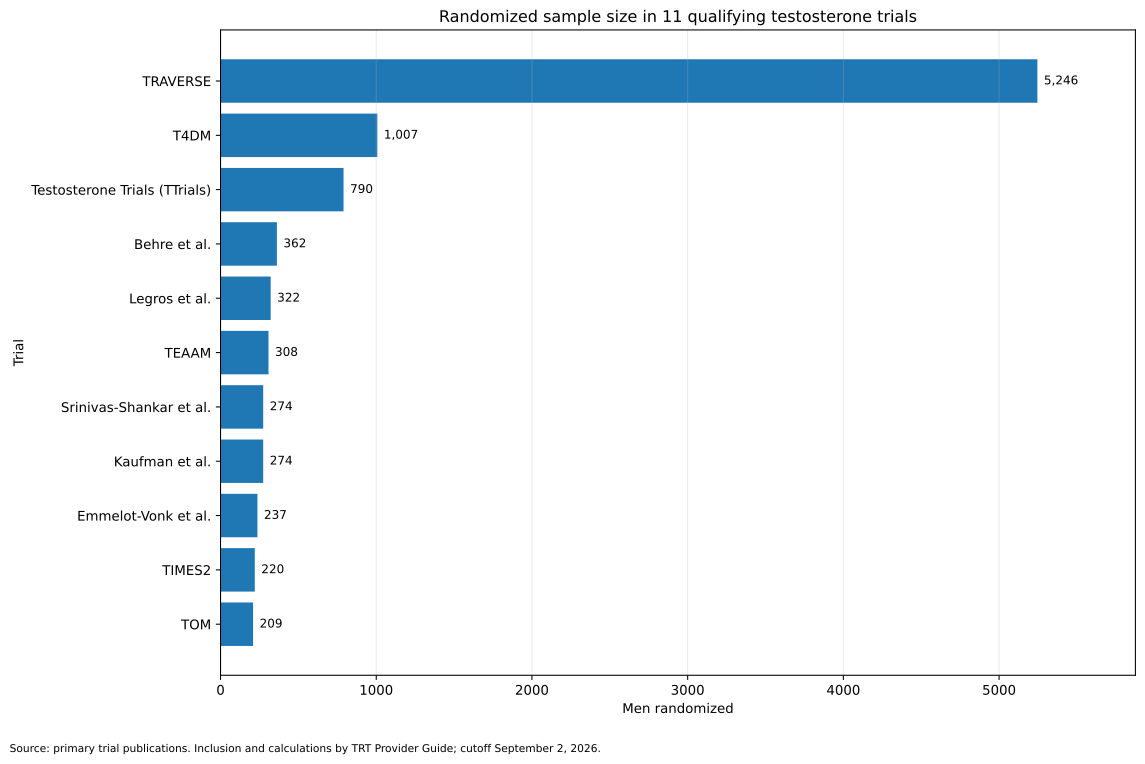
TRAVERSE changed the shape of this evidence base. Before it is added, the other 10 qualifying trials total 4,003 men. TRAVERSE adds 5,246. That is 1,243 more men than all 10 earlier and smaller qualifying trials combined.
That strength is also a limit. More than half of the people in this dataset came from one protocol, one main formulation, and one defined risk group.
What the TRAVERSE testosterone study found
TRAVERSE randomized 5,246 men age 45 to 80. Each man had symptoms of hypogonadism, two fasting testosterone readings below 300 ng/dL, and either existing cardiovascular disease or a high risk of it. The trial compared 1.62% testosterone gel with placebo gel.
Its primary end point was a group of three events called MACE:
- death from a cardiovascular cause;
- nonfatal heart attack; or
- nonfatal stroke.
| Measure | Testosterone | Placebo | Effect estimate |
|---|---|---|---|
| Primary MACE | 7.0% | 7.3% | Hazard ratio 0.96 (95% CI 0.78–1.17) |
Source: Lincoff AM et al. Cardiovascular Safety of Testosterone-Replacement Therapy. New England Journal of Medicine, 2023.
What “noninferior” means
The trial did not try to prove that testosterone caused zero extra events. It tested whether testosterone stayed below a set boundary for being worse than placebo. It passed that test.
The hazard ratio was 0.96. That does not mean 4% fewer men had an event. A hazard ratio compares event rates over time. The 95% confidence interval ran from 0.78 to 1.17. That range includes both a lower and a higher hazard.
What TRAVERSE did not settle
TRAVERSE does not answer every testosterone safety question.
- It tested men with diagnosed hypogonadism and existing or high cardiovascular risk.
- It mainly tested adjusted-dose transdermal gel.
- It did not test bodybuilding doses.
- It did not prove that every formulation has the same risk.
- It observed more atrial fibrillation, acute kidney injury, and pulmonary embolism in the testosterone group.
- Its main result was a combined end point. A result for the combined end point does not make every other safety signal disappear.
What the other ten trials add
| Trial | Main question | Cardiovascular role | What the result means here | Source |
|---|---|---|---|---|
| TRAVERSE | Major cardiovascular event safety | The only qualifying trial built and powered as a clinical cardiovascular outcomes safety trial | Primary MACE: 7.0% with testosterone vs 7.3% with placebo; hazard ratio 0.96 (95% CI 0.78–1.17); met the prespecified noninferiority test | Primary report |
| T4DM | Prevention or reversal of type 2 diabetes alongside a lifestyle program | Not a cardiovascular outcomes trial | Tested diabetes prevention and metabolic outcomes; cardiovascular events were not the primary end point | Primary report |
| Testosterone Trials (TTrials) | Sexual function, physical function, vitality, and linked efficacy outcomes | The parent trial was not a clinical cardiovascular outcomes trial; a 170-man ancillary study measured coronary plaque | The ancillary coronary CT study found a greater increase in noncalcified coronary plaque volume with testosterone, but it did not test heart attacks or strokes | Primary report |
| Behre et al. | Dose, testosterone normalization, efficacy, and safety | Not a cardiovascular outcomes trial | A product efficacy and safety trial; it was not designed to settle heart-attack or stroke risk | Primary report |
| Legros et al. | Symptoms and sexual function across oral doses | Not a cardiovascular outcomes trial | A symptom and dose-response trial; it was not designed to settle clinical cardiovascular risk | Primary report |
| TEAAM | Carotid artery wall thickness and coronary artery calcium | A cardiovascular imaging trial, not a clinical event trial | No significant between-group difference in the prespecified atherosclerosis imaging progression measures | Primary report |
| Kaufman et al. | Testosterone normalization, efficacy, and safety | Not a cardiovascular outcomes trial | A product efficacy and safety trial; it was not designed to settle heart-attack or stroke risk | Primary report |
| Srinivas-Shankar et al. | Muscle strength, physical function, body composition, and quality of life | Not a cardiovascular outcomes trial | A function and frailty trial; cardiovascular events were not the primary end point | Primary report |
| Emmelot-Vonk et al. | Functional mobility, cognition, body composition, metabolic measures, and quality of life | Not a cardiovascular outcomes trial | A broad aging and function trial; it was not designed to settle clinical cardiovascular risk | Primary report |
| TIMES2 | Insulin resistance and metabolic control | Not a cardiovascular outcomes trial | A metabolic trial; clinical cardiovascular events were not the primary end point | Primary report |
| TOM | Muscle strength and physical function | Not powered as a cardiovascular outcomes trial; stopped early after a cardiovascular adverse-event imbalance | Cardiovascular-related adverse events were reported in 23 testosterone participants and 5 placebo participants; the event category was broader than MACE | Primary report |
Source: Primary trial reports in the last column. Cardiovascular role was classified from each trial’s prespecified main question and reported end points.
The studies do not point in one simple direction because they did not ask one simple question.
- TOM raised a real warning signal. The trial stopped early after a cardiovascular adverse-event imbalance. It was small, and its event category was broader than TRAVERSE’s MACE definition.
- TEAAM did not find a significant treatment difference in its main artery-imaging progression measures over three years. It did not test enough men to settle heart attacks or strokes.
- The Testosterone Trials cardiovascular substudy found a greater rise in noncalcified coronary plaque volume with testosterone. It included 170 men and did not test clinical event risk.
- T4DM and TIMES2 were built around diabetes and metabolism.
- The remaining trials mainly tested symptoms, function, body composition, dose, or product efficacy.
A pooled event percentage would make these trials look more alike than they are. This page does not calculate one.
Which testosterone forms were studied
| Formulation | Trials | Men randomized | Share of all participants |
|---|---|---|---|
| Transdermal testosterone gel | 8 | 7,683 | 83.1% |
| Intramuscular testosterone undecanoate | 1 | 1,007 | 10.9% |
| Oral testosterone undecanoate | 2 | 559 | 6.0% |
Source: Formulation reported in each primary trial publication. Shares use the 9,249-man randomized total.
The trial record is heavily weighted toward gel. Eight of 11 trials and 83.1% of all participants used transdermal testosterone gel. One trial used intramuscular testosterone undecanoate. Two used oral testosterone undecanoate.
No qualifying trial in this set used testosterone cypionate, testosterone enanthate, pellets, nasal gel, or buccal testosterone. The dataset should not be used to claim that all forms have identical cardiovascular effects.
Does TRT increase heart attack or stroke risk?
For men like those in TRAVERSE, adjusted-dose testosterone gel did not produce a higher rate of the primary MACE outcome than placebo under the trial’s noninferiority rule. The raw event percentages were 7.0% and 7.3%.
That is the best direct clinical-event evidence in this dataset. It is not a blank check.
The safest reading is narrow and concrete:
- Supported: TRAVERSE’s primary cardiovascular result in its enrolled population and gel protocol.
- Not supported: “TRT has no heart risk for anyone.”
- Not supported: “All injections, pellets, gels, and oral products have the same result.”
- Not supported: “The result applies to high-dose anabolic-steroid use.”
- Still needs attention: blood pressure and the trial’s atrial fibrillation, pulmonary embolism, and acute kidney injury signals.
FDA testosterone warning timeline
| Date | What happened | What it did not mean | Primary source |
|---|---|---|---|
| March 3, 2015 | FDA required labeling changes that clarified approved use and warned about a possible increased risk of heart attack and stroke. | FDA did not approve testosterone for low levels caused only by normal aging. | FDA Drug Safety Communication |
| June 2023 | TRAVERSE reported that testosterone gel was noninferior to placebo for its primary MACE end point in the men studied. | The trial did not show that every dose, product, patient group, or safety outcome has no risk. | TRAVERSE primary report |
| February 28, 2025 | FDA announced removal of boxed-warning language about increased adverse cardiovascular outcomes and required class-wide blood-pressure warning changes. | FDA did not remove all warnings, erase product-specific risks, or approve use for normal aging. | FDA class-wide action |
| June 18, 2026 | FDA requested removal of the age-related hypogonadism limitation and revisions to prostate-cancer and benign-prostatic-hyperplasia labeling. | This was a request to manufacturers; the current label and approved indication must be checked for the specific product. | HHS announcement; FDA Testosterone Information |
| September 2, 2026 | This evidence ledger and regulatory timeline were checked for this version. | A dated check is not a promise that a live registry or product label will never change. | Version 2.0 methods below |
Source: U.S. Food and Drug Administration class-wide testosterone communications and the TRAVERSE primary publication.
The February 2025 action changed cardiovascular warning language, required blood-pressure warnings and retained the age-related limitation. In June 2026, FDA requested removal of that limitation and prostate/BPH revisions. The announcement did not make every product label identical. Check the current prescribing information for the exact product.
Sources: HHS, June 18, 2026; FDA Testosterone Information. Regulatory section rechecked October 3, 2026. The completed-trial ledger remains the September 2, 2026 version.
A current product label still matters. Testosterone products do not all share the same route, dosing, or product-specific warnings.
Registered testosterone studies: a separate live snapshot
The live registry file is kept separate from the completed-trial ledger. The draft contained an 18-record candidate snapshot. A registry record can change status, dates, enrollment, or results after a page is published.
The corrected package handles that in three ways:
- Registry candidates do not count toward the 11 completed trials unless they also pass every completed-trial rule and have a primary report.
- Each ClinicalTrials.gov row has a check date and a
verification_statusfield. - A row marked “not rechecked” must not be described as current.
Open the dated registry candidate snapshot. The file is a research lead list, not proof that a study finished, followed its plan, or published results.
Methodology
Research question
How much long-duration randomized, placebo-controlled testosterone evidence exists in trials large enough to enroll at least 200 men, and what can those trials truly say about cardiovascular risk?
Inclusion rules
A study was included only when all of these rules were met:
- Men were randomly assigned to testosterone or a matching placebo group.
- At least 200 men were randomized in the parent trial.
- The planned blinded assignment lasted at least six months. A stated 182-day period was treated as six months.
- Testosterone was used as medical treatment, not as a bodybuilding drug.
- A completed primary trial report was available by September 2, 2026.
- The same randomized population was counted once. Ancillary papers and substudies were linked to the parent trial, not counted as new trials.
TOM stayed in the ledger because its planned treatment period met the duration rule, even though the trial stopped early.
Exclusion rules
The ledger excludes:
- observational studies;
- uncontrolled studies;
- active-comparator trials with no placebo group;
- trials below 200 randomized men;
- planned blinded treatment shorter than six months;
- open-label extensions counted as if they were new randomized trials;
- duplicate papers from the same randomized group; and
- registry records with no completed primary report.
Data fields
For each trial, the ledger records:
- trial or lead-author name;
- publication year;
- number randomized;
- blinded or assigned duration;
- study population;
- testosterone formulation;
- the main question the trial was built to answer;
- its role in the cardiovascular evidence; and
- a primary-source link.
The denominator is the number randomized. It is not the number who completed treatment, entered a substudy, or appeared in one outcome analysis.
Calculations
- Total randomized: 9,249.
- TRAVERSE share: 5,246 ÷ 9,249 = 56.7%.
- Other 10 trials: 9,249 − 5,246 = 4,003.
- TRAVERSE minus all other trials: 5,246 − 4,003 = 1,243.
- Three largest trials: 5,246 + 1,007 + 790 = 7,043, or 76.1% of the total.
No pooled treatment effect was calculated. The trials differ too much in population, formulation, main outcome, duration, and event definition for a simple event-rate mashup to be honest.
Verification order
Sources were checked in this order:
- the primary peer-reviewed trial report;
- the official trial registry record when one was available;
- the FDA for regulatory claims; and
- a companion trial paper only for a clearly labeled ancillary outcome.
News stories, clinic pages, manufacturer summaries, and search-result snippets were not used as the source for a trial count or event number.
Version history
- Version 1 draft: 8 trials and 8,291 men.
- Version 2.0 — September 2, 2026: Added the omitted Legros, Kaufman, and Behre trials; corrected the total to 11 trials and 9,249 men; recalculated every share; corrected “longest” to “largest”; fixed the hazard-ratio explanation; separated the live registry snapshot from the completed evidence ledger; and updated the FDA timeline.
Reproduce the numbers
The package includes the full CSV ledger, JSON ledger, source manifest, and a small reproduction script. The script checks the 11-trial count, 9,249-person total, 56.7% TRAVERSE share, 4,003-person remainder, and 76.1% top-three share.
Limits of this dataset
One trial dominates the count
TRAVERSE supplies 56.7% of all randomized participants. The total is large, but it is not evenly spread across 11 independent protocols.
Most participants used gel
Transdermal gel accounts for 83.1% of participants. Common U.S. injections such as testosterone cypionate are not represented in a qualifying trial here.
Trial goals were different
Only TRAVERSE was designed as a clinical cardiovascular outcomes safety trial. A function trial, diabetes trial, and plaque-imaging trial cannot be treated as if they measured the same thing.
Event definitions were different
TOM used a broad cardiovascular adverse-event category. TRAVERSE used adjudicated MACE as its primary end point. Those counts should not be mixed as if they were one shared outcome.
Trial populations were different
The set includes men with confirmed hypogonadism, older men with low or low-normal testosterone, frail men, men with diabetes risk, and men with high cardiovascular risk. One result does not automatically fit all of them.
A trial result is not a personal treatment decision
This dataset cannot tell one person whether to start, stop, or change testosterone. Diagnosis and treatment require symptoms, repeat morning testosterone testing, a search for the cause, and clinical monitoring. The Endocrine Society guideline also calls for symptoms plus consistently low testosterone before diagnosing hypogonadism.
What this means for a patient
Do not turn the 7.0% versus 7.3% result into “testosterone is safe for everyone.” Do not turn TOM into “testosterone always causes heart problems,” either.
A sound next step is to match the evidence to the real patient:
- Was low testosterone confirmed more than once in the morning?
- Is there a known medical cause?
- Which product and dose are being used?
- Is blood pressure being checked?
- Does the person match the men in TRAVERSE?
- Are there clot, rhythm, kidney, prostate, fertility, or blood-count concerns that change the decision?
Those questions matter more than a slogan.
Frequently asked questions
Does TRT increase the risk of heart attack or stroke?
In TRAVERSE, major cardiovascular events occurred in 7.0% of men assigned testosterone gel and 7.3% assigned placebo. Testosterone met the trial’s noninferiority test in that population. The result does not prove that every testosterone product, dose, patient group, or safety outcome has no risk.
What did the TRAVERSE trial prove?
TRAVERSE showed that adjusted 1.62% testosterone gel was not worse than placebo by the trial’s prespecified margin for cardiovascular death, nonfatal heart attack, or nonfatal stroke in men age 45 to 80 with confirmed hypogonadism and existing or high cardiovascular risk.
Does a hazard ratio of 0.96 mean 4% fewer men had a heart event?
No. A hazard ratio compares event rates over time. It is not the same as subtracting the two event percentages. The 95% confidence interval was 0.78 to 1.17, so the data allow both a lower and a higher hazard within that range.
Why does this dataset count 11 trials instead of 8?
Three studies met the draft’s own rules but were missing from its ledger: Legros 2009 with 322 men, Kaufman 2011 with 274 men, and Behre 2012 with 362 men. Adding them changes the total from 8,291 to 9,249 randomized men.
Was TRAVERSE the longest testosterone trial?
No. It was the largest. TEAAM assigned treatment for 3 years. TRAVERSE reported a mean treatment duration of 21.7 months and a mean follow-up of 33.0 months.
Did FDA say testosterone is risk-free?
No. In 2025, FDA removed boxed-warning language about increased adverse cardiovascular outcomes after reviewing TRAVERSE, but it also required class-wide blood-pressure warning changes and kept the limit on use for low testosterone caused only by aging.
Does this evidence cover common testosterone cypionate injections?
No qualifying trial in this 11-study set used testosterone cypionate or enanthate. Most participants used transdermal gel. That limits how far the result can be carried to other formulations.
Does this page apply to bodybuilding doses?
No. These were medical treatment trials. They do not test supraphysiologic anabolic-steroid use.
How to cite this page and dataset
These formats identify the exact page version and dataset used.
Page citation
TRT Provider Guide. “Testosterone Cardiovascular Risk: 11 Trials, 9,249 Men.” Version 2.0. Last verified September 2, 2026. https://trtproviderguide.com/research/testosterone-cardiovascular-risk/
Dataset citation
TRT Provider Guide. Long-Duration Randomized Placebo-Controlled Testosterone Treatment Trial Ledger. Version 2.0. September 2, 2026. 11 trials; 9,249 randomized men. https://trtproviderguide.com/research/data/testosterone-long-duration-rct-ledger-2026.csv
Suggested access-date form
Accessed [month day, year]. Use the version and last-verified date above so later registry or label changes are not confused with this snapshot.
Primary sources
- Lincoff AM, et al. Cardiovascular Safety of Testosterone-Replacement Therapy. New England Journal of Medicine. 2023.
- Wittert G, et al. Testosterone treatment to prevent or revert type 2 diabetes in men enrolled in a lifestyle programme (T4DM). Lancet Diabetes & Endocrinology. 2021.
- Snyder PJ, et al. Effects of Testosterone Treatment in Older Men. New England Journal of Medicine. 2016.
- Budoff MJ, et al. Testosterone Treatment and Coronary Artery Plaque Volume in Older Men With Low Testosterone. JAMA. 2017.
- Behre HM, et al. Efficacy and safety of two doses of a 2% testosterone gel in hypogonadal men. European Urology. 2012.
- Legros JJ, et al. Oral testosterone replacement in symptomatic late-onset hypogonadism. European Journal of Endocrinology. 2009.
- Basaria S, et al. Effects of Testosterone Administration for 3 Years on Subclinical Atherosclerosis Progression in Older Men. JAMA. 2015.
- Kaufman JM, et al. Efficacy and safety study of 1.62% testosterone gel for the treatment of hypogonadal men. Journal of Sexual Medicine. 2011.
- Srinivas-Shankar U, et al. Effects of testosterone on muscle strength, physical function, body composition, and quality of life in intermediate-frail and frail elderly men. Journal of Clinical Endocrinology & Metabolism. 2010.
- Emmelot-Vonk MH, et al. Effect of testosterone supplementation on functional mobility, cognition, and other parameters in older men. JAMA. 2008.
- Jones TH, et al. Testosterone replacement in hypogonadal men with type 2 diabetes and/or metabolic syndrome: the TIMES2 study. Diabetes Care. 2011.
- Basaria S, et al. Adverse Events Associated with Testosterone Administration. New England Journal of Medicine. 2010.
- U.S. Food and Drug Administration. FDA issues class-wide labeling changes for testosterone products. February 28, 2025.
- U.S. Food and Drug Administration. FDA cautions about using testosterone products for low testosterone due to aging; requires labeling change. March 3, 2015; updated February 28, 2025.
- Bhasin S, et al. Testosterone Therapy in Men With Hypogonadism: An Endocrine Society Clinical Practice Guideline. Journal of Clinical Endocrinology & Metabolism. 2018.