Testosterone Half Life: 2026 Data by Form, Route, and Ester
By TRT Provider Guide
Published: September 3, 2026
Last verified and updated: September 3, 2026
Headline finding, verified September 3, 2026: We checked 16 direct testosterone half-life records. The shortest source-stated endpoint was 10 minutes. The longest point estimate was 70.8 days. That is a 10,195-fold span. Without pellet implants, the longest point estimate was 33.9 days, a 4,882-fold span.
For testosterone cypionate, the current U.S. prescribing information, updated August 21, 2026, says approximately 8 days when injected into a muscle (intramuscularly). These numbers are not interchangeable. The way it is taken, the chemical form, the oil or delivery system, the dose, the study group, and the exact result measured all change the answer. The most surprising example is testosterone undecanoate. The current TLANDO label reports about 2 hours for the parent undecanoate ester taken by mouth, while human injection studies report 18.3 to 33.9 days. Two 1,000 mg phase I study groups reported 20.9 days in tea seed oil and 33.9 days in castor oil. This does not mean one form is 10,195 times stronger or works exactly 10,195 times longer. It shows why every half-life number needs its route, product form, method, and source beside it.
Testosterone half life data at a glance
| Evidence-map fact | Verified result |
|---|---|
| Core evidence records | 26 |
| Primary source documents in the core map | 20 |
| Direct numeric half-life results | 16 |
| Model-based half-life estimates | 2 |
| Context or timing records with no stated half-life | 6 |
| Other “half” metrics kept separate from half-life | 2 |
| Full direct endpoint span | 10 minutes to 70.8 days |
| Full endpoint fold span | 1,020-fold to 10,195-fold, depending on whether 100 or 10 minutes is used |
| Direct non-pellet endpoint span | 10 minutes to 33.9 days |
| Non-pellet endpoint fold span | 488-fold to 4,882-fold |
Source and method: TRT Provider Guide Testosterone Half-Life Evidence Map, version 2.0, assembled from current U.S. prescribing information and peer-reviewed human pharmacokinetic studies; calculations verified September 3, 2026.
Direct testosterone half-life results on one scale
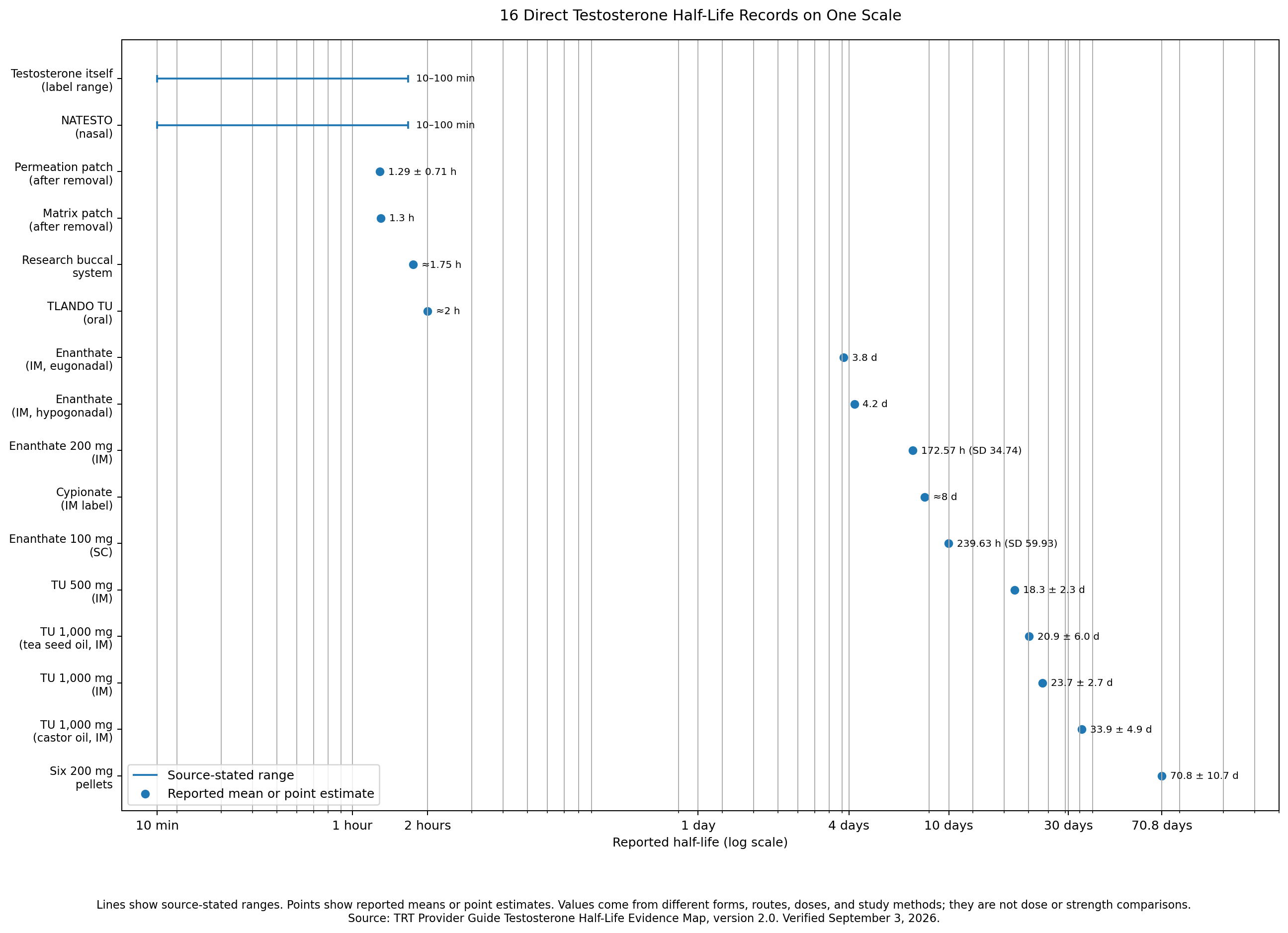
Source: TRT Provider Guide Testosterone Half-Life Evidence Map, version 2.0. Direct numeric records only. Lines show source-stated ranges. Points show reported means or point estimates. The x-axis is logarithmic because the values span more than four orders of magnitude. These are different products, routes, doses, and study methods—not strength or dose comparisons.
Download the full 26-record evidence map as CSV
What is the half-life of testosterone?
Half-life is the time it takes for a measured amount or blood level to fall by half. Testosterone does not have one universal half-life because each ester and delivery system changes how fast it enters the blood. The useful answer must name the exact form, route, and result being measured. After one half-life, a simple math model leaves 50% of the starting amount. After two, it leaves 25%. That model is useful for learning, but a real product may still be releasing testosterone from an oil pocket at the injection site (a depot), a skin system, or a pellet. An ester is a chemical group attached to testosterone. Cypionate, enanthate, propionate, and undecanoate are different esters. The body splits the ester off to release free testosterone. Hypogonadism means the body does not make enough testosterone because of a medical condition. An apparent half-life follows the whole release-and-decline pattern, while a terminal half-life describes the last, slow part of the curve. Route terms used below are simple: intramuscular means into a muscle; subcutaneous means under the skin; transdermal means through the skin; intranasal means through the nose; and buccal means held against the cheek.
Quick testosterone half-life chart
| Form or context | Best source-checked answer | What the number describes | Primary source |
|---|---|---|---|
| Testosterone itself | 10–100 minutes | General label range for testosterone itself, not the enanthate oil depot | Current testosterone enanthate prescribing information |
| NATESTO nasal testosterone | 10–100 minutes | Label-stated half-life range for the nasal product | NATESTO prescribing information |
| TLANDO oral testosterone undecanoate | About 2 hours | Elimination half-life of the parent undecanoate ester | TLANDO prescribing information |
| Testosterone cypionate | About 8 days | Current label value after intramuscular injection | DEPO-Testosterone prescribing information |
| Testosterone enanthate | 3.8 and 4.2 days | Reported half-lives in men with normal testosterone production and men with hypogonadism in one human study | Sokol et al., 1982 |
| Testosterone enanthate, 100 mg subcutaneous | 239.63 hours (SD 59.93), or 9.98 days | Apparent half-life in one human study arm | Kaminetsky et al., 2015 |
| Testosterone undecanoate, intramuscular | 18.3–33.9 days across four study results | Final slow-decline or depot half-life in dose- and oil-specific human studies | Zhang et al., 1998; Behre et al., 1999 |
| Testosterone patch after removal | 1.29–1.3 hours | Fall in serum testosterone after the studied patch was removed | Meikle et al., 1996; Raynaud et al., 2008 |
| Research buccal system | About 1.75 hours | Elimination half-life after one dose in five healthy men | Kim et al., 1995 |
| Six 200 mg testosterone pellets | 70.8 ± 10.7 days | Apparent terminal half-life in 14 men with hypogonadism | Jockenhövel et al., 1996 |
Sources: current DailyMed prescribing information and the linked peer-reviewed human studies. Values belong only to the stated form and study context.
What does the 2026 Testosterone Half-Life Evidence Map show?
The map contains 26 evidence records from 20 primary source documents. It keeps 16 direct numeric half-life results, 2 model estimates, 2 non-equivalent pellet metrics, and 6 context records in separate classes so unlike numbers are not quietly blended together. The table below is the full core dataset. “No direct half-life stated” is a finding from the named source as checked on September 3, 2026. It does not prove that no other source has ever reported a value. A source boundary is the exact product, route, dose, method, and limit that must stay with a number.
Full evidence map
| # | Testosterone form and context | Route | Reported result | Evidence class | Source boundary | Primary source |
|---|---|---|---|---|---|---|
| 1 | Testosterone itself | Not route-specific | 10–100 minutes | Label: direct numeric statement | General literature range in an enanthate label; not an enanthate oil-depot half-life | Testosterone enanthate prescribing information |
| 2 | NATESTO testosterone | Intranasal | 10–100 minutes | Label: direct numeric statement | Product label also says the maximum concentration is reached within about 40 minutes | NATESTO prescribing information |
| 3 | TLANDO testosterone undecanoate | Oral | About 2 hours | Label: direct numeric statement | Parent undecanoate ester; not an injection-depot value | TLANDO prescribing information |
| 4 | Testosterone cypionate in oil | Intramuscular | Approximately 8 days | Label: direct numeric statement | Current label answer for intramuscular cypionate | DEPO-Testosterone prescribing information |
| 5 | Depot testosterone cypionate | Intramuscular | 4.05 days | Model estimate | Median estimate from the fitted model, with the body’s own testosterone production included | Bi et al., 2018 |
| 6 | Depot testosterone cypionate | Intramuscular | 6.87 days | Model estimate under a changed assumption | Same model with the body’s own testosterone production set to zero | Bi et al., 2018 |
| 7 | Testosterone enanthate in men with normal testosterone production (eugonadal) | Intramuscular | 3.8 days | Human study: direct apparent half-life | Population-specific result from a classic study | Sokol et al., 1982 |
| 8 | Testosterone enanthate in men with hypogonadism (hypogonadal) | Intramuscular | 4.2 days | Human study: direct apparent half-life | Population-specific result from the same study | Sokol et al., 1982 |
| 9 | Testosterone enanthate, 100 mg in sesame oil | Subcutaneous | 239.63 hours (SD 59.93), or 9.98 days | Human study: direct apparent half-life | Human study product, route, dose, and study context | Kaminetsky et al., 2015 |
| 10 | Testosterone enanthate, 200 mg reference arm | Intramuscular | 172.57 hours (SD 34.74), or 7.19 days | Human study: direct apparent half-life | Reference arm in the same human study | Kaminetsky et al., 2015 |
| 11 | Testosterone propionate, 25 mg | Intramuscular | No numeric half-life in the accessible abstract | Human study: context record | Plasma testosterone propionate stayed at 2–4 ng/mL from 3–36 hours; labeled active testosterone stayed above the physiological testosterone level for 48 hours | Fujioka et al., 1986 |
| 12 | Testosterone undecanoate, 500 mg | Intramuscular | 18.3 ± 2.3 days | Human study: direct terminal half-life | Single-dose study in men with hypogonadism | Zhang et al., 1998 |
| 13 | Testosterone undecanoate, 1,000 mg | Intramuscular | 23.7 ± 2.7 days | Human study: direct terminal half-life | Higher-dose arm in the same study | Zhang et al., 1998 |
| 14 | Testosterone undecanoate, 1,000 mg in tea seed oil | Intramuscular | 20.9 ± 6.0 days (mean ± SEM) | Human study: direct depot half-life | Seven men; dose split between both buttock muscles | Behre et al., 1999 |
| 15 | Testosterone undecanoate, 1,000 mg in castor oil | Intramuscular | 33.9 ± 4.9 days (mean ± SEM) | Human study: direct depot half-life | Fourteen men; injected into one buttock; not the current 750 mg U.S. AVEED product | Behre et al., 1999 |
| 16 | Permeation-enhanced testosterone patch after removal | Transdermal | 1.29 ± 0.71 hours | Human study: direct post-removal half-life | Thirty-four men with hypogonadism; one studied system | Meikle et al., 1996 |
| 17 | Testosterone-in-adhesive matrix patch after removal | Transdermal | 1.3 hours | Human study: direct post-removal half-life | Twenty-four men with hypogonadism; one studied matrix patch | Raynaud et al., 2008 |
| 18 | Single-dose research buccal system | Buccal | About 1.75 hours | Human study: direct elimination half-life | Five healthy men; not a universal buccal-product value | Kim et al., 1995 |
| 19 | Crystalline 100 mg and 200 mg testosterone pellets | Subcutaneous implant | 2.5 months | Other metric: absorption half-duration | Not a conventional elimination half-life | Handelsman et al., 1990 |
| 20 | Six 200 mg testosterone pellets | Subcutaneous implant | 70.8 ± 10.7 days | Human study: direct apparent terminal half-life | Fourteen men; 1,200 mg total research implant dose | Jockenhövel et al., 1996 |
| 21 | Six 200 mg testosterone pellets | Subcutaneous implant | 74.7 days (95% CI 71.1–78.5) | Other metric: absorption half-time | Same study, but this metric is not terminal half-life | Jockenhövel et al., 1996 |
| 22 | XYOSTED testosterone enanthate | Subcutaneous | No direct half-life stated | Label: context record | Median peak at 11.9 hours; steady state by week 6 | XYOSTED prescribing information |
| 23 | AVEED testosterone undecanoate, 750 mg | Intramuscular | No depot half-life stated | Label: context record | Maximum concentration after a median of 7 days (range 4–42 days); the 10-week dosing profile is not a half-life | AVEED prescribing information |
| 24 | AndroGel 1.62% | Topical | No gel-specific half-life stated | Label: context record | Continuous delivery for 24 hours; return toward baseline within 48–72 hours after the last dose | AndroGel 1.62% prescribing information |
| 25 | AndroGel 1% | Topical | No gel-specific half-life stated | Label: context record | Normal range for 24–48 hours after stopping; pretreatment level by day 5 | AndroGel 1% prescribing information |
| 26 | TESTOPEL, 75 mg pellets | Subcutaneous implant | No pellet-specific half-life stated | Label: context record | Label says adequate effect usually lasts 3–4 months and sometimes 6 months; effect duration is not half-life | TESTOPEL prescribing information |
Sources: the 20 official-label and peer-reviewed human-study documents linked in the table. Every row was manually checked and classified on September 3, 2026.
What does this data show, and what does it not show?
The data shows that a testosterone half-life number is only useful when its form, route, exact measured result, and source stay attached. It does not show that one product is stronger, safer, better, or active for an exact multiple of another product. Four comparisons explain most of the disagreement:
| Comparison | Source-checked numbers | Original calculation | What it shows | What it does not prove |
|---|---|---|---|---|
| Same ester, different route | Oral testosterone undecanoate: about 2 hours; intramuscular studies: 18.3–33.9 days | The injected values are about 220–407 times longer | Route and depot release can dominate the curve | That oral and injected products can be compared dose for dose |
| Same ester and dose, different oil-study groups | 1,000 mg intramuscular undecanoate: 20.9 days in tea seed oil; 33.9 days in castor oil | The castor-oil group’s reported value was 62.2% higher | Oil and depot design can matter | A clean causal effect from a randomized head-to-head trial; the groups and injection methods differed |
| Same ester, different method | Cypionate: 8 days in the label; 4.05 and 6.87 days in one model | The highest value is about 1.98 times the lowest | Model rules and measured results change the estimate | That one source cancels the others |
| Same ester, different route and study | Enanthate: 3.8–9.98 days across four human-study results | A 2.63-fold spread | Route, dose, population, and study design matter | One universal enanthate half-life |
Sources: current TLANDO and DEPO-Testosterone prescribing information; Sokol et al. 1982; Kaminetsky et al. 2015; Bi et al. 2018; Zhang et al. 1998; Behre et al. 1999. Calculations by TRT Provider Guide, verified September 3, 2026. The full 10,195-fold headline span is also a comparison of unlike forms. It shows that “the half-life of testosterone” is too broad a question. It is not a clinical conversion factor.
Which testosterone half-life number should you report?
For intramuscular testosterone cypionate, the clearest current label statement is approximately 8 days. For testosterone products as a group, there is no honest single number: direct source-stated endpoints and point estimates in our 26-record map run from 10 minutes to 70.8 days, or from 10 minutes to 33.9 days when pellet implants are excluded.
| Subject of the statement | Defensible wording | Qualifier that must stay with it |
|---|---|---|
| Intramuscular testosterone cypionate | The current U.S. label states a half-life of approximately 8 days | This is the labeled intramuscular cypionate value |
| Testosterone products as a group | Direct source-stated endpoints and point estimates span 10 minutes to 70.8 days | The endpoints come from unlike forms, routes, and studies; this is not a clinical conversion factor |
| Testosterone products without pellets | Direct source-stated endpoints and point estimates span 10 minutes to 33.9 days | The endpoints still combine nasal, oral, injection, patch, and buccal contexts |
| Testosterone undecanoate | About 2 hours by mouth versus 18.3 to 33.9 days in human intramuscular studies | Route, dose, oil, and formulation differ |
| Testosterone pellets | One 14-man study reported 70.8 ± 10.7 days | Six 200 mg research pellets were used; this is not a current TESTOPEL label value |
Sources: current DEPO-Testosterone and TLANDO prescribing information; Zhang et al. 1998; Behre et al. 1999; Jockenhövel et al. 1996; TRT Provider Guide Evidence Map calculations verified September 3, 2026. A number without its qualifier is easy to repeat and easy to misuse. The source boundary is part of the finding, not fine print.
How to cite this page
How should this page be cited?
The citation below identifies the page, publisher, dataset version, and verification date. It is provided as neutral attribution information so the research can be described accurately.
Page citation
TRT Provider Guide. “Testosterone Half Life: 2026 Data by Form, Route, and Ester.” TRT Provider Guide. Published and last verified September 3, 2026. https://trtproviderguide.com/research/testosterone-half-life/
Dataset citation
TRT Provider Guide. TRT Provider Guide Testosterone Half-Life Evidence Map, 2026. Version 2.0. Verified September 3, 2026. https://trtproviderguide.com/research/data/testosterone-half-life-evidence-map-2026.csv
Key calculation to reproduce
70.8 days × 24 hours/day × 60 minutes/hour ÷ 10 minutes = 10,195.2
How did we build the Testosterone Half-Life Evidence Map?
We built the map from current U.S. prescribing information and peer-reviewed human pharmacokinetic studies. Pharmacokinetics tracks how a drug enters, moves through, and leaves the body. We recorded each form, route, dose, metric, value, population, and source boundary without turning a dosing interval or another timing marker into a made-up half-life. The /research section of TRT Provider Guide publishes source-checked reference pages. This page explains the data. It does not rank providers or give a personal treatment plan.
Source rules
A record entered the core map only when it came from:
- current U.S. prescribing information on DailyMed; or
- a peer-reviewed human pharmacokinetic study.
Secondary explainers helped us find candidate sources, but they were not used as evidence for the published numbers. Animal-only data and unsourced charts were left out.
Evidence classes
| Evidence class | Records | Rule |
|---|---|---|
| Direct numeric half-life | 16 | The source clearly named a half-life, apparent half-life, terminal half-life, or product half-life and gave the form and route |
| Model estimate | 2 | A human population model produced the value; its assumptions stay visible |
| Context or timing record | 6 | The source gave useful timing, such as peak, steady state, or return to baseline, but did not state a direct formulation half-life |
| Other “half” metric | 2 | The source used absorption half-time or half-duration, which is kept separate from conventional half-life |
| Total | 26 | Each record keeps its source and limit beside it |
Source: TRT Provider Guide Testosterone Half-Life Evidence Map, version 2.0; classification completed September 3, 2026.
How did we handle the ± values?
We kept each uncertainty measure in the form reported by the source. The 2015 enanthate paper reports mean half-life with SD, or standard deviation. The 1999 undecanoate paper reports mean half-life with SEM, or standard error of the mean. When an accessible abstract did not name the uncertainty type, we kept the ± value but did not guess what it meant.
Direct-value rule
A value was called a direct half-life only when the source itself named the metric. We kept words such as apparent, terminal, and post-removal because those words change what the number means.
Proxy rule
If a label gave only a peak time, steady-state time, effect duration, dosing interval, or time to baseline, we marked it as context. We did not calculate a half-life backward from those markers.
Different-value rule
When primary sources reported different values, we kept the values side by side. We did not average them. The cypionate label value and the two cypionate model values are one example.
Unit rule
We converted hours and days only when the underlying metric was comparable. We did not silently turn months into a fixed number of days. For the headline calculation:
- 10 minutes stayed 10 minutes.
- 70.8 days became 101,952 minutes.
- 101,952 divided by 10 equals 10,195.2.
For the non-pellet calculation:
- 33.9 days became 48,816 minutes.
- 48,816 divided by 10 equals 4,881.6.
Headline rule
Only direct numeric statements from current labels or peer-reviewed human studies could set the headline limits. Model results, context records, absorption half-time, and absorption half-duration were excluded from those limits.
Absence rule
When we say a current label did not state a formulation-specific half-life, we mean we searched the label and read its pharmacokinetics section on the verification date. It is a dated label finding, not a claim that no value exists anywhere.
Duplicate statement rule
Several labels repeat the same 10–100-minute literature range for testosterone itself. The core map records that general statement once. A product gets its own row only when the source gives a product-specific half-life or a different timing marker.
Why is there no single testosterone half life?
There is no single testosterone half life because the body may clear testosterone from the blood quickly while a product keeps releasing more of it. An oil depot, skin system, nasal gel, oral capsule, buccal system, or pellet can become the slow step. Researchers call this flip-flop pharmacokinetics when absorption is slower than elimination. In plain language, the storage site acts like a slow tap. The speed of release from that tap can shape the blood curve more than the short half-life of testosterone itself. A peer-reviewed pharmacokinetics review explains this pattern. Three terms are especially important:
- Terminal half-life describes the final slow part of a concentration curve.
- Apparent half-life describes the decline seen from the full release-and-clearance process.
- Model-based half-life is an estimate produced by a mathematical model and its assumptions.
That is why the same cypionate source set can contain 4.05, 6.87, and 8 days without any of the numbers being a simple typo. The sources measured or modeled the problem differently.
What is the half-life of testosterone cypionate?
The clearest short answer is approximately 8 days after an intramuscular injection, according to the current U.S. DEPO-Testosterone prescribing information. A 2018 population model estimated 4.05 days and produced 6.87 days when natural testosterone secretion was set to zero, so the source and method must stay beside each number.
| Cypionate source | Result | What it means |
|---|---|---|
| Current DEPO-Testosterone prescribing information | Approximately 8 days | Official intramuscular label answer |
| 2018 population model of drug levels and effects | 4.05 days | Median estimate with the body’s own testosterone production included |
| Same model, sensitivity case | 6.87 days | Estimate when the body’s own testosterone production was set to zero |
Sources: DEPO-Testosterone prescribing information and Bi et al., 2018. The DailyMed record was updated August 21, 2026 and checked September 3, 2026. The values should not be averaged into one “better” answer. For a brief factual statement about the labeled intramuscular product, about 8 days is the clearest wording. For research on model assumptions, all three values matter.
What is the half-life of testosterone enanthate?
Human enanthate studies in this map report apparent half-lives from 3.8 to 9.98 days. The spread comes from different populations, routes, doses, and study designs, so there is no honest single value that covers every enanthate product.
| Enanthate study context | Route | Reported apparent half-life |
|---|---|---|
| Men with normal testosterone production in a 1982 study | Intramuscular | 3.8 days |
| Men with hypogonadism in the same study | Intramuscular | 4.2 days |
| 100 mg autoinjector study arm | Subcutaneous | 239.63 hours (SD 59.93), or 9.98 days |
| 200 mg reference arm in the same human study | Intramuscular | 172.57 hours (SD 34.74), or 7.19 days |
Sources: Sokol et al., 1982 and Kaminetsky et al., 2015. The current general testosterone enanthate label repeats a 10–100 minute literature range for testosterone itself. It does not state that the enanthate oil depot has a 10–100 minute half-life. The current XYOSTED label gives a median peak time of 11.9 hours and says steady state was reached by week 6. Those facts help describe the product’s curve, but neither is a direct half-life.
What is known about testosterone propionate half life?
The primary human propionate abstract we could verify does not state a numeric half-life. After a 25 mg intramuscular dose, plasma testosterone propionate stayed at 2–4 ng/mL from 3 to 36 hours, and labeled active testosterone stayed above the physiological testosterone level for 48 hours. We did not publish a numeric propionate half-life because the accessible primary abstract we reviewed did not state one. This source boundary does not prove that no numeric propionate half-life exists in another source. It means the accessible primary abstract did not support publishing one as a directly verified value. Source: Fujioka et al., “Pharmacokinetic properties of testosterone propionate in normal men,” 1986.
What is the half-life of testosterone undecanoate?
Testosterone undecanoate has the widest route-based split in this map. The current TLANDO oral label reports about 2 hours for the parent ester, while intramuscular human studies report 18.3 to 33.9 days.
| Undecanoate form | Route and context | Reported result | Key limit |
|---|---|---|---|
| TLANDO | Oral capsules | About 2 hours | Parent ester in the oral product |
| Research injection | 500 mg intramuscular | 18.3 ± 2.3 days | Single-dose human study |
| Research injection | 1,000 mg intramuscular | 23.7 ± 2.7 days | Higher-dose arm of the same study |
| Research injection in tea seed oil | 1,000 mg intramuscular | 20.9 ± 6.0 days (mean ± SEM) | Seven men; dose split between both buttock muscles |
| Research injection in castor oil | 1,000 mg intramuscular | 33.9 ± 4.9 days (mean ± SEM) | Fourteen men; not AVEED 750 mg |
| AVEED | 750 mg intramuscular label | No depot half-life stated | Maximum concentration after a median of 7 days (range 4–42 days); the 10-week profile is not a half-life |
Sources: TLANDO prescribing information, Zhang et al., 1998, Behre et al., 1999, and AVEED prescribing information. The oral-to-injection difference is about 220-fold to 407-fold when the 2-hour oral value is compared with the 18.3-day to 33.9-day injection values. That calculation describes the reported results. It does not compare strength or dose. The two 1,000 mg oil results also need care. The castor-oil group’s reported mean half-life was 62.2% higher than the tea-seed-oil group’s reported mean, but the groups and injection methods differed. This was not a clean randomized test of oil alone. The current AVEED product is 750 mg. Its label says serum testosterone reached its maximum after a median of 7 days, with a 4–42-day range. That range is time to peak, not half-life. The label also says testosterone undecanoate was nearly undetectable 42 days after injection and describes average testosterone exposure over a 10-week interval. None of those timing markers is labeled as the depot half-life, so the 33.9-day research result should not be relabeled as “the AVEED half-life.”
What are the half-lives of nasal, patch, gel, buccal, and pellet testosterone?
Non-injection forms still do not share one number. Nasal testosterone has a short stated half-life, patch studies measured the decline after removal, gel labels give post-stop windows instead of a direct half-life, and one small pellet study reported a 70.8-day terminal phase.
| Form | Verified result | Study or label context | What not to call it |
|---|---|---|---|
| NATESTO nasal gel | 10–100 minutes | Label says the maximum concentration is reached within about 40 minutes | The length of a full treatment day |
| Permeation-enhanced patch | 1.29 ± 0.71 hours | Decline after removal in 34 men with hypogonadism | A universal patch or gel half-life |
| Matrix patch | 1.3 hours | Decline after removal in 24 men with hypogonadism | The wear time of every patch |
| Research buccal system | About 1.75 hours | Single dose in five healthy men | A current STRIANT product half-life |
| AndroGel 1.62% | No gel-specific half-life stated | Return toward baseline within 48–72 hours after the last dose | A 48- or 72-hour half-life |
| AndroGel 1% | No gel-specific half-life stated | Normal range for 24–48 hours after stopping; pretreatment by day 5 | A five-day half-life |
| Crystalline research pellets | 2.5-month absorption half-duration | 100 mg and 200 mg pellets | A conventional elimination half-life |
| Six 200 mg research pellets | 70.8 ± 10.7-day apparent terminal half-life | Fourteen men with hypogonadism; 1,200 mg total | A TESTOPEL label value |
| Same six-pellet study | 74.7-day absorption half-time | A separate absorption metric | The same thing as terminal half-life |
| TESTOPEL 75 mg pellets | No pellet-specific half-life stated | Label says effect usually lasts 3–4 months and sometimes 6 months | A 3-, 4-, or 6-month half-life |
Sources: NATESTO, AndroGel 1%, AndroGel 1.62%, and TESTOPEL prescribing information; Meikle et al. 1996; Raynaud et al. 2008; Kim et al. 1995; Handelsman et al. 1990; Jockenhövel et al. 1996. The pellet result sets the top of the full headline span. It also carries the biggest warning. The study included only 14 men and used six 200 mg research pellets, while the current TESTOPEL pellet contains 75 mg.
Which U.S. testosterone label records state a formulation-specific half-life?
We checked 12 U.S. DailyMed label records and found a formulation-specific numeric half-life statement in 3: DEPO-Testosterone, TLANDO, and NATESTO. The other 9 gave a generic testosterone range, peak time, steady-state timing, post-stop window, effect duration, or no direct formulation half-life in the pharmacokinetics text we reviewed. This is a dated wording audit of records available on DailyMed. One older STRIANT record contains inactivated NDC codes, so this table is a label-language audit, not a list of products confirmed to be actively marketed. “Not located” means no formulation-specific statement was found during our September 3, 2026 review; it does not mean no research paper has studied the product or active ingredient.
| DailyMed label record checked | Formulation-specific numeric half-life found? | What the label gives instead or in addition |
|---|---|---|
| DEPO-Testosterone | Yes: approximately 8 days | Intramuscular cypionate in oil |
| NATESTO | Yes: 10–100 minutes | Maximum concentration within about 40 minutes |
| TLANDO | Yes: about 2 hours | Parent oral testosterone undecanoate ester |
| General testosterone enanthate injection | No ester-depot value located | Generic formed-testosterone range of 10–100 minutes |
| XYOSTED | No | Median peak at 11.9 hours; steady state by week 6 |
| AVEED | No | Maximum concentration after a median of 7 days (range 4–42 days); exposure described over a 10-week interval |
| JATENZO | No direct value located | Detailed oral pharmacokinetic and food-effect data |
| KYZATREX | No direct value located | Detailed fed oral pharmacokinetic data |
| AndroGel 1.62% | No gel-specific value | Return toward baseline within 48–72 hours after stopping |
| AndroGel 1% | No gel-specific value | Normal range for 24–48 hours after stopping; pretreatment by day 5 |
| TESTOPEL | No pellet-specific value | Adequate effect usually 3–4 months and sometimes 6 months |
| STRIANT | No system-specific conventional value | Serum testosterone falls below the normal range within 2–4 hours after removal; generic testosterone range also appears |
Sources: the 12 DailyMed label records linked in the Primary Sources section. Audit completed September 3, 2026. This audit explains a common error. A label may contain the words “half-life” but still be talking about testosterone itself in general, not the slow-release product named at the top of the page.
How much testosterone remains after each half-life?
In a simple first-order model, the same share is removed during each equal block of time. One half-life leaves 50% of the starting amount, and five half-lives leave 3.125%. This is math, not a measured blood test, and it can be a poor fit while a depot or pellet is still releasing testosterone.
The formula is:
Percent remaining = 100 × (0.5)^(time passed ÷ half-life)
| Half-lives passed | Theoretical amount remaining |
|---|---|
| 0 | 100% |
| 1 | 50% |
| 2 | 25% |
| 3 | 12.5% |
| 4 | 6.25% |
| 5 | 3.125% |
| 6 | 1.5625% |
| 7 | 0.78125% |
| 8 | 0.390625% |
| 10 | 0.09765625% |
Source: first-order exponential decay calculation. This table is mathematical, not a patient-level pharmacokinetic forecast. Using the current cypionate label value, five half-lives equal 40 days. Using TLANDO’s 2-hour parent-ester value, five half-lives equal 10 hours. Neither calculation tells a person when effects stop, when natural production returns, or when a test will be negative.
Is half-life the same as active life, dosing interval, effect time, or detection time?
No. Half-life, peak time, dosing interval, effect duration, time to baseline, and detection time answer different questions. Swapping one term for another can turn a true source statement into a false claim.
| Term | What it means | Source-backed example |
|---|---|---|
| Half-life | Time for a measured amount or level to fall by half | The cypionate label states approximately 8 days after intramuscular injection |
| Peak time, or Tmax | Time until the measured concentration reaches its peak | NATESTO reaches its maximum concentration within about 40 minutes; XYOSTED has a median peak at 11.9 hours |
| Steady state | Point when repeated input and removal settle into a repeating pattern | XYOSTED reached steady state by week 6 in its label data |
| Dosing interval | Planned time between doses | AVEED’s 10-week interval is not a 10-week half-life |
| Return to baseline | Time for a measured value to move back near its starting level | AndroGel 1.62% returns toward baseline within 48–72 hours after the last dose |
| Duration of effect | How long a product’s effect is described as adequate | TESTOPEL’s label says adequate effect usually lasts 3–4 months and sometimes 6 months |
| Detection window | Time a test can detect a drug, ester, metabolite, or change | It depends on the sample, test method, cutoff, dose history, and target; it is not given by half-life alone |
Sources: current NATESTO, XYOSTED, DEPO-Testosterone, AVEED, AndroGel 1.62%, and TESTOPEL prescribing information. “Active life” is used loosely online. It may mean how long a person notices an effect, how long levels stay in a chosen range, or how often a product is used. The labels and human studies used here do not define it as a formal endpoint.
What are the limits of this testosterone half-life data?
This is a cross-source evidence map, not a head-to-head trial and not a personal prediction. It cannot tell one person’s blood level, symptom course, safe dose, fertility recovery, side-effect risk, or detection window. The main limits are clear:
- The studies used different routes, doses, oils, products, populations, and blood-sampling plans.
- Several studies are old because they remain key primary pharmacokinetic sources.
- Some studies are small. The buccal study had 5 men, the tea-seed-oil group had 7, the castor-oil group had 14, and the long pellet study had 14.
- “Apparent” and “terminal” half-life values may reflect slow release from a depot as well as clearance from blood.
- The cypionate model results depend on mathematical assumptions about natural testosterone production.
- The 33.9-day undecanoate result came from a 1,000 mg research formulation, not the current 750 mg AVEED product.
- The 70.8-day pellet result came from six 200 mg research pellets, not current 75 mg TESTOPEL pellets.
- A current label can change after this page is checked.
- “Not found in the label” is a dated absence finding, not proof that no study value exists.
- Five-half-life math does not account for continued absorption, repeated doses, natural hormone production, metabolites, or person-to-person differences.
Medical-use boundary: This page explains published drug data. It does not tell anyone how to start, stop, inject, dose, or time prescription testosterone or a lab test. Use the exact current product label and a licensed prescriber for personal decisions.
Why does the September 3, 2026 verification date matter?
Study results stay fixed unless a paper is corrected or retracted, but current labels and product wording can change. A real verification date tells readers when we last checked the product-to-number mapping instead of simply changing the year in the title. The DEPO-Testosterone DailyMed page was updated on August 21, 2026, and it still states approximately 8 days after intramuscular injection. The general testosterone enanthate page was updated on May 8, 2026. TLANDO was updated on February 25, 2026. NATESTO was updated on July 22, 2025, and TESTOPEL on July 17, 2025. DailyMed’s page header and archive list did not always show the same date. On September 3, 2026, the KYZATREX page header showed August 26, 2026, while its archive listed September 2, 2026 as the current version. The JATENZO page header showed September 30, 2025, while its archive listed July 24, 2026 as the current version. The label wording audit used the current text shown in each record and keeps the verification date visible. For this page, the visible verification date means those 12 label records and the cited study pages were checked on that date.
What else do people ask about testosterone half life?
Most follow-up questions come from mixing a source value with a different form, route, or time term. The answers below keep the shortest useful number beside the limit that makes it true.
What is the half-life of “Test C”?
When “Test C” refers to testosterone cypionate, the current U.S. intramuscular prescribing information says its half-life is approximately 8 days.
Is the testosterone cypionate half-life 4, 7, or 8 days?
The current label gives about 8 days. A 2018 population model estimated 4.05 days, or 6.87 days when the model set natural testosterone secretion to zero; these are method-specific estimates, not one universal patient value.
What is the half-life of testosterone enanthate?
Human studies in this map report 3.8, 4.2, 7.19, and 9.98 days in different populations, routes, doses, and study settings. A useful answer must name which setting it means.
Is testosterone enanthate shorter acting than testosterone cypionate?
The source set does not support a universal yes-or-no rule. Enanthate study results overlap the cypionate label and model values, and the products were not tested in one uniform head-to-head dataset.
What is the half-life of testosterone propionate?
The accessible primary human abstract we verified did not state a numeric half-life. After a 25 mg intramuscular dose, plasma testosterone propionate stayed at 2–4 ng/mL from 3 to 36 hours, and labeled active testosterone stayed above the physiological testosterone level for 48 hours.
What is the half-life of testosterone undecanoate?
The route changes the answer. The current TLANDO oral label says about 2 hours, while intramuscular human studies in this map report 18.3 to 33.9 days.
What is the half-life of testosterone gel?
The AndroGel labels reviewed here do not state one gel-specific conventional half-life. They instead give post-stop timing, including return toward baseline within 48–72 hours for AndroGel 1.62% and return to pretreatment levels by day 5 for AndroGel 1%.
What is the half-life of testosterone pellets?
One study of six 200 mg research pellets in 14 men reported an apparent terminal half-life of 70.8 ± 10.7 days. That is not a current TESTOPEL label value and should not be applied to every pellet dose or implant method.
Does five half-lives mean testosterone is gone?
No. A simple decay model leaves 3.125% after five half-lives, not zero. Real products can also keep releasing testosterone while the body is clearing it.
Does the injection route change testosterone half-life?
Yes. In this map, oral testosterone undecanoate is about 2 hours, while intramuscular undecanoate studies report 18.3 to 33.9 days. Route changes how the drug reaches the blood.
Is an AVEED 10-week dosing interval the same as a 10-week half-life?
No. The current AVEED label describes exposure over a 10-week interval but does not state a 10-week depot half-life.
Can this table be used to change a testosterone dose or schedule?
No. Half-life is only one part of a treatment plan, and this cross-source table cannot predict an individual blood level or safe schedule. Use the exact product label and a licensed prescriber.
Related TRT research
Which primary sources support this page?
The core evidence comes from current U.S. prescribing information and peer-reviewed human pharmacokinetic studies. The list below also includes three extra DailyMed label records used in the 12-record wording audit.
U.S. prescribing information and DailyMed label records
- DEPO-Testosterone (testosterone cypionate) injection
- Testosterone enanthate injection
- XYOSTED (testosterone enanthate) injection
- AVEED (testosterone undecanoate) injection
- TLANDO (testosterone undecanoate) capsules
- JATENZO (testosterone undecanoate) capsules
- KYZATREX (testosterone undecanoate) capsules
- NATESTO testosterone nasal gel
- AndroGel 1.62% testosterone gel
- AndroGel 1% testosterone gel
- TESTOPEL testosterone pellets
- STRIANT testosterone buccal system
Peer-reviewed human studies
- Sokol RZ et al. Comparison of the kinetics of injectable testosterone in eugonadal and hypogonadal men. 1982.
- Kaminetsky J et al. Pharmacokinetic Profile of Subcutaneous Testosterone Enanthate Delivered via a Novel, Prefilled Single-Use Autoinjector. 2015.
- Bi Y et al. Population Pharmacokinetic/Pharmacodynamic Modeling of Depot Testosterone Cypionate in Healthy Male Subjects. 2018.
- Fujioka M et al. Pharmacokinetic properties of testosterone propionate in normal men. 1986.
- Zhang GY et al. A pharmacokinetic study of injectable testosterone undecanoate in hypogonadal men. 1998.
- Behre HM et al. Intramuscular injection of testosterone undecanoate for the treatment of male hypogonadism: phase I studies. 1999.
- Meikle AW et al. Pharmacokinetics and metabolism of a permeation-enhanced testosterone transdermal system in hypogonadal men. 1996.
- Raynaud JP et al. Pharmacokinetic study of a new testosterone-in-adhesive matrix patch applied every 2 days to hypogonadal men. 2008.
- Kim MK et al. Pharmacokinetics of a single dose of buccal testosterone. 1995.
- Handelsman DJ et al. Pharmacokinetics and pharmacodynamics of testosterone pellets in man. 1990.
- Jockenhövel F et al. Pharmacokinetics and pharmacodynamics of subcutaneous testosterone implants in hypogonadal men. 1996.