TRT Guidelines Data: 10 Current Guidance Sets Compared (2026)
By TRT Provider Guide
Published and last verified: September 2, 2026 · Dataset version 2.0 · Not clinically reviewed
TRT guidelines can give very different readings of the same lab result. In this September 2, 2026 audit, a morning total testosterone result of 320 ng/dL falls below the main action line in 3 guidance sets, lands in a gray or context zone in 3, sits above the main numeric line in 3, and has no FDA diagnostic cutoff to compare with.
“Symptoms alone are not diagnostic of hypogonadism.”
— Endocrine Society, July 16, 2026
The number to quote: At 320 ng/dL, the ten current guidance sets in this audit split 3 below the main line, 3 gray or context-dependent, 3 above the main line, and 1 with no diagnostic cutoff.
That split is original analysis from the TRT Guideline Comparison Dataset, 2026. It does not mean three groups would automatically prescribe testosterone. Every current clinical document in the comparison also asks about symptoms, repeat testing, causes, safety, and treatment goals.
Related research: what guidelines say about screening questionnaires.
| Finding | Audited result |
|---|---|
| Current professional-group clinical documents in the main denominator | 8 |
| Require clinical features plus biochemical evidence | 8 of 8 |
| Explicitly call for repeat or consistently low testosterone results | 7 of 8 |
| Explicitly say one result alone is enough | 0 of 8 |
| Require fasting for the diagnostic blood draw | 5 of 8 |
| Advise or prefer fasting without making it absolute | 1 of 8 |
| Use 54% as the main hematocrit ceiling or action point | 6 of 8 |
| Address fertility or sperm suppression | 8 of 8 |
| Publish a treatment goal above the normal range | 0 of 8 |
| Verdicts for one 320 ng/dL result across all 10 guidance sets | 3 below · 3 gray/context · 3 above · 1 no cutoff |
Source: TRT Provider Guide, TRT Guideline Comparison Dataset, 2026, version 2.0. The eight-document denominator is AUA, Endocrine Society, EAU, EAA, BSSM, Society for Endocrinology, CUA, and ICSM 2024. FDA regulatory labeling and Alabama Board guidance are shown separately because they are not professional-society clinical guidelines.
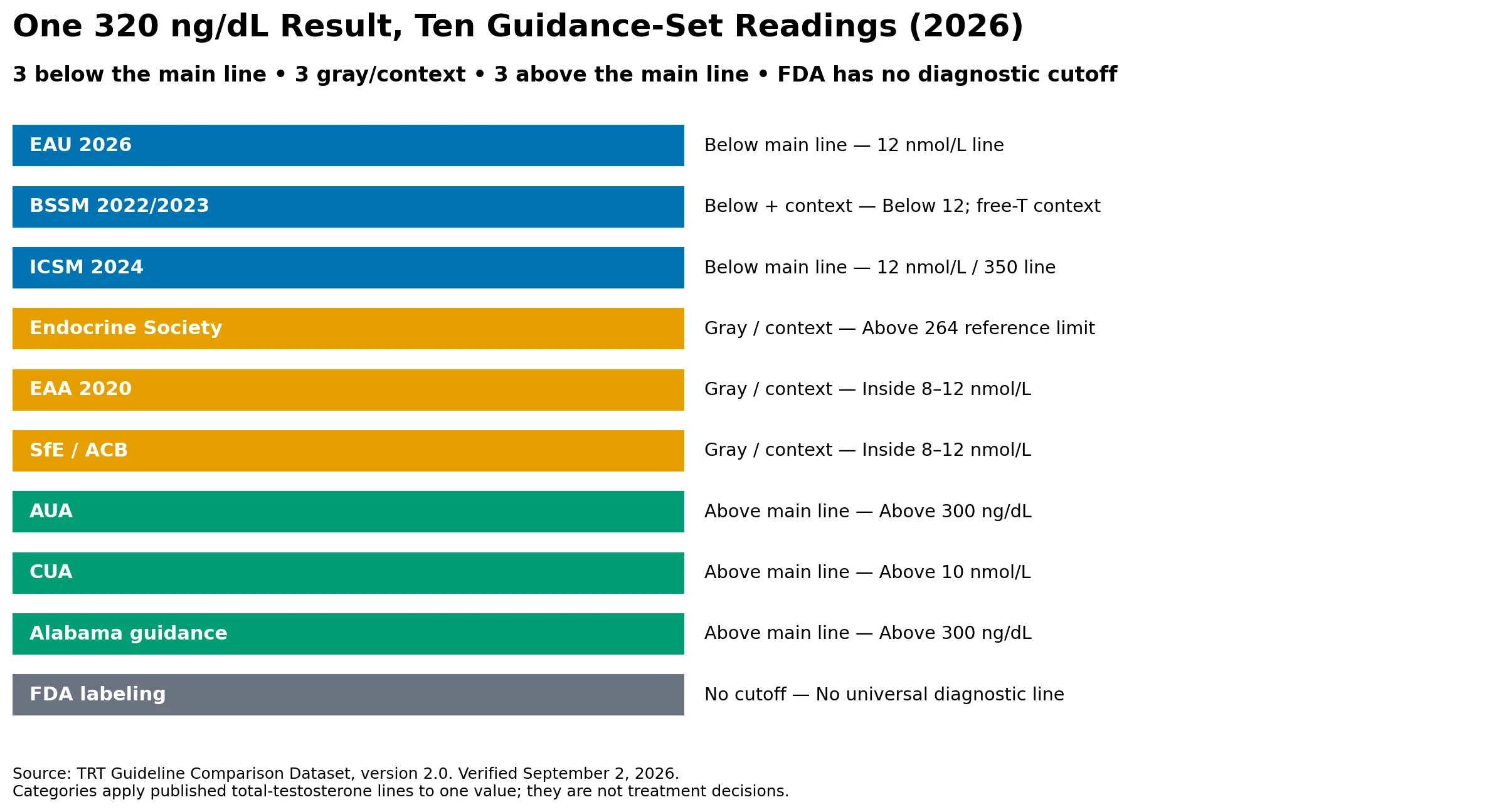
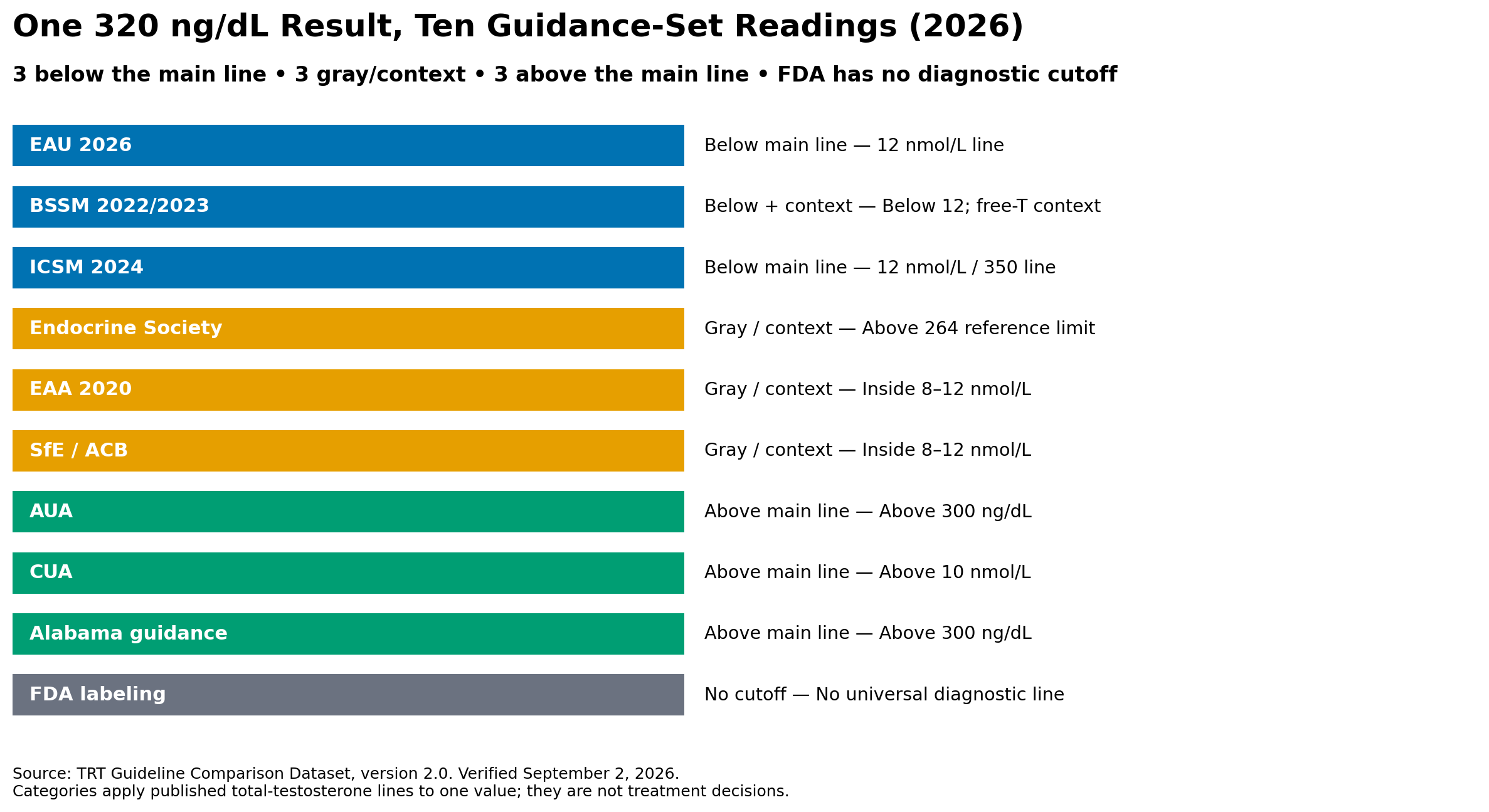
Figure 1 source: TRT Provider Guide application of each issuing body's published threshold or interpretation band to 320 ng/dL; verified September 2, 2026. Download the underlying comparison data (CSV).
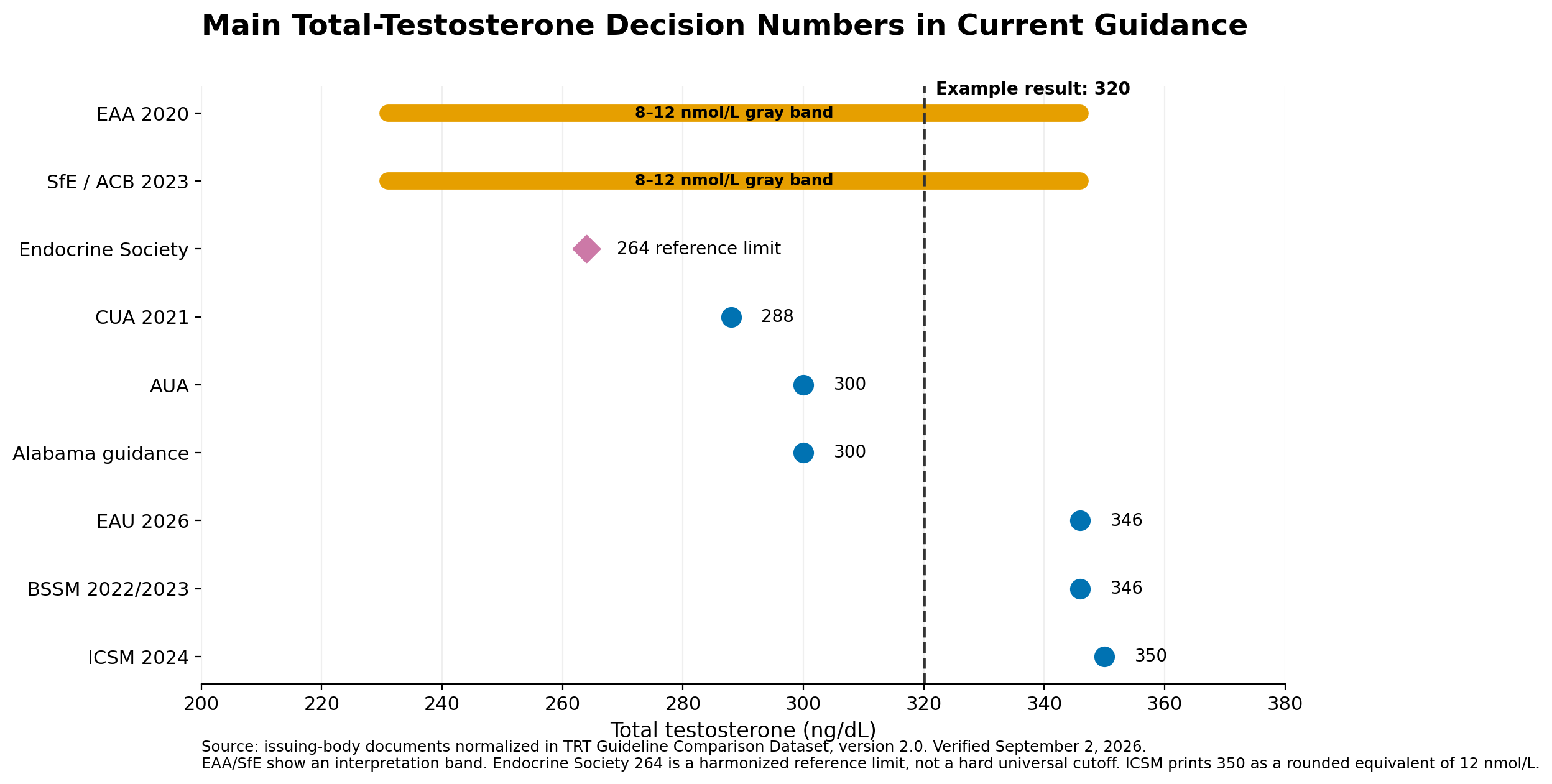
Data files: one-fact-per-row comparison dataset (CSV) · guideline and regulatory timeline (CSV) · 320 ng/dL verdict chart (SVG) · threshold comparison chart (SVG)
Scope in plain words. TRT means prescription testosterone used to treat a diagnosed testosterone deficiency. The source documents do not all use hypogonadism, testosterone deficiency, and low testosterone in exactly the same way. This page keeps each body's wording and does not treat those labels as perfect synonyms. It describes published guidance. It does not diagnose anyone or tell any person to start, stop, or change treatment.
TRT guidelines in 2026: the 10 guidance sets in this audit
There is no single worldwide TRT rulebook. This audit compares eight current professional-group clinical documents, one federal regulatory track, and one state medical-board guidance document.
The categories matter:
- A clinical guideline or consensus recommendation tells clinicians how an issuing group reads the evidence.
- An FDA label states approved uses, warnings, and product instructions. It is not a full diagnostic guideline.
- The Alabama document is titled Recommended Guidelines. It is board guidance, not a national standard and not labeled as a statute or regulation.
| Guidance set | What it is | Edition or status on September 2, 2026 | Main diagnostic number or band |
|---|---|---|---|
| American Urological Association (AUA) | U.S. clinical guideline | Published 2018; reviewed and validity confirmed in 2024 | Below 300 ng/dL is a reasonable cutoff supporting diagnosis |
| Endocrine Society | International clinical practice guideline | Full guideline 2018; July 16, 2026 statement reaffirmed the diagnostic process | No single hard cutoff in the recommendation; 264 ng/dL is a harmonized lower reference limit for CDC-certified assays |
| European Association of Urology (EAU) | European clinical guideline | 2026 edition | 12 nmol/L, about 346 ng/dL, is a reliable threshold for late-onset hypogonadism |
| European Academy of Andrology (EAA) | European clinical guideline for functional hypogonadism | 2020 | Below 8 nmol/L is more likely; 8–12 is borderline; above 12 is highly unlikely |
| British Society for Sexual Medicine (BSSM) | UK clinical guideline | Updated 2022; published 2023 | Below 12 nmol/L with symptoms is its main treatment line; free testosterone adds context in the borderline band |
| Society for Endocrinology (SfE) | UK clinical guideline plus lab position statement | Clinical guideline 2022; SfE/ACB biochemical statement 2023 | Two morning fasted results below 8 nmol/L are likely; 8–12 needs context; above 12 is usually not consistent |
| Canadian Urological Association (CUA) | Canadian clinical guideline | 2021 | Below 10 nmol/L, about 288 ng/dL, is reasonable but not absolute |
| Fifth International Consultation on Sexual Medicine (ICSM 2024) | International consensus recommendations | Meeting in 2024; recommendations published online August 27, 2025 | 12 nmol/L, printed as 350 ng/dL, is a reliable threshold |
| U.S. Food and Drug Administration (FDA) | Federal product labeling and regulatory actions | Class-wide action in 2025; further label updates requested in June 2026 | No universal diagnostic testosterone cutoff |
| Alabama Board of Medical Examiners | State board's recommended guidelines | Approved February 20, 2025 | Below 300 ng/dL, confirmed on later morning testing |
Source: issuing-body documents: AUA, Endocrine Society, EAU, EAA, BSSM, Society for Endocrinology, CUA, ICSM 2024, FDA, and Alabama Board of Medical Examiners. Verified September 2, 2026.
Why the main denominator is eight
The cross-guideline counts use only the eight current professional-group clinical documents. That keeps like with like.
The FDA is outside that denominator because product labels are not a complete clinical workup. Alabama is outside it because it is one state board's recommended guidance. The inactive American College of Physicians guideline is outside it because ACP now lists that 2020 document as inactive and because it covered a narrow question: whether to treat age-related low testosterone, not how to diagnose all male hypogonadism.
TRT guideline statistics: what the eight clinical documents agree on
The numbers differ. The process is much more stable.
All eight current clinical documents require both sides of the diagnosis: clinical features and biochemical evidence. A low lab result without the right clinical setting is not the whole diagnosis. Symptoms without low and confirmed testosterone are not the whole diagnosis either.
| Question | Result | What the count means |
|---|---|---|
| Clinical features plus biochemical evidence? | 8 of 8 | Each document joins symptoms or signs to low or deficient testosterone evidence |
| Repeat or consistently low results? | 7 of 8 explicit | CUA calls for morning testing but does not print a fixed repeat count in its main recommendation |
| One result explicitly accepted as enough? | 0 of 8 | No document says a single result alone completes the diagnosis |
| Morning testing? | 8 of 8 | Exact time windows and exceptions differ |
| Fasting required? | 5 of 8 | Endocrine Society, EAU, EAA, SfE/ACB, and ICSM make fasting part of the diagnostic draw |
| Fasting advised but not absolute? | 1 of 8 | BSSM says ideally fasted |
| Fixed 54% hematocrit ceiling or action point? | 6 of 8 | CUA uses 55%; SfE starts action above 50% and escalates when markedly raised |
| Fertility or sperm suppression addressed? | 8 of 8 | Standard systemic testosterone is not treated as fertility-neutral |
| Above-normal treatment target? | 0 of 8 | Numeric and worded targets stay within a normal or physiologic range |
Source: TRT Provider Guide normalization of the eight issuing-body documents listed under Table 2, using the definitions in the Methodology section. Verified September 2, 2026.
The biggest shared lesson is simple: the diagnosis is a sequence, not a number. The usual sequence is symptoms or signs, a properly timed total testosterone test, confirmation, a search for the cause, a safety review, a fertility discussion, and a plan to measure response and harm.
Low testosterone cutoff data: why 264 and 346 are 31% apart
The lowest prominent number in the current documents is 264 ng/dL. The highest common main line is 12 nmol/L, equal to 346 ng/dL with the conversion used in this dataset.
The gap is 82 ng/dL, or 31.1% of 264.
That comparison is useful, but the two numbers are not the same kind of rule:
- 264 ng/dL is the Endocrine Society guideline's harmonized lower limit of the reference range for healthy, non-obese young men when a CDC-standardized assay is used. The recommendation itself does not turn 264 into a universal hard diagnostic cutoff.
- 12 nmol/L is used by EAU as a reliable diagnostic threshold and by ICSM as a reliable threshold. BSSM uses the same line in its treatment statements. EAA and the SfE/ACB statement use 12 as the top of a gray band: values above it make hypogonadism unlikely in the usual setting.
So the honest sentence is not “the guidelines disagree between two hard cutoffs.” It is: prominent decision numbers run from a 264 ng/dL harmonized reference limit to a 346 ng/dL clinical threshold, a 31.1% spread.
| Guidance set | Number as published | Converted value | What the number means there |
|---|---|---|---|
| EAA | Below 8 nmol/L | Below 231 ng/dL | Functional hypogonadism is more likely when values are consistently this low |
| SfE/ACB | Two results below 8 nmol/L | Below 231 ng/dL | Likely hypogonadism when clinical features fit |
| Endocrine Society | 264 ng/dL | 9.2 nmol/L | Harmonized lower reference limit for CDC-certified assays, not a universal hard cutoff |
| CUA | Below 10 nmol/L | Below 288 ng/dL | Reasonable diagnostic threshold, but not absolute |
| AUA | Below 300 ng/dL | Below 10.4 nmol/L | Reasonable cutoff supporting diagnosis |
| Alabama guidance | Below 300 ng/dL | Below 10.4 nmol/L | Board guidance for symptomatic men, with later morning confirmation |
| EAA | 8–12 nmol/L | 231–346 ng/dL | Borderline range requiring more context |
| SfE/ACB | 8–12 nmol/L | 231–346 ng/dL | May occur in eugonadal or hypogonadal men; needs clinical correlation |
| EAU | 12 nmol/L | 346 ng/dL | Reliable threshold for late-onset hypogonadism |
| BSSM | Below 12 nmol/L | Below 346 ng/dL | Main line used in treatment statements for symptomatic men |
| ICSM 2024 | 12 nmol/L or 350 ng/dL | 346 ng/dL by conversion | Reliable threshold; the paper prints 350 ng/dL as a rounded equivalent |
| FDA | None | None | Federal labeling does not set one universal diagnostic cutoff |
Source: diagnostic recommendations and interpretation statements in the primary documents linked under Table 2. Conversion: testosterone ng/dL = nmol/L × 28.84. Values are rounded to the nearest whole ng/dL.
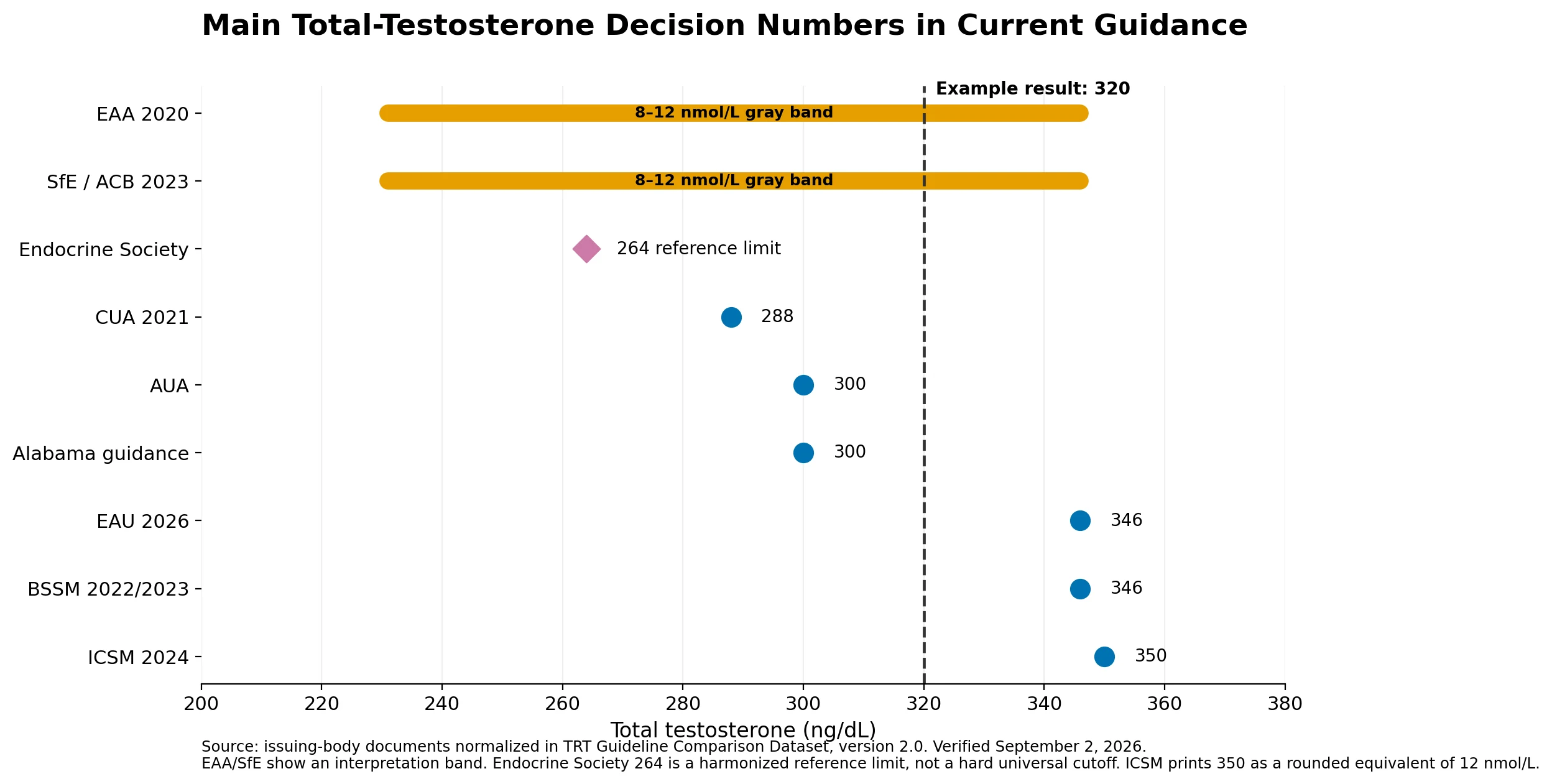
Figure 2 source: TRT Provider Guide normalization of values as published by the issuing bodies; verified September 2, 2026. The figure labels 264 as a reference limit, not a hard Endocrine Society cutoff.
A lab range is not a diagnosis by itself. Assays can differ. Time of day matters. Food can matter under several documents. Illness can lower a result. Sex hormone–binding globulin, called SHBG, can make total testosterone harder to read. For age-based reference context, see Testosterone Levels by Age.
What happens to a 320 ng/dL testosterone result?
A total testosterone result of 320 ng/dL equals about 11.1 nmol/L. It was chosen because it sits above the AUA and Alabama 300 lines but below the 12 nmol/L line used by several European, UK, and international documents.
This is not a treatment recommendation. It is a controlled comparison: one morning result, ten published frameworks.
| Guidance set | Classification in this audit | Why |
|---|---|---|
| EAU 2026 | Below the main line | 320 is below 12 nmol/L; EAU calls for repeat fasting morning testing before treatment |
| BSSM 2022/2023 | Below the main line, with added context | 320 is below 12 nmol/L and also in a band where free testosterone can help |
| ICSM 2024 | Below the main line | 320 is below its 12 nmol/L or rounded 350 ng/dL threshold |
| Endocrine Society 2018/2026 | Gray or context-dependent | 320 is above the 264 harmonized reference limit, but a borderline total result can require free testosterone and assay context |
| EAA 2020 | Gray or context-dependent | 320 lies inside 8–12 nmol/L |
| SfE/ACB 2023 | Gray or context-dependent | 320 lies inside 8–12 nmol/L, where clinical and assay context matter |
| AUA 2018/2024 | Above the main numeric line | It is not below 300 ng/dL; the AUA still allows clinical judgment and adjunctive testing in selected symptomatic men |
| CUA 2021 | Above the main numeric line | It is above the guideline's reasonable 10 nmol/L threshold, which CUA says is not absolute |
| Alabama guidance 2025 | Above the main numeric line | It is not below 300 ng/dL |
| FDA labeling | No diagnostic cutoff | FDA labeling gives approved-use and safety language but no universal diagnostic number |
Source: TRT Provider Guide application of the published numbers and interpretation bands in Table 4 to 320 ng/dL; verified September 2, 2026. Categories describe the number only. They do not predict a final diagnosis or prescription.
The result is 3 below, 3 gray, 3 above, 1 no cutoff. That is why a clean report should always name the document and the rule being used. “The guidelines say 320 is low” is not accurate. “EAU places 320 below its 12 nmol/L line” is accurate.
What tests do TRT guidelines require before treatment?
Total testosterone is the starting test. The details are where errors happen.
| Clinical document | Repeat count | Timing | Fasting | When free testosterone helps |
|---|---|---|---|---|
| AUA | At least two tests on separate occasions | Early morning | Not made a diagnostic requirement | When total testosterone is equivocal or symptoms and total testosterone do not line up |
| Endocrine Society | Repeat to confirm a consistently low result | Morning | Required | When total testosterone is near the lower limit or SHBG is altered |
| EAU | At least two separate tests when total testosterone is below 12 nmol/L | 7:00–10:00 a.m. | Required | When SHBG is altered or calculated free testosterone can clarify the result |
| EAA | At least two different days | 7:00–11:00 a.m. | Required | Especially in the 8–12 nmol/L band or when SHBG is altered |
| BSSM | At least two occasions | Before 11:00 a.m. | Ideally fasted | In borderline total testosterone ranges and when SHBG affects interpretation |
| Society for Endocrinology / ACB | Two consecutive tests | Morning | Required | Borderline results need clinical and assay context; calculated free testosterone may help when SHBG is abnormal |
| CUA | No fixed count printed in the main recommendation | Morning, 7:00–11:00 a.m. | Not specified | Calculated free or bioavailable testosterone for equivocal cases |
| ICSM 2024 | At least two tests | Morning | Required | In borderline cases or when SHBG is altered |
Source: diagnostic testing sections of AUA, Endocrine Society, EAU, EAA, BSSM, SfE/ACB, CUA, and ICSM 2024. Verified September 2, 2026.
Why two morning tests are common
Testosterone changes during the day. It can also shift with sleep, food, acute illness, medicines, obesity, and lab method. Repeat testing lowers the chance that one unusual morning becomes a lifelong label.
The Endocrine Society's July 2026 statement made the point in beginner-friendly terms: diagnosis should rest on at least two early-morning, fasting tests plus the clinical picture. The Society also warned that non-standardized assays can read the same sample differently.
What else gets checked before treatment
The exact workup depends on the person and the source document. Common pieces include:
- LH and sometimes FSH: These hormones help separate a testicular cause from a brain or pituitary cause.
- Prolactin: This can help find a pituitary problem, especially when testosterone and LH are low.
- SHBG and calculated free testosterone: These help when total testosterone is borderline or SHBG is likely to be unusual.
- Hemoglobin and hematocrit: Testosterone can raise red-cell measures, so a high baseline matters.
- PSA and prostate assessment: The age, risk rules, and follow-up differ by document.
- Fertility plans: Standard systemic testosterone can reduce sperm production.
- Medicines, illness, sleep, weight, and substance use: These can lower testosterone or change treatment risk.
No single table can replace the cause workup. A very low result with low or normal LH raises a different question than a borderline result in a man who slept poorly, was acutely ill, or takes a medicine known to affect the hormone axis.
TRT monitoring schedule data: when do labs get rechecked?
There is no one first-recheck date for every product. Gels, short-acting injections, long-acting injections, patches, oral products, pellets, and nasal products reach and hold levels differently.
| Guidance set | First main follow-up | Later follow-up | Important detail |
|---|---|---|---|
| AUA | After an interval suited to the formulation | Testosterone every 6–12 months; hematocrit every 6–12 months or sooner | The early testosterone date is product-specific, not one universal 2–4 week rule |
| Endocrine Society | 3–6 months | At 12 months, then annually | Check response, adverse effects, testosterone, and hematocrit; prostate monitoring follows the chosen risk plan |
| EAU | 3 months | 6 months, 12 months, then annually | Men at high risk of raised hematocrit: every 3 months in year one, then at least every 6 months |
| EAA | 3–6 months | At least annually after early review | Recheck symptoms, testosterone, and safety measures, including hematocrit |
| BSSM | 3 months | 6–12 months, then yearly | Judge clinical benefit as well as the number |
| Society for Endocrinology | Formulation-specific | Blood count and treatment review at intervals tied to formulation, often 6–12 months once stable | Gel levels may be checked 2–6 hours after use at 2–3 weeks; long-acting injection levels are read at the trough |
| CUA | 3 months | 6 months, then yearly | Its follow-up table includes symptoms, testosterone, hematocrit, and prostate measures |
| ICSM 2024 | 3 months | 6 months, 12 months, then yearly | Uses a baseline-to-annual monitoring table |
| FDA labeling | Product-specific | Product-specific | Use the current label for the exact testosterone product; there is no one class-wide lab calendar |
| Alabama guidance | 3 months | Testosterone and hemoglobin/hematocrit every 6 months; annual in-person physician visit | Also calls for PSA at 3 months and at least yearly; it says no refill without safety labs from the past 6 months |
Source: follow-up tables and treatment sections in the issuing-body documents. Alabama details come from its Recommended Guidelines, approved February 20, 2025. FDA labeling is product-specific; the class-wide regulatory page does not create one universal schedule. Verified September 2, 2026.
When do guidelines say to stop if symptoms do not improve?
The answer is not one fixed date.
- AUA: Discuss stopping after 3–6 months when testosterone has normalized but the target symptoms have not improved.
- Alabama guidance: At the 3-month review, offer discontinuation if no benefit is confirmed.
- BSSM: It gives symptom-specific response windows and supports stopping when an adequate trial produces no meaningful benefit.
- ACP 2020, now inactive: For its narrow age-related-low-testosterone question, it called for reevaluation within 12 months and stopping when sexual function did not improve.
A lab number can reach a target while the reason for treatment does not change. The current documents generally treat that as a reason to recheck the diagnosis, dose, formulation, adherence, competing causes, and whether treatment should continue.
What hematocrit is too high on TRT?
Hematocrit is the share of blood made up of red blood cells. Testosterone can raise it. A very high value may lead to a lower dose, a different product, a pause, further testing, or removal of blood under medical care.
Six of the eight current clinical documents use 54% as their main ceiling or action point. CUA uses 55%. Society for Endocrinology begins action above 50% and calls for stopping and urgent hematology review when the rise is marked.
| Clinical document | Before treatment | Main on-treatment action line | What the document calls for |
|---|---|---|---|
| AUA | If baseline hematocrit is above 50%, consider withholding until the cause is explained | 54% or higher | Intervention; first adjust dose when on-treatment testosterone is high, with further evaluation as needed |
| Endocrine Society | Elevated hematocrit is a reason not to start until addressed | Above 54% | Stop until safe, evaluate for low oxygen or sleep apnea, then restart at a lower dose when appropriate |
| EAU | Baseline 48–50% needs care; 54% or higher is listed as an absolute contraindication | Above 54% | Adjust or withdraw therapy and use venesection when required |
| EAA | Check before and after treatment | Above 54% | Stop therapy, evaluate, and restart lower only after it returns to a safe level |
| BSSM | High baseline hematocrit is a contraindication in its table | Above 54% | Reduce dose or switch formulation; venesection may be needed |
| Society for Endocrinology | A value above 50% prompts dose reduction, withholding, or another formulation | Markedly raised | Stop testosterone and seek urgent hematology review |
| CUA | Check at baseline | 55% or higher | Dose reduction, drug holiday, formulation change, or phlebotomy |
| ICSM 2024 | Hematocrit should be below 54% before treatment | Above 54% | Adjust or stop treatment and manage the rise |
Source: hematocrit and safety sections in the eight primary clinical documents listed under Table 6. Wording such as “above,” “at least,” and “markedly raised” is kept because the comparators are not identical. Verified September 2, 2026.
The safe takeaway is not “54 is always fine.” Baseline matters. The rate of rise matters. Smoking, sleep apnea, lung disease, altitude, dehydration, and the testosterone formulation can matter. EAU tells clinicians to watch people at high risk more often. AUA tells them to explain a baseline value above 50% before moving ahead.
What testosterone level should TRT aim for?
The documents do not agree on one “optimal” target. They do agree that the goal is not an above-normal level.
| Guidance set | Target as published or summarized from the recommendation |
|---|---|
| AUA | Middle tertile of the normal range, defined as 450–600 ng/dL |
| Endocrine Society | Mid-normal range for healthy young men, adjusted for formulation timing |
| EAU | Restore testosterone to the normal range and improve or resolve relevant symptoms; no single fixed numeric target |
| EAA | Mid-normal range |
| BSSM | 15–30 nmol/L, about 433–865 ng/dL, while also judging clinical response and safety |
| Society for Endocrinology | Formulation-specific; often mid-normal for gels and lower-normal trough levels for long-acting injections |
| CUA | Mid-normal range, shown as 14–17 nmol/L, about 404–490 ng/dL |
| ICSM 2024 | Mid-normal range |
| FDA labeling | Product-specific dosing and measurement instructions; no one class-wide target |
| Alabama guidance | For intramuscular therapy, mid-dose levels should never be above 700 ng/dL; above 800 ng/dL is called excessive |
Source: treatment-target sections of the issuing-body documents. Alabama's 700 and 800 values apply to its injection guidance and are not a universal target for all products. Verified September 2, 2026.
The old draft claimed that 450–490 ng/dL was the one band inside every target. That cannot be supported. EAU does not publish a fixed numeric target, and its discussion of the Testosterone Trials' 280–873 ng/dL range describes a study approach, not an EAU target. Some documents use words such as mid-normal instead of a fixed band. A mathematical overlap across unlike targets would create false precision.
What do TRT guidelines say about PSA and the prostate?
The documents do not share one PSA rule for every age and risk group. A clean summary has to name the body.
| Guidance set | Before treatment | During treatment or referral trigger |
|---|---|---|
| AUA | Measure PSA in men over age 40 before treatment | Follow prostate-cancer screening guidance and investigate concerning results |
| Endocrine Society | Discuss and assess prostate-cancer risk before treatment for men who choose monitoring, including ages 55–69 and ages 40–69 at increased risk | In the first year, seek urologic review for a confirmed PSA rise over 1.4 ng/mL above baseline, a confirmed PSA over 4.0 ng/mL, an abnormal prostate exam, or major worsening of lower urinary tract symptoms |
| EAU | PSA and digital rectal exam before treatment | Its follow-up table checks PSA at baseline, 3 and 12 months, then annually; the 6-month PSA mark is for prostate-cancer survivors. Decisions about biopsy or stopping follow local prostate-cancer guidance |
| Alabama guidance | PSA before treatment | PSA at 3 months and at least yearly; consider every 6 months with a close family history or a personal history of prostate cancer in durable remission |
Source: prostate sections of the AUA guideline, Endocrine Society guideline, EAU 2026 guideline, and Alabama recommended guidelines. Verified September 2, 2026.
A rising PSA is not the same thing as a prostate-cancer diagnosis. It is a signal to confirm the result and decide whether further evaluation is needed. The exact step depends on age, baseline PSA, rate of change, exam, symptoms, personal history, family history, and the prostate guideline used in that country.
Who should not start TRT under current guidance?
There is no honest one-line list that fits every document. The wording and strength differ.
The clearest repeated barriers are:
- a near-term plan to conceive or an active desire for fertility;
- a high or unexplained hematocrit;
- active or untreated prostate or male breast cancer in documents that address it;
- certain recent cardiovascular events, uncontrolled heart failure, severe untreated sleep apnea, severe urinary symptoms, or high prostate risk, depending on the document;
- no confirmed biochemical deficiency or no matching clinical picture.
| Topic | Examples of document-specific wording |
|---|---|
| Fertility | AUA says not to prescribe exogenous testosterone to men currently trying to conceive; EAU lists active desire for children as an absolute contraindication; Endocrine Society recommends against starting in men planning fertility soon |
| Hematocrit | AUA pauses to explain a baseline above 50%; EAU lists 54% or higher as an absolute contraindication; CUA acts at 55% during treatment |
| Prostate cancer | EAU lists locally advanced or metastatic prostate cancer as an absolute contraindication; Endocrine Society lists breast or prostate cancer among conditions against starting; other documents allow narrow specialist-led discussions after treated localized disease |
| Recent cardiovascular event | Endocrine Society names myocardial infarction or stroke within six months; AUA advises waiting 3–6 months after a cardiovascular event; Alabama guidance lists a major cardiac or thromboembolic event within six months |
| Sleep apnea | Endocrine Society lists untreated severe obstructive sleep apnea; Alabama guidance lists undiagnosed or unmanaged obstructive sleep apnea; EAU's 2026 evidence summary says there is no evidence of a relationship with mild, moderate, or CPAP-treated severe sleep apnea |
| Severe urinary symptoms | Endocrine Society lists severe lower urinary tract symptoms; EAU calls an IPSS score over 19 a relative contraindication |
Source: contraindication and safety sections of the issuing-body documents. This table preserves differences rather than turning them into a claim that every body uses the same list. Verified September 2, 2026.
A person can also have a reason for low testosterone that should be treated first. Examples include a pituitary problem, hyperprolactinemia, severe obesity, acute illness, untreated sleep problems, or a medicine effect. Several guidelines tell clinicians to look for and treat reversible causes before or alongside testosterone decisions.
What do TRT guidelines say about fertility?
All eight current clinical documents address fertility or sperm suppression. None treats standard systemic testosterone as fertility-neutral.
Testosterone from outside the body can turn down LH and FSH signals from the brain. That can lower sperm production. Testicular size can fall. Recovery after stopping can take time and is not identical for every man.
| Clinical document | Main fertility point |
|---|---|
| AUA | Do not prescribe exogenous testosterone to men currently trying to conceive; discuss the long-term effect on sperm production |
| Endocrine Society | Do not start testosterone in men planning fertility in the near term |
| EAU | Testosterone is contraindicated in men seeking fertility; gonadotropin treatment may be used for some forms of secondary hypogonadism |
| EAA | Desire for paternity is treated as a contraindication to testosterone therapy |
| BSSM | Counsel that treatment suppresses sperm production and avoid standard testosterone when fertility is wanted |
| Society for Endocrinology | The clinical guideline addresses fertility before treatment and does not present standard replacement as a fertility-preserving option |
| CUA | A wish to preserve fertility changes treatment choice; exogenous testosterone can suppress spermatogenesis |
| ICSM 2024 | Its recommendation box says not to use testosterone therapy in men looking to father a child |
Source: fertility recommendations in the eight primary clinical documents. ICSM also reviews small studies of short-acting intranasal testosterone, but that discussion is not a recommendation that standard testosterone therapy preserves fertility. Verified September 2, 2026.
The practical question comes before the prescription: Could this person want children now or later? The answer can change the drug choice and whether a fertility specialist should be involved.
What current TRT guidelines do not support
The documents are not identical, but none supports a shortcut built from one vague symptom and one random blood draw.
They do not support one universal cutoff
AUA uses 300 ng/dL. CUA uses 10 nmol/L as a reasonable but non-absolute threshold. EAU and ICSM use 12 nmol/L. EAA and SfE use bands. Endocrine Society uses a reference limit plus clinical and assay context.
They do not support an above-normal treatment goal
Targets are mid-normal, middle-tertile, normal, or formulation-specific. No current clinical document in this audit sets an above-normal level as the routine goal.
They do not all promise more energy or sharper thinking
The evidence and wording differ:
- AUA says evidence is inconclusive for energy, fatigue, and cognition.
- EAU says not to use testosterone to improve cognition, vitality, or physical strength in aging men.
- The inactive ACP guideline said not to start testosterone for energy, vitality, physical function, or cognition in men with age-related low testosterone.
They do not all handle a “normal” total result the same way
EAU and ICSM explicitly say not to use testosterone in eugonadal men. CUA, however, allows a supervised three-month trial in selected symptomatic men with an equivocal picture and a total testosterone result that appears normal, with weak recommendation strength and low-quality evidence. That is an exception built around uncertainty, not a blank check for treatment at any number.
They do not replace the current product label
A clinical guideline may say when treatment is reasonable. The FDA-approved label for the exact gel, injection, patch, oral product, pellet, buccal system, or nasal product controls that product's approved use, warnings, dosing, and lab timing.
What changed in TRT guidance in 2025 and 2026?
The largest recent changes are regulatory and publication updates, not a new universal diagnostic number.
| Date | What happened | What it did not mean |
|---|---|---|
| February 28, 2025 | FDA announced class-wide labeling changes after reviewing TRAVERSE and blood-pressure studies: add TRAVERSE results, keep the age-related limitation at that time, remove boxed-warning language about increased cardiovascular outcomes, and add or update blood-pressure warnings | It did not create a diagnostic cutoff or one class-wide lab calendar |
| February 20, 2025 | Alabama Board of Medical Examiners approved Recommended Guidelines for testosterone therapy in males and females | It did not create a national TRT rulebook |
| August 27, 2025 | The ICSM 2024 male-hypogonadism recommendations were published online; they appeared in the October 2025 issue of Sexual Medicine Reviews | “ICSM 2024” names the consultation, not the publication year |
| April 20, 2026 | FDA published notice of a possible new indication for low libido in men with idiopathic hypogonadism and invited application holders to discuss supplemental applications | A notice of possible expansion was not an approval of a new indication |
| June 18–23, 2026 | HHS/FDA said FDA requested removal of the age-related-hypogonadism limitation and revisions to prostate-cancer and benign-prostatic-hyperplasia safety language; FDA's Testosterone Information page was current June 23 | A request for label updates should not be described as one finished, identical label change on every marketed product without checking the product's current label |
| July 16, 2026 | Endocrine Society issued a statement reaffirming symptoms plus at least two early-morning fasting tests and noting a common clinical threshold near 300 ng/dL | It was not a replacement clinical practice guideline |
| 2026 edition | EAU published its current annual Sexual and Reproductive Health guideline, including the male-hypogonadism chapter | Annual edition changes do not make every older professional-group guideline inactive |
Source: FDA February 2025 action, FDA Testosterone Information, Federal Register notice, Alabama guidance, ICSM article, Endocrine Society statement, and EAU 2026 chapter. Verified September 2, 2026.
The FDA sequence is easy to misstate. In February 2025, FDA said to retain the age-related limitation. In June 2026, FDA requested removal of it. A page that reports only one of those dates can give the wrong current picture.
Historical note: the ACP 2020 guideline is inactive
The American College of Physicians issued a 2020 guideline on testosterone treatment in adult men with age-related low testosterone. It did not set a diagnostic cutoff. It focused on whether treatment improved outcomes after age-related low testosterone was already identified.
ACP now places that guideline on its Inactive ACP Guidelines page. For that reason, it is not counted as one of the ten current guidance sets and is not used in the eight-document clinical denominator.
Its narrow historical message is still useful to understand old articles: discuss treatment mainly for sexual dysfunction, reevaluate benefit, and do not start it for energy, vitality, physical function, or cognition alone. But calling ACP 2020 a current broad TRT guideline in 2026 would be wrong.
Source: ACP's inactive-guidelines list and the 2020 ACP guideline, checked September 2, 2026.
Do states have their own TRT guidelines?
This audit verified one clear state-board example: Alabama.
Alabama's document is titled Recommended Guidelines for Testosterone Replacement Therapy in Males. It calls for symptoms, two early-morning tests, a result below 300 ng/dL, a confirmatory fasting workup, a three-month review, six-month safety labs, and an annual in-person physician visit. It also says physicians should not refill testosterone without testosterone and hemoglobin/hematocrit safety labs from the prior six months.
Those are specific Alabama Board recommendations. This page does not claim that every Alabama sentence is a statute, that every state uses the same rules, or that states without a similar document have no legal requirements. A complete state-law answer would require a separate, current 50-state legal review of statutes, board rules, controlled-substance requirements, telemedicine law, prescribing standards, and enforcement materials.
Source: Alabama Board of Medical Examiners Recommended Guidelines, approved February 20, 2025.
Methodology: how the TRT Guideline Comparison Dataset was made
This section is the audit trail. It explains exactly what was counted and what was not.
Research question
The dataset asks: How do current, broad guidance documents for adult male testosterone deficiency differ on diagnosis, testing, treatment targets, safety, and monitoring as of September 2, 2026?
Inclusion rules
A current clinical document was included in the main denominator when it:
- came from a professional medical body;
- covered broad adult male testosterone-deficiency or hypogonadism care rather than one drug, one cancer-survivor group, or one narrow disease;
- was the newest edition, validity-confirmed version, or current page available from that body on September 2, 2026; and
- gave enough original recommendations to code the main decision points.
The eight documents meeting those rules were AUA, Endocrine Society, EAU, EAA, BSSM, Society for Endocrinology, CUA, and ICSM 2024.
Separate guidance tracks
Two current documents were included in the reader-facing ten-set comparison but excluded from clinical-society denominators:
- FDA: class-wide regulatory actions and current federal testosterone information;
- Alabama Board of Medical Examiners: state recommended guidance.
The ACP 2020 guideline was kept only in the historical table because ACP lists it as inactive.
Document pairing rule
The Society for Endocrinology's 2022 clinical guideline and the 2023 joint SfE/ACB biochemical position statement were treated as one clinical guidance set, not two votes. The 2022 document covers treatment and monitoring. The 2023 statement adds laboratory interpretation. Counting them separately would give one organization extra weight.
Unit conversion
The dataset uses:
ng/dL = nmol/L × 28.84 (convert any result with our testosterone unit converter)
The factor comes from testosterone's molecular weight of about 288.4 g/mol. Converted ng/dL values are rounded to the nearest whole number in reader tables. Source values stay in their published units in the CSV.
Examples:
- 8 nmol/L = 230.7 ng/dL, shown as 231;
- 10 nmol/L = 288.4 ng/dL, shown as 288;
- 12 nmol/L = 346.1 ng/dL, shown as 346.
Some papers print 12 nmol/L as 350 ng/dL. The dataset preserves the printed value and also records the formula conversion.
Counting rules
- Symptoms plus biochemical evidence: counted yes only when the document joins the clinical picture to low or deficient testosterone evidence.
- Repeat testing: counted explicit only when the document calls for repeat, consecutive, consistently low, or at least two measurements.
- One result enough: counted yes only if a document plainly says one result can complete diagnosis. None did.
- Fasting required: counted yes when fasting is part of the recommendation, not merely discussed.
- Hematocrit 54%: counted yes when 54% is the main ceiling, stop point, or intervention point. CUA's 55% and SfE's different action scheme were kept separate.
- Fertility: counted addressed when the document warns about sperm suppression, advises against treatment while trying to conceive, or changes treatment to preserve fertility.
- Above-normal target: counted yes only if routine treatment is aimed above the normal or physiologic range. None did.
The 320 ng/dL experiment
The 320 analysis holds the lab value constant and applies each set's published total-testosterone number or band:
- Below main line: 320 falls under a primary published line used to support diagnosis or treatment consideration.
- Gray or context-dependent: 320 falls inside a published borderline band or above a reference limit where free testosterone, SHBG, assay, and clinical context can still change interpretation.
- Above main numeric line: 320 is above the document's primary numeric threshold.
- No diagnostic cutoff: the document publishes no universal total-testosterone number.
The categories do not say whether a person would receive treatment. They isolate one decision point so the disagreement can be measured.
Verification process
Each included fact was checked against the issuing body's guideline page, the original paper, an official regulator page, or the original board document. Secondary summaries were not used to override a primary source. The dataset records one source URL and the verification date for each row.
Versioning
Version 2.0 replaces the draft's mixed denominator. It:
- adds the full Society for Endocrinology clinical guideline to the clinical set;
- pairs it with the SfE/ACB lab statement;
- separates FDA and Alabama from clinical-society counts;
- moves inactive ACP to history;
- changes the 320 table from 11 rows to the promised 10 current sets;
- removes claims that could not be reproduced from like-for-like targets.
Limits of this dataset
This comparison is broad, but it has edges.
- It is a document audit, not a patient-outcome study.
- It compares issuing-body wording. It does not measure how every clinician practices.
- AUA, Endocrine Society, EAA, BSSM, SfE, CUA, and ICSM do not all update on the same schedule.
- The EAU page is updated annually, so its year changes more often than most other documents.
- FDA-approved testosterone products have different labels. A class-wide FDA row cannot replace the current label for a specific product.
- Alabama is one verified state example. This is not a 50-state legal survey.
- Total testosterone thresholds are not interchangeable with free-testosterone thresholds, assay reference ranges, or treatment targets.
- The 320 ng/dL split is a reproducible reading of published rules, not proof that three clinicians would reach each final decision.
- The page was not clinically reviewed. It should not be used for personal diagnosis or dosing.
- A source can change after the verification date. The date is shown so later readers can repeat the check.
TRT guidelines FAQ
What testosterone level qualifies for TRT?
There is no one worldwide cutoff. AUA uses below 300 ng/dL as a reasonable line. CUA uses below 10 nmol/L, about 288 ng/dL, as reasonable but not absolute. EAU and ICSM use 12 nmol/L, about 346 ng/dL. Endocrine Society uses symptoms, consistently low results, assay context, and a 264 ng/dL harmonized lower reference limit rather than one universal hard cutoff.
Is 320 ng/dL low testosterone?
It depends on the guidance set and the rest of the case. In this audit, 320 ng/dL is below the main line in three sets, gray or context-dependent in three, above the main numeric line in three, and not classifiable by an FDA diagnostic cutoff.
Do you need two testosterone tests?
Seven of the eight current clinical documents explicitly call for repeat or consistently low testing. CUA calls for a morning test but does not print a fixed count in its main recommendation. None of the eight explicitly says one result alone is enough.
Should a testosterone test be fasting?
Five of the eight current clinical documents require fasting. BSSM advises an ideally fasted draw. AUA does not make fasting a diagnostic requirement. CUA does not specify fasting in its main testing recommendation.
What is the AUA cutoff for low testosterone?
The AUA says total testosterone below 300 ng/dL is a reasonable cutoff supporting diagnosis. It also requires symptoms or signs and at least two early-morning tests on separate days.
What is the Endocrine Society cutoff?
The Endocrine Society recommendation does not set one universal hard cutoff. Its 2018 guideline shows 264 ng/dL as a harmonized lower reference limit for CDC-certified assays. Its July 2026 statement refers to a common clinical threshold near 300 ng/dL while still requiring symptoms and at least two early-morning fasting tests.
What hematocrit is too high on TRT?
Six of the eight current clinical documents use 54% as the main ceiling or action point. CUA uses 55%. Society for Endocrinology starts action above 50% and escalates when the value is markedly raised. A high or rising result needs clinician review; it is not a self-treatment number.
How often should TRT blood work be done?
Most documents have an early review around three to six months and at least annual follow-up once stable. The exact testosterone draw depends on the product. EAU uses 3, 6, and 12 months, then yearly. CUA uses baseline, 3 months, 6 months, then yearly. AUA uses formulation-specific early timing and then testosterone every 6–12 months.
What is the target testosterone level on TRT?
There is no one target. AUA prints 450–600 ng/dL. CUA prints 14–17 nmol/L, about 404–490 ng/dL. BSSM prints 15–30 nmol/L, about 433–865 ng/dL. Several others say mid-normal or normal and adjust the draw to the product. None sets an above-normal routine goal.
Does TRT affect fertility?
Yes. All eight current clinical documents address fertility or sperm suppression. Standard systemic testosterone can lower LH and FSH signaling and reduce sperm production. Men who may want children should raise that before treatment.
Does the FDA have a TRT guideline?
FDA has product labels, safety communications, and regulatory actions. Those are not a complete clinical diagnostic guideline. FDA does not publish one universal testosterone cutoff for diagnosis.
Are there new TRT guidelines in 2026?
EAU has a 2026 annual edition, and Endocrine Society issued a July 2026 statement, but the Society's full clinical practice guideline remains the 2018 document. FDA also requested label updates in June 2026. These changes did not create one new worldwide cutoff.
Is the ACP 2020 testosterone guideline current?
No. ACP lists its 2020 age-related-low-testosterone guideline as inactive. It remains useful as historical context but is not counted as a current guideline here.
How to cite this page
This block gives neutral attribution details for readers who need a citation format.
Page citation
TRT Provider Guide. “TRT Guidelines Data: 10 Current Guidance Sets Compared (2026).” By TRT Provider Guide. Last verified September 2, 2026. https://trtproviderguide.com/research/trt-guidelines/
Dataset citation
TRT Provider Guide. TRT Guideline Comparison Dataset, 2026. Version 2.0. Verified September 2, 2026. https://trtproviderguide.com/research/data/trt-guidelines-dataset-2026.csv
Suggested description of the original 320 analysis
“TRT Provider Guide's September 2, 2026 comparison found that a 320 ng/dL morning total testosterone result fell below the main line in three current guidance sets, into a gray or context zone in three, above the main numeric line in three, and under no diagnostic cutoff in FDA labeling.”
Primary sources
Every major clinical, status, and regulatory claim above traces to an issuing body or original publication.
- American Urological Association. Evaluation and Management of Testosterone Deficiency: AUA Guideline. Published 2018; reviewed and validity confirmed 2024.
- Mulhall JP, Trost LW, Brannigan RE, et al. Evaluation and Management of Testosterone Deficiency: AUA Guideline. Journal of Urology. 2018.
- Bhasin S, Brito JP, Cunningham GR, et al. Testosterone Therapy in Men With Hypogonadism: An Endocrine Society Clinical Practice Guideline. Journal of Clinical Endocrinology & Metabolism. 2018.
- Endocrine Society. Testosterone Therapy for Hypogonadism Guideline Resources.
- Endocrine Society. Statement on Testosterone Replacement Therapy. July 16, 2026.
- European Association of Urology. Sexual and Reproductive Health Guideline, Chapter 3: Male Hypogonadism. 2026 edition.
- Corona G, Goulis DG, Huhtaniemi I, et al. European Academy of Andrology guidelines on investigation, treatment and monitoring of functional hypogonadism in males. Andrology. 2020.
- Hackett G, Kirby M, Rees RW, et al. British Society for Sexual Medicine Guidelines on Male Adult Testosterone Deficiency. World Journal of Men's Health. 2023.
- Jayasena CN, Anderson RA, Llahana S, et al. Society for Endocrinology guidelines for testosterone replacement therapy in male hypogonadism. Clinical Endocrinology. 2022.
- Jayasena CN, de Silva NL, O'Reilly MW, et al. Standardising the biochemical confirmation of adult male hypogonadism: joint SfE/ACB position statement. Annals of Clinical Biochemistry. 2023.
- Grober ED, Krakowsky Y, Khera M, et al. Canadian Urological Association guideline on testosterone deficiency in men. Canadian Urological Association Journal. 2021.
- Khera M, Torres LO, Grober ED, et al. Male hypogonadism: recommendations from the Fifth International Consultation on Sexual Medicine (ICSM 2024). Sexual Medicine Reviews. 2025.
- U.S. Food and Drug Administration. FDA issues class-wide labeling changes for testosterone products. February 28, 2025.
- U.S. Food and Drug Administration. Testosterone Information. Content current June 23, 2026.
- Federal Register. Potential New Indication for Testosterone Replacement Therapy. April 20, 2026.
- Alabama Board of Medical Examiners. Recommended Guidelines for Testosterone Replacement Therapy in Males. Approved February 20, 2025.
- American College of Physicians. Inactive ACP Guidelines.
- Qaseem A, Horwitch CA, Vijan S, et al. Testosterone Treatment in Adult Men With Age-Related Low Testosterone. ACP clinical guideline. 2020.
- National Library of Medicine, PubChem. Testosterone compound record, molecular weight 288.4.
Educational information only. This page reports published guidance and original document comparison. It is not medical advice and cannot decide whether testosterone therapy is right for any person.