Testosterone Unit Converter: 1 nmol/L ≈ 28.84 ng/dL
By TRT Provider Guide · Updated September 2026
For testosterone, 1 nmol/L is about 28.84 ng/dL (NIST). So 12 nmol/L is about 346 ng/dL. This testosterone unit converter covers seven lab units. In TRT Provider Guide's September 2026 check, comparable visible factors or examples on 7 of 11 conversion pages were within 0.15% of that basis. One other page had reversed table labels. The bigger trap is the unit itself.
How do I use this testosterone unit converter?
Type the number from your lab report. Pick the unit printed right next to it. You'll get the same result in seven lab units, with the math shown so you can check it. Keep the test name—total, free, or bioavailable—next to the number.
Unit arithmetic
Testosterone unit converter
Enter the number and the unit printed on your report. The reported test type is a label only; it does not change the math.
A dot or decimal comma is accepted. Enter one result at a time.
Use the unit beside the number. Plain % is not a concentration unit. “ug/L” and “μg/L” mean µg/L.
Result
Enter a number to see its unit equivalents.
Worked example: Say your UK report says 12 nmol/L. 12 × 28.84244 ≈ 346 ng/dL. As ng/mL, that's about 3.46.
Compare unit examples
12 nmol/L ≈ 346.1 ng/dL, while 12 ng/dL ≈ 0.4161 nmol/L; 100 nmol/L ≈ 2,884 ng/dL. These are examples, not clinical thresholds.
Nothing you type is sent anywhere or saved by this page. Copying is optional; when selected, a result is placed on your device's clipboard.
The converter uses one number for testosterone's molar mass—the weight of one mole of molecules: 288.4244 grams per mole, from the U.S. National Institute of Standards and Technology (NIST). Everything else is moving decimal points. It changes the unit. It doesn't change the test result, and it doesn't tell you whether a number is good or bad.
Key testosterone conversion statistics
- One nanomole per liter (nmol/L) of testosterone is about 28.84 nanograms per deciliter (ng/dL), and 1 ng/dL is about 0.0347 nmol/L, calculated from NIST's listed molar mass of 288.4244 g/mol (source; checked September 29, 2026).
- In TRT Provider Guide's September 29, 2026 check of 11 conversion pages, comparable factors or paired-value examples on 7 pages were within 0.15% of the NIST-based value; this was not a test of their interactive calculators (factors and source pages).
- The CDC uses ±6.4% mean bias as a total-testosterone assay certification criterion across 2.50–1,000 ng/dL; it is not an error margin for one person's result (CDC; checked September 29, 2026).
- One page in the 11-page check printed a reversed-label example: EndMemo's table read “1 ng/dL = 28.818444 nmol/L,” about 831 times the NIST-based result when read with those labels (page and calculation; checked September 29, 2026).
- 8 of the 11 conversion pages printed a normal, low, or "optimal" band somewhere on the page, and 5 of those 8 named no study or guideline for it on the examined page (TRT Provider Guide converter check, September 29, 2026; page-level record).
- Two examined pages illustrate different low labels: Eden used below 300 ng/dL (about 10.4 nmol/L), while Origin's Low band ended at 15 nmol/L (about 433 ng/dL). These are the sites' labels, not equivalent diagnostic rules (Eden; Origin; checked September 29, 2026).
- The CDC's National Health and Nutrition Examination Survey (NHANES) converts total testosterone from ng/dL to nmol/L by multiplying by 0.0347, and Mayo Clinic Laboratories publishes the same factor (NHANES 2021–2023; Mayo; checked September 29, 2026).
- For free testosterone, 10 pg/mL equals 1 ng/dL and 1 pg/mL is about 3.467 pmol/L; Mayo Clinic Laboratories lists 34.672 to convert free testosterone from ng/dL to pmol/L (NIST; Mayo; checked September 29, 2026).
- Reading the wrong unit makes the apparent concentration 10 times off (pg/mL vs. ng/dL), 100 times off (ng/mL vs. ng/dL), or 1,000 times off (pmol/L vs. nmol/L) (TRT Provider Guide calculation from NIST SI prefixes, checked September 29, 2026).
- 12 nmol/L, a threshold discussed in EAU, BSSM, and ICSM guidance for symptomatic men, is about 346 ng/dL; the American Urological Association's 300 ng/dL cutoff is about 10.4 nmol/L. Their other diagnostic conditions still apply (EAU; BSSM; ICSM; AUA; checked September 29, 2026).
- The 2017 harmonized total-testosterone reference interval for 1,185 healthy, nonobese men aged 19–39 was 264–916 ng/dL, or about 9.15–31.76 nmol/L (Travison et al., Journal of Clinical Endocrinology & Metabolism, source; checked September 29, 2026).
- A systematic review published online April 24, 2026 in The Journal of Clinical Endocrinology & Metabolism named an online converter, UnitsLab, as the tool it used to put testosterone results into common units (source, Table 2, footnote c; checked September 29, 2026).
On this page: nmol/L to ng/dL · Conversion chart · ng/mL and µg/L · Free testosterone units · Normal levels in both units · Unit mistakes · Converter check · Lab differences · Which unit your lab uses · Limits · Method · Cite · Download · FAQ · Sources
How do you convert testosterone from nmol/L to ng/dL?
Multiply nmol/L by about 28.84 to get ng/dL. To go the other way, multiply ng/dL by about 0.0347. Both numbers come from testosterone's molar mass, 288.4244 grams per mole, as listed by NIST. Our tables use the unrounded ratios 288.4244 ÷ 10 and 10 ÷ 288.4244.
Here's why that works, in plain words.
A nanomole is a count of molecules. A nanogram is a weight. Using that listed molar mass, one nanomole of testosterone weighs 288.4244 nanograms. A deciliter is a tenth of a liter. So 1 nmol/L holds 288.4244 ng per liter, which is 28.84 ng per deciliter.
Say your UK report says 15 nmol/L. Multiply: 15 × 28.84 ≈ 433 ng/dL. Now it's in the same units as most US articles.
Who publishes the testosterone conversion factor?
You don't have to take our word for 0.0347. The CDC's national health survey uses it. So does Mayo Clinic Laboratories.
| Source | What it states | Same factor as ng/dL per nmol/L | Difference from NIST basis |
|---|---|---|---|
| NIST Chemistry WebBook | Molecular weight 288.4244 | 28.84244 | Calculation basis |
| CDC NHANES 2021–2023 documentation | Total testosterone ng/dL × 0.0347 = nmol/L | 28.818 | 0.083% |
| CDC NHANES 2019–March 2020 documentation | Same 0.0347 factor | 28.818 | 0.083% |
| CDC NHANES lab procedure manual, total testosterone, 2013–2014 | Reportable range 2.5–1,000 ng/dL or 0.09–34.7 nmol/L | Not inferred from a rounded interval | Not compared |
| Mayo Clinic Laboratories SI conversion table | Total testosterone ng/dL × 0.0347 = nmol/L | 28.818 | 0.083% |
| Mayo Clinic Laboratories SI conversion table | Free testosterone ng/dL × 34.672 = pmol/L | 28.842 | 0.003% |
Source: each linked page, checked September 29, 2026. TRT Provider Guide first expresses each factor as ng/dL per nmol/L, then calculates |factor − 28.84244| ÷ 28.84244 × 100. Display values are rounded. The NIST value is a published reference basis, not a claim of physically exact measurement.
The 0.0347 factor is just 0.034671 rounded to three significant figures. It's the number most people have seen. It's also a hair high, by 0.083%. At 500 ng/dL, it changes the converted value by about 0.0144 nmol/L; the converter check shows the full calculation.
What is 400 ng/dL testosterone in nmol/L?
400 ng/dL is about 13.87 nmol/L. 300 ng/dL is about 10.40 nmol/L, 500 ng/dL is about 17.34 nmol/L, and 1,000 ng/dL is about 34.67 nmol/L. The two tables below go both ways.
Every row is the same amount of testosterone written in different units, rounded for display. These are conversions, not normal ranges.
| ng/dL | nmol/L | ng/mL |
|---|---|---|
| 100 | 3.47 | 1.00 |
| 200 | 6.93 | 2.00 |
| 250 | 8.67 | 2.50 |
| 264 | 9.15 | 2.64 |
| 300 | 10.40 | 3.00 |
| 350 | 12.13 | 3.50 |
| 400 | 13.87 | 4.00 |
| 450 | 15.60 | 4.50 |
| 500 | 17.34 | 5.00 |
| 600 | 20.80 | 6.00 |
| 700 | 24.27 | 7.00 |
| 800 | 27.74 | 8.00 |
| 900 | 31.20 | 9.00 |
| 1,000 | 34.67 | 10.00 |
| 1,200 | 41.61 | 12.00 |
| 1,500 | 52.01 | 15.00 |
Source: TRT Provider Guide calculation from NIST molar mass 288.4244 g/mol and NIST SI prefixes, checked September 29, 2026.
| nmol/L | ng/dL | ng/mL |
|---|---|---|
| 5 | 144.2 | 1.44 |
| 8 | 230.7 | 2.31 |
| 10 | 288.4 | 2.88 |
| 12 | 346.1 | 3.46 |
| 15 | 432.6 | 4.33 |
| 18 | 519.2 | 5.19 |
| 20 | 576.8 | 5.77 |
| 25 | 721.1 | 7.21 |
| 30 | 865.3 | 8.65 |
| 35 | 1,009.5 | 10.09 |
| 40 | 1,153.7 | 11.54 |
Source: TRT Provider Guide calculation from NIST molar mass 288.4244 g/mol and NIST SI prefixes, checked September 29, 2026.
The full chart runs every 25 ng/dL from 100 to 1,600 and every 0.5 nmol/L from 0.5 to 60. It also includes 10–90 ng/dL in steps of 10, the 264 ng/dL row above, and smaller-unit examples. Download it here.
How do you convert ng/mL, µg/L, and ng/L?
Switching between ng/mL, µg/L, ng/L, pg/mL, and ng/dL is just moving decimal points, so those changes are exact. 1 ng/mL equals 100 ng/dL, and 1 µg/L equals 1 ng/mL. So 5 ng/mL is 500 ng/dL, or about 17.34 nmol/L after the molar-mass conversion.
Some labs, older papers, and reports outside the US print total testosterone in ng/mL. It looks tiny next to ng/dL. It isn't. It's the same amount, written with a smaller unit of volume.
| Unit on the report | Same as | To get ng/dL |
|---|---|---|
| ng/mL | µg/L | Multiply by 100 |
| µg/L | ng/mL | Multiply by 100 |
| ng/100 mL | ng/dL | No change |
| ng% (legacy notation) | ng/dL | No change; not plain % |
| ng/L | pg/mL | Divide by 10 |
| pg/mL | ng/L | Divide by 10 |
Source: NIST Metric (SI) Prefixes, updated August 13, 2025; checked September 29, 2026. The legacy ng% notation means nanograms per 100 mL and also appears on the UnitsLab testosterone page. Plain % is not the same label.
How do you convert free testosterone from pg/mL to pmol/L or ng/dL?
For free testosterone, 10 pg/mL equals 1 ng/dL, and 1 pg/mL is about 3.467 pmol/L. So 70 pg/mL is 7.0 ng/dL, or 242.7 pmol/L. Changing units never turns a total result into a free one.
Total and free are two different tests. MedlinePlus, the National Library of Medicine's health site, puts it simply: a total test measures testosterone that's stuck to proteins plus the part that isn't, and a free test measures only the unattached part (MedlinePlus). Free testosterone is a small slice of the total when both are expressed in the same unit. A total-testosterone reference range does not tell you whether a free-testosterone result is in range.
Labs don't even agree on the unit for free testosterone. Mayo Clinic Laboratories lists free testosterone in ng/dL (Mayo). Labcorp's Free Testosterone (Direct) test reports pg/mL. That is one named test, not a rule for every free-testosterone method. Our page about how free testosterone is estimated explains the distinction. A free testosterone of 7.0 ng/dL and one of 70 pg/mL are the same amount written two ways.
| pg/mL | ng/dL | pmol/L | nmol/L |
|---|---|---|---|
| 10 | 1.0 | 34.7 | 0.0347 |
| 25 | 2.5 | 86.7 | 0.0867 |
| 50 | 5.0 | 173.4 | 0.1734 |
| 70 | 7.0 | 242.7 | 0.2427 |
| 100 | 10.0 | 346.7 | 0.3467 |
| 150 | 15.0 | 520.1 | 0.5201 |
| 200 | 20.0 | 693.4 | 0.6934 |
Source: TRT Provider Guide calculation from NIST molar mass 288.4244 g/mol and NIST SI prefixes, checked September 29, 2026.
If you're sorting out which tests a workup should include, our guide to which blood tests a TRT evaluation usually includes walks through total, free, SHBG, and the rest.
What about bioavailable testosterone?
Bioavailable testosterone is free testosterone plus the part held loosely by proteins other than sex hormone-binding globulin (SHBG) (MedlinePlus). It uses the same rounded factor as total: ng/dL × 0.0347 ≈ nmol/L. The test type stays bioavailable.
What is a normal testosterone level in nmol/L?
There isn't one number everyone uses. A widely cited harmonized range for healthy, nonobese men aged 19 to 39 is 264 to 916 ng/dL, or about 9.15 to 31.76 nmol/L. Your lab prints its own range next to your result, and that's the one to read first.
That reference interval came from 1,185 healthy, nonobese men aged 19–39 in two cohorts. The wider project included 9,054 men in four US and European cohorts, with results lined up to a CDC reference method (Travison et al., 2017). The smaller group—not all 9,054 men—provided the 264–916 ng/dL interval. Guidelines then draw their own lines, and they don't all draw them in the same place.
Here are widely cited lines, in both units. They're reference points, not a diagnosis. MedlinePlus says a testosterone test alone can't diagnose any health condition (MedlinePlus).
| Line as published | ng/dL boundary | nmol/L boundary | What it is | Source |
|---|---|---|---|---|
| <20 ng/dL | 20 | 0.69 | EAU 2026: preferred castration threshold discussed for prostate-cancer care | EAU 2026 |
| <50 ng/dL | 50 | 1.73 | EAU 2026: historical castration threshold still used in regulatory/trial definitions | EAU 2026 |
| <8 nmol/L | 231 | 8.00 | EAA 2020 and SfE/ACB 2023: likely hypogonadism with compatible features and repeat fasting morning results | EAA 2020; SfE/ACB 2023 |
| 264 ng/dL | 264 | 9.15 | Lower harmonized reference limit (2.5th percentile); 1,185 healthy nonobese men aged 19–39 | Travison et al., 2017 |
| <10 nmol/L | 288 | 10.00 | CUA 2021: a reasonable, not absolute threshold, alongside symptoms and clinical evaluation | CUA 2021 |
| <300 ng/dL (AUA); 300 ng/dL (FDA interval boundary) | 300 | 10.40 | AUA reasonable cutoff supporting diagnosis with repeated morning results and symptoms/signs; separately, lower 24-hour average-level boundary in FDA’s 2011 AndroGel review | AUA, 2018; validity confirmed 2024; FDA 2011 |
| 12 nmol/L | 346 | 12.00 | Threshold discussed in EAU 2026, BSSM 2023 and ICSM 2024 recommendations published in 2025; contexts differ; ICSM also prints 350 ng/dL | EAU 2026; BSSM 2023; ICSM 2024 recommendations, published 2025 |
| 916 ng/dL | 916 | 31.76 | Upper harmonized reference limit (97.5th percentile); same 1,185-man reference population | Travison et al., 2017 |
| 1,000 ng/dL | 1,000 | 34.67 | Upper 24-hour average-level boundary of the 300–1,000 ng/dL interval in FDA’s 2011 AndroGel statistical review | FDA 2011 |
Source: each primary document linked in its row, checked September 29, 2026. Conversions use 1 nmol/L = 28.84244 ng/dL on the NIST basis, then round for display. The two number columns show boundaries; keep each row's < sign or other qualifier when quoting it. These are adult male and prostate-cancer reference lines, not diagnostic rules for other populations or treatment targets for a reader.
The AUA requires low results on two separate early mornings plus symptoms or signs; a cutoff alone is not a diagnosis. The 264–916 ng/dL interval is a population reference interval. The FDA row is a 24-hour average in a 2011 product review. Those are three different uses of a number, not one “normal range.”
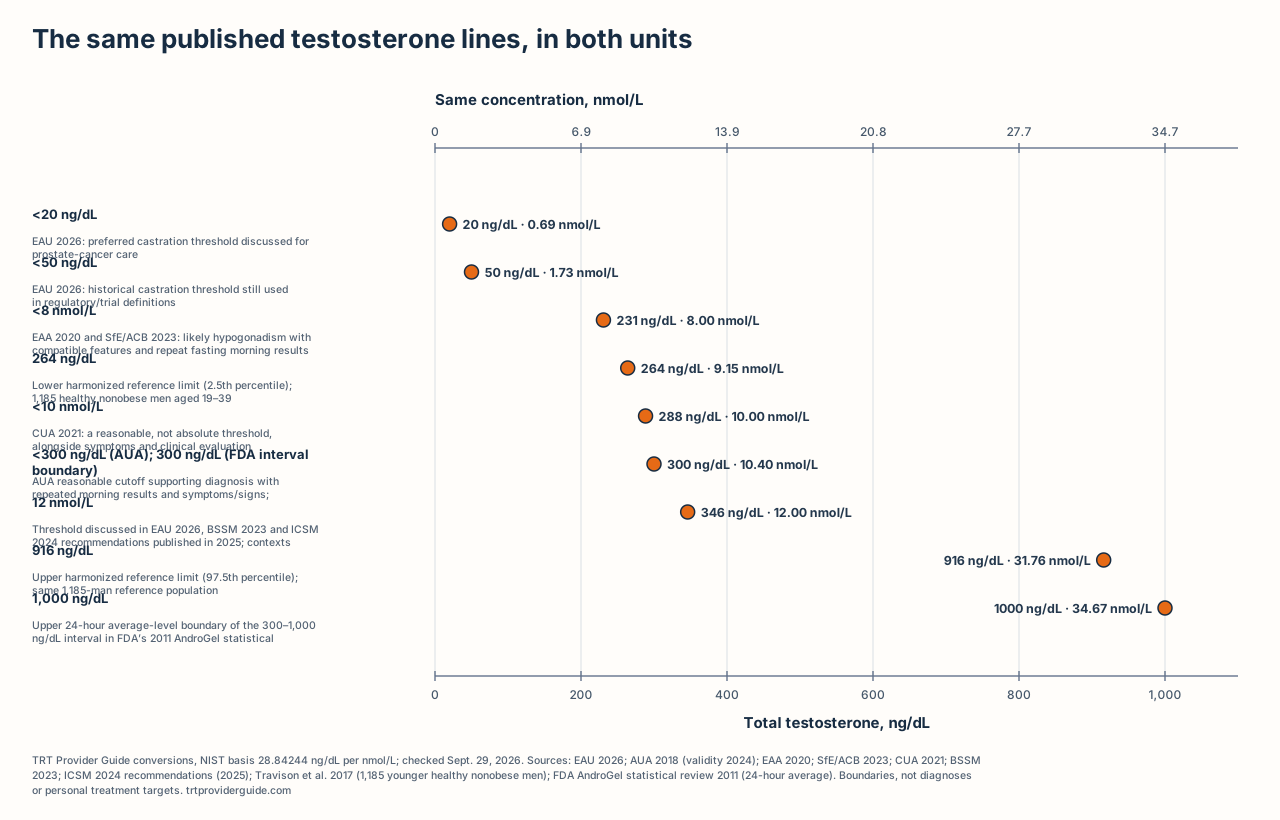
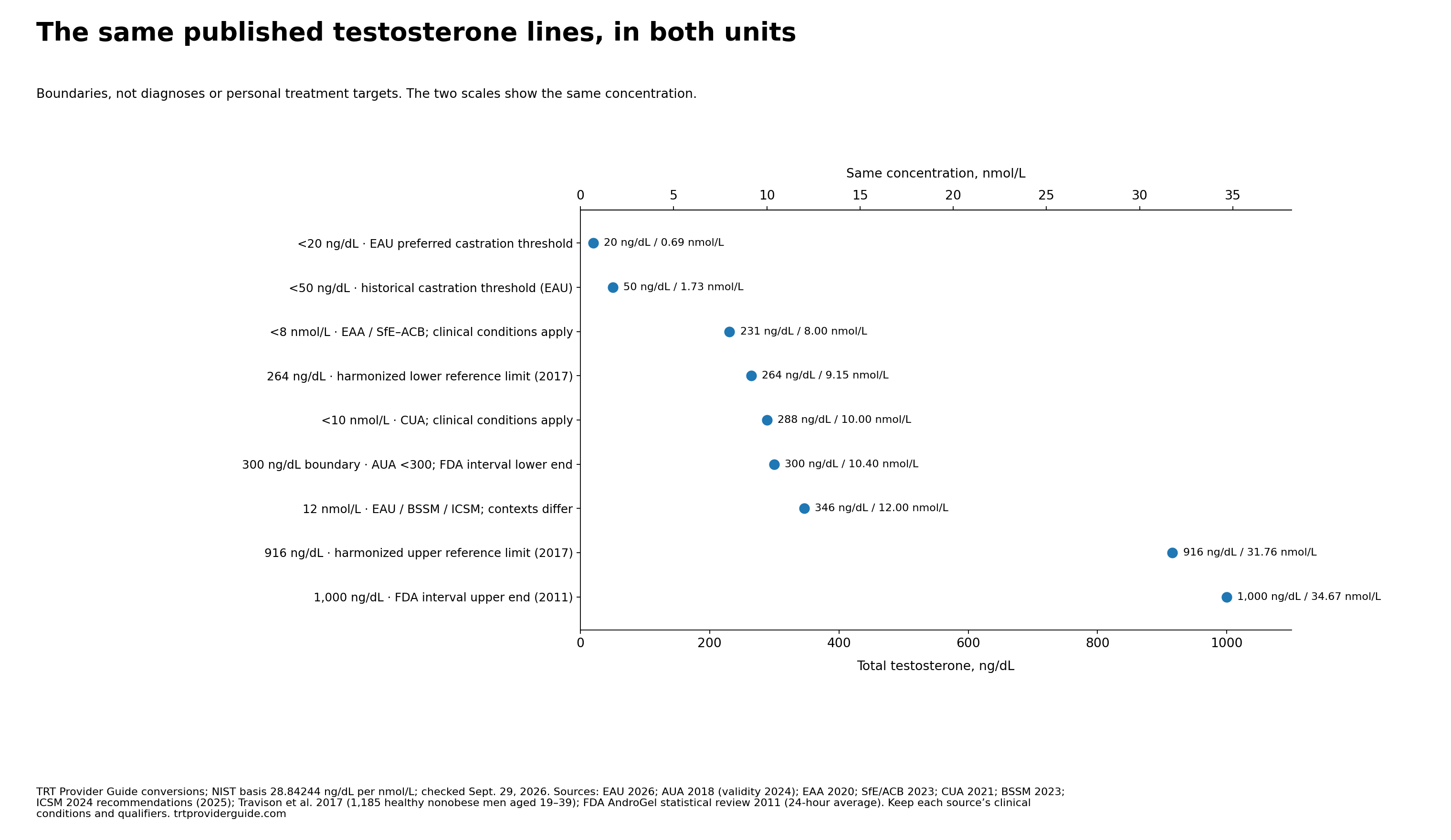
Say a UK report says 11 nmol/L. That's 317 ng/dL. It sits above AUA's 300 ng/dL line and below the 12 nmol/L line EAU uses. Same measured result, two different threshold comparisons, depending on the rulebook. Neither comparison is a diagnosis by itself. Our comparison of 10 guidance sets shows how each one reads the same result. For what a result has to show before treatment is even considered, see TRT eligibility requirements. For ranges by age, see testosterone levels by age.
Which unit mistakes cause the biggest errors?
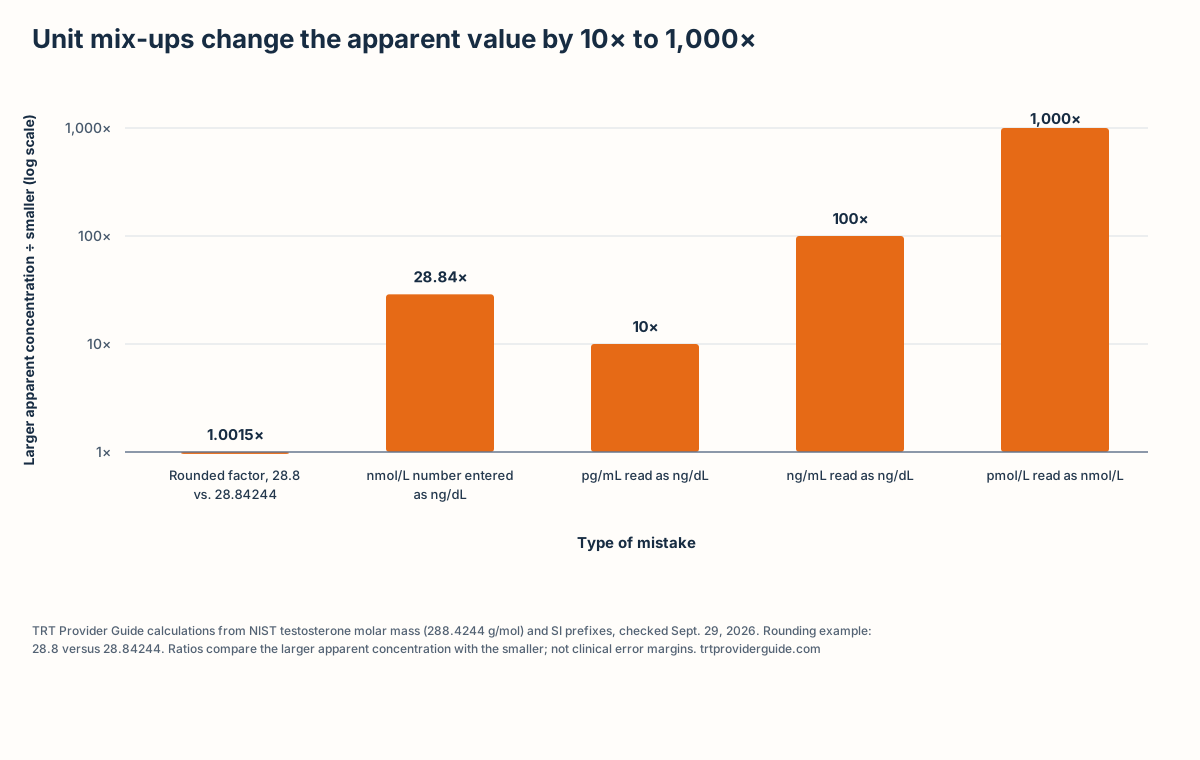
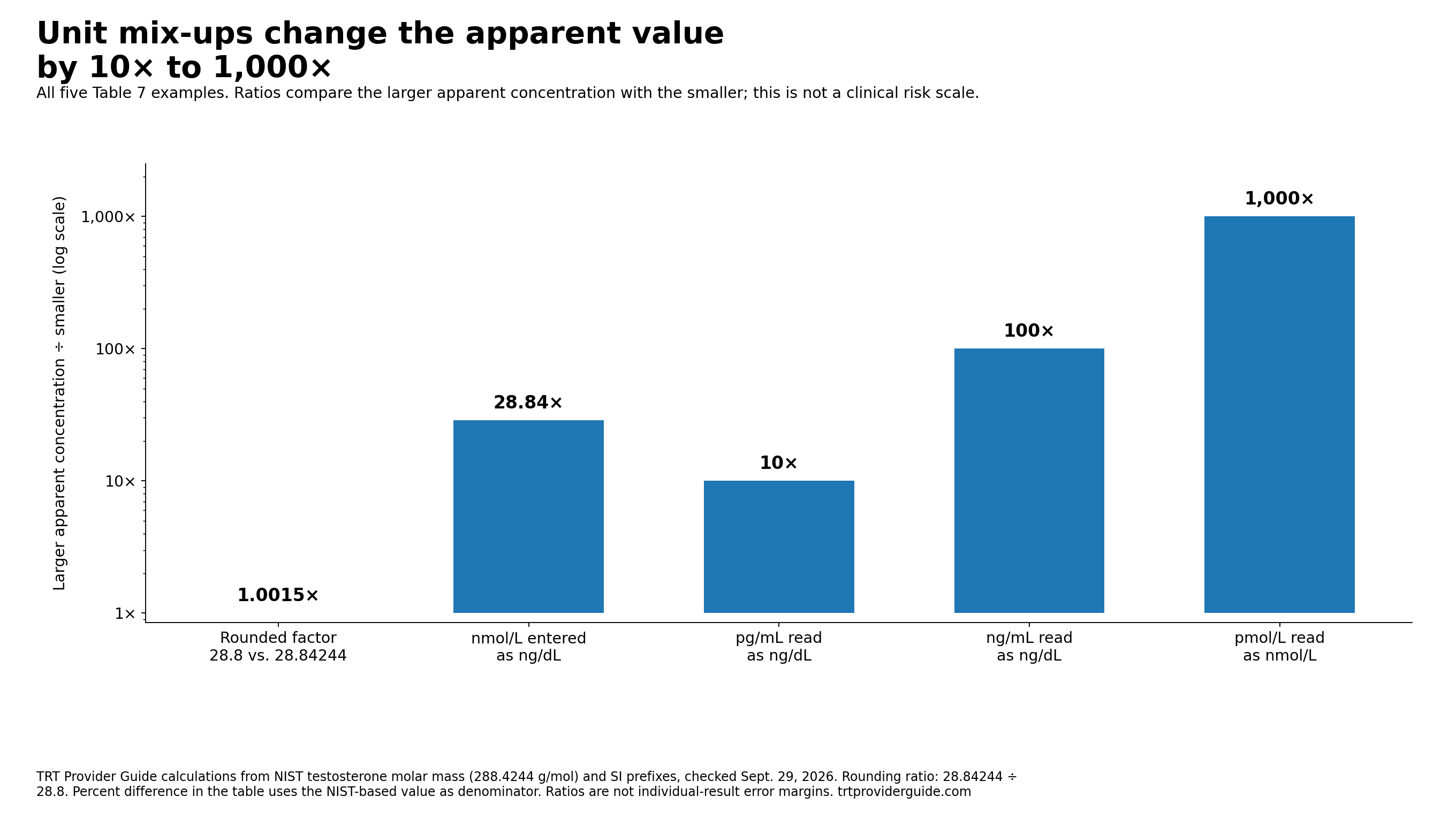
Among the comparable factors and examples we checked, the largest normalized difference was 0.147%. Reading the wrong unit can move the apparent result by 10, 100, or 1,000 times. The unit printed on the report matters far more than the fourth digit of the factor.
Think of it like money. Rounding is being off by a penny on a $10 bill. A unit mix-up is reading $10 as $10,000.
| Mistake | How far off | Example |
|---|---|---|
| Rounding the factor (28.8 instead of 28.84244) | 1.0015 times (0.147% of the NIST-based value) | 12 nmol/L becomes 345.6 ng/dL instead of 346.1 |
| An nmol/L number typed as ng/dL | 28.84 times | 12 nmol/L entered as "12 ng/dL" shows 0.4161 nmol/L instead of 12 |
| pg/mL read as ng/dL | 10 times | A free testosterone of 70 pg/mL read as 70 ng/dL |
| ng/mL read as ng/dL | 100 times | 5 ng/mL read as 5 ng/dL instead of 500 ng/dL |
| pmol/L read as nmol/L | 1,000 times | 243 pmol/L read as 243 nmol/L |
Source: TRT Provider Guide calculation from NIST molar mass 288.4244 g/mol and NIST SI prefixes; rounding row uses the largest difference among eligible factors in the September 29, 2026 page check. “Times” means the larger concentration divided by the smaller; the rounding percentage instead uses the NIST-based value as its denominator. Figures are rounded for display.
How accurate are online testosterone converters?
In our September 29, 2026 check of 11 conversion pages, comparable factors or paired-value examples on 7 pages were within 0.15% of the NIST-based value. EndMemo's reversed-label table was excluded, not counted as accurate. Eight pages printed a normal, low, or "optimal" band, and 5 of those 8 named no study or guideline for it on the examined page.
The comparable factors were close. That does not clear every calculator—or the words around it.
This matters because these little boxes end up in serious places. A 2026 systematic review in The Journal of Clinical Endocrinology & Metabolism says in a table footnote that it converted reported testosterone values using UnitsLab (Konnyu et al., 2026). Transfeminine Science, a hormone reference resource, lists UnitsLab and EndMemo under hormone unit conversion (Transfeminine Science). When a tool gets cited in research, where its number comes from matters.
The factors we found
Seven of the 11 pages visibly show a correctly labeled factor, formula, or paired-value example we could compare. Some show two factors, one for each direction. This checks published arithmetic, not what an interactive calculator does. UnitsLab's rounded reference intervals and whole-number molecular weight do not identify its calculation factor, so they are not used in this comparison.
| Factor or example as shown | Same as ng/dL per nmol/L | Difference from NIST basis | Shown by |
|---|---|---|---|
| 28.8 (nmol/L → ng/dL) | 28.800 | 0.147% | Testavan |
| 0.0347 (ng/dL → nmol/L) | 28.818 | 0.083% | Testavan, Eden Clinic, ConvertMedUnits, Fasto |
| 28.85 (nmol/L → ng/dL) | 28.850 | 0.026% | TestoChecker |
| 28.84 (nmol/L → ng/dL) | 28.840 | 0.008% | Fasto |
| 3.467 (ng/mL → nmol/L) | 28.843 | 0.003% | ScyMed MediCalc |
| 10/288.42 (ng/dL → nmol/L) | 28.842 | 0.002% | ConvertMedUnits |
| 500 ng/dL paired with 17.3358 nmol/L (ng/dL → nmol/L) | 28.842 | 0.001% | Balance My Hormones |
Source: TRT Provider Guide check of the source pages linked in Table 10, September 29, 2026; basis 28.84244 ng/dL per nmol/L from NIST molar mass 288.4244 g/mol. The Balance My Hormones ratio is inferred from its paired-value example, not its widget. Factor-normalization expressions and source URLs are in testosterone-converter-factor-comparison.csv. EndMemo, UnitsLab, PeterBond, and Origin are excluded from this numerical comparison for the reasons in Table 10.
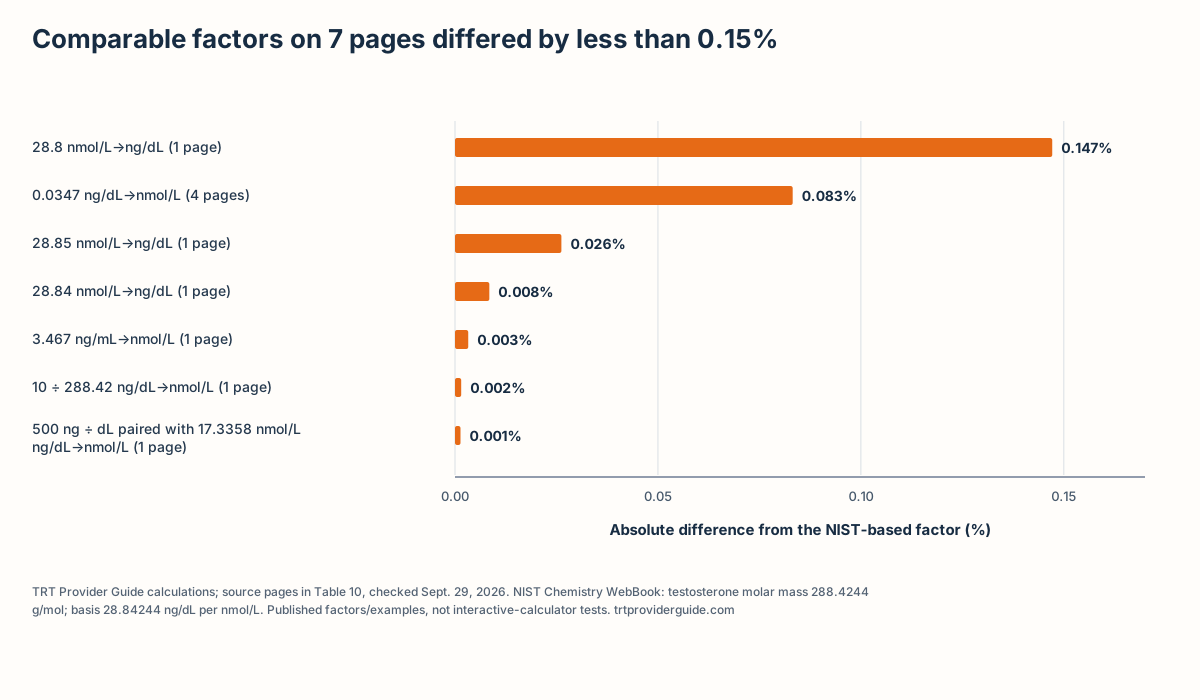
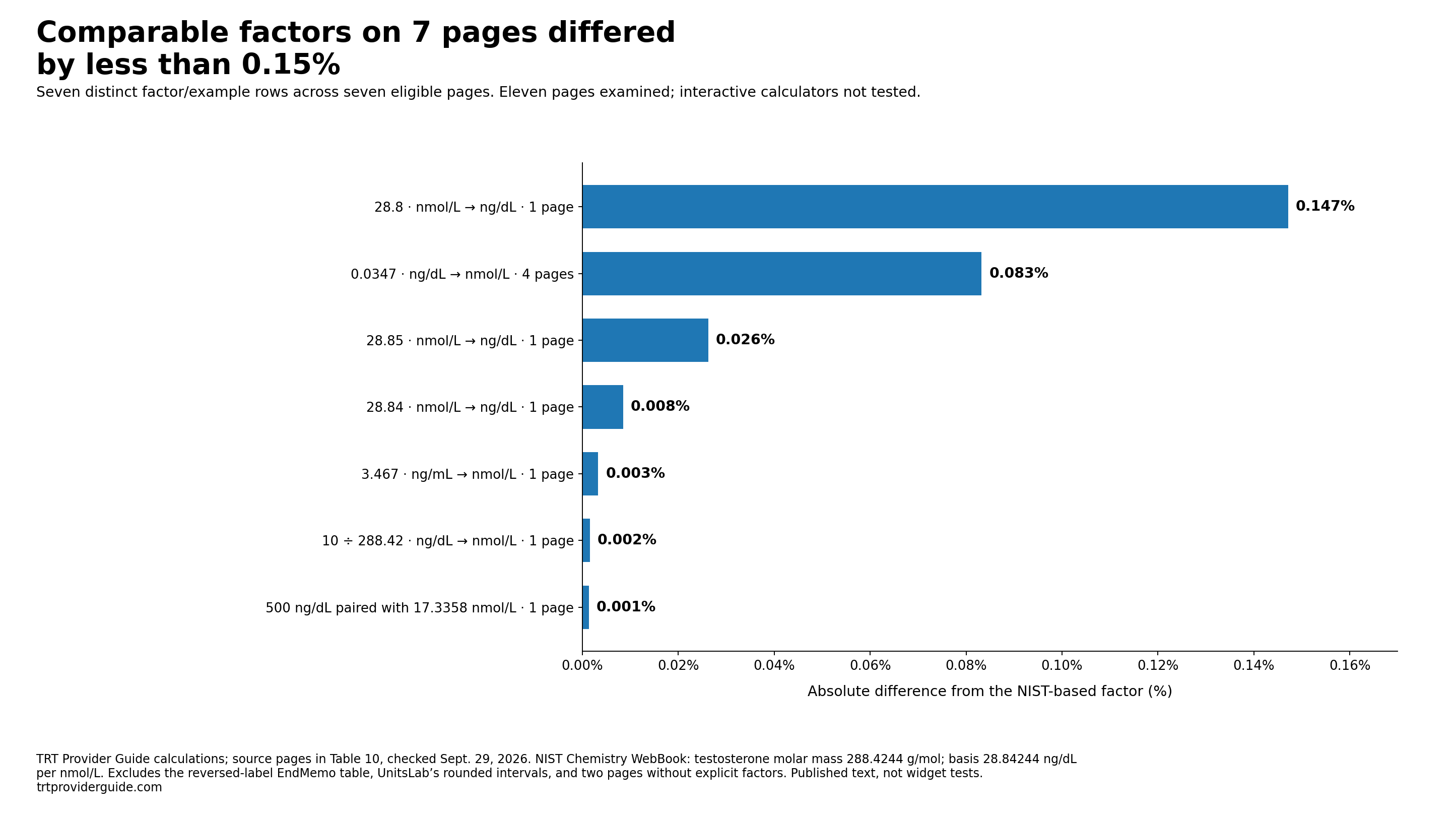
The largest normalized difference is 0.147%, for 28.8 versus 28.84244. The CDC's ±6.4% criterion measures mean assay bias, not conversion rounding or the error in one result. It is a different measure, so it is not plotted as another factor or treated as a patient-result margin (CDC).
Same 500 ng/dL, four calculation choices
Here's what that looks like with an example number—not a patient's sample.
| Factor used | 500 ng/dL becomes | Difference from NIST-based calculation |
|---|---|---|
| NIST-based (10 ÷ 288.4244) | 17.336 nmol/L | — |
| ÷ 28.85 | 17.331 nmol/L | −0.005 nmol/L |
| × 0.0347 | 17.350 nmol/L | +0.014 nmol/L |
| ÷ 28.8 | 17.361 nmol/L | +0.026 nmol/L |
Source: TRT Provider Guide calculation, September 29, 2026, using the factors in Table 8.
The whole spread is about 0.03 nmol/L. That is the largest converted value minus the smallest, using the unrounded results above. It tells you how these calculation choices differ; it does not measure lab accuracy.
One small oddity: two pages print one rounded factor going out and a different one coming back. Applying Testavan's printed factors, 500 ng/dL becomes 17.35 nmol/L, and converting back gives 499.68 ng/dL. Applying Fasto's printed factors, the round trip lands at 500.37 ng/dL. These are calculations from the text, not widget tests. It's why our converter uses one basis in every direction.
The 11 converters we checked
| Converter | Factor or example shown | Factor attribution on the examined page | Prints a band on the page? | Names a study or guideline for the band? | What we noticed |
|---|---|---|---|---|---|
| TestoChecker | 28.85 | No | No | — | A list of links to other converters, plus its own factor |
| Balance My Hormones | Paired-value example (500 ng/dL = 17.3358 nmol/L) | No | Yes: above 500 ng/dL called "optimal" | No | Free testosterone above 0.35 nmol/L also called "optimal" |
| UnitsLab | Molecular weight "288 daltons"; rounded reference intervals—not an identified factor | No | Yes: reference intervals by age and sex | No (names a test method only) | Cited in a 2026 JCEM review |
| EndMemo | “1 ng/dL = 28.818444 nmol/L” | No specific factor source | No | — | Reversed-label table excluded; HTML calculator code uses 0.0347 correctly; widget not tested |
| ScyMed MediCalc | 3.467 (ng/mL → nmol/L) | No | Yes: "0 - 10 ng/mL" | No | Normal range printed as starting at 0 |
| PeterBond.org | None shown | — | Yes: harmonized ranges by age | Yes (Travison et al., 2017) | |
| Testavan (healthcare-professional tool) | 0.0347 and 28.8 | No | Yes: treatment-consideration bands | Yes (Wang et al., 2009; Traish et al., 2011) | Largest difference among eligible factors |
| Origin TRT | None shown | No | Yes: Low 0–15, Borderline 15.1–18, Normal above 18.1 nmol/L | No | "Low" line of 15 nmol/L (433 ng/dL) |
| Eden Clinic | 0.0347 | Vague attribution (“JAMA 2001, NCBI Clinical Guidelines”); no specific document identified | Yes: 300–1,000 ng/dL; "Optimal Levels 500+ ng/dL"; low below 300 | Partly (credits AUA) | |
| ConvertMedUnits | 0.0347 and 10 ÷ 288.42 | General statement; linked methodology names AMA, Mayo and ARUP, not a specific testosterone-factor document | No | — | Selected page and linked methodology read |
| Fasto Calculator | 0.0347 and 28.84 | General statement only | Yes: adult male 300–1,000 ng/dL | No | Offers pg/mL; unit choice does not identify total versus free testosterone |
Source: each linked converter page's retrieved text, checked September 29, 2026; ConvertMedUnits' linked methodology page was also read. “No” means no specific source found in the examined page, not proof that none exists elsewhere. A named reference is not proof that every displayed band follows it. Pages change; the full record is in the downloadable dataset. No widget was interactively tested.
Which 11 pages are in this check?
This is a fixed check of the 11 conversion pages listed in Table 10, re-read on September 29, 2026. It includes a link directory, TestoChecker, alongside calculator pages. It is not a representative survey of all converters or a verified list of current Google rankings. The count describes these pages only.
The bands printed on the pages
The comparable factors were close. The labels differed.
Eden labels below 300 ng/dL as low; Origin's Low band ends at 15 nmol/L (about 433 ng/dL). The 15 nmol/L boundary is 25% above the 12 nmol/L threshold discussed in EAU 2026 guidance (15 ÷ 12 = 1.25). That is a comparison of two stated boundaries, not a claim that 12 is the highest value discussed in every guideline. BSSM 2023, for example, also discusses 8–14 nmol/L in particular clinical contexts.
Two pages use the word “optimal.” Balance My Hormones names no study or guideline for that label on the examined page. Eden names the American Urological Association, but that attribution alone does not establish that its 500+ ng/dL label is an AUA diagnostic rule.
If a converter tells you a number is "low" or "optimal," look for the document behind it. Without a source that supports that exact label, it is not a verified clinical rule.
The table that reads backwards
The table text retrieved from EndMemo's testosterone page on September 29, 2026 reads “1 ng/dL = 28.818444 nmol/L.” That reverses the relationship. The NIST-based conversion is 1 nmol/L ≈ 28.84 ng/dL, or 1 ng/dL ≈ 0.0347 nmol/L. Read with its printed labels, that table value is about 831 times too high: 28.818444 ÷ (10 ÷ 288.4244) ≈ 831. This finding concerns the retrieved table text, not a test of the interactive calculator. The same page's JavaScript contains the correctly directed 0.0347 factor for ng/dL to nmol/L. The reversed table does not show that its input calculator makes the same error.
We'll re-check these pages on a schedule. If you run one of these tools and something has changed, send it through our corrections page and we'll look again.
Why can two labs give different numbers even after converting?
A perfect conversion can't fix a lab difference. The CDC's total-testosterone certification criterion is mean bias within ±6.4% of its reference method, across 2.50–1,000 ng/dL (CDC). This is an assay-performance criterion, not a ±6.4% uncertainty interval for every patient result.
For scale only, 6.4% of 500 ng/dL is 32 ng/dL, or about 1.1 nmol/L. That multiplication does not mean a person's 500 ng/dL result is known to be within 468–532 ng/dL. The certification criterion does not supply that patient-level interval.
That's the CDC's Hormone Standardization Program, called HoSt (CDC). Certified tests are close to the reference method on average. They're not identical to each other, and not every lab test is certified.
The harmonized-range study found the same thing from another angle. Its authors wrote that a large part of the difference between study groups came from differences between lab tests (Travison et al., 2017).
Time of day matters too. For how much a level can move between morning and afternoon, see how much testosterone drops during the day. For repeat-test variation, see testosterone test accuracy.
Which unit will my lab report use?
Read the unit printed next to your number; it beats any rule of thumb. US sources such as NHANES and the American Urological Association use ng/dL, while European, UK, and Canadian guidelines publish their lines in nmol/L. Do not guess the unit from the size of the number or from the test name alone.
The same typed number can describe very different concentrations. 450 nmol/L converts to about 12,979 ng/dL, while 450 ng/dL converts to about 15.60 nmol/L. And 14 ng/dL converts to about 0.49 nmol/L, while 14 nmol/L converts to about 403.8 ng/dL. These examples show the unit difference; they do not identify which unit your lab used or classify your health.
Still, check the report. That's the whole game.
If you're still at the testing stage, see what a testosterone blood test costs, including direct-order labs and repeat tests.
What can this converter tell you, and what can't it?
It can show one result in another unit, with the math. It can't tell you whether you have a health problem, turn a total result into a free one, or erase a difference between labs.
What it does
- Converts total, free, or bioavailable testosterone between ng/dL, nmol/L, ng/mL, µg/L, pg/mL, pmol/L, and ng/L.
- Shows its math, using one published molar mass in every direction.
- Shows where commonly quoted published lines fall in the same unit.
What it doesn't do
- Diagnose anything. A testosterone result alone can't diagnose a health condition (MedlinePlus).
- Estimate free testosterone from total. That takes total testosterone, SHBG, and albumin; see how free testosterone is estimated.
- Convert other hormones. Estradiol, for example, has a different molar mass, so 28.84 doesn't work for it. Pure decimal moves, like ng/mL to ng/dL, work for any substance.
- Convert medicine doses. It handles blood-test concentrations only, not milligrams, milliliters, or syringe units.
- Speak for the 11 examined pages after September 29, 2026, or certify their interactive calculators. Web pages change.
How did we build this?
We started from one number and checked it against the people who publish it.
- The basis. Testosterone's molar mass, 288.4244 g/mol, from the NIST Chemistry WebBook. SI prefixes from NIST. Both checked September 29, 2026.
- The cross-check. We compared that basis with the factors the CDC (NHANES) and Mayo Clinic Laboratories publish. Their 0.0347 is our 0.034671, rounded.
- The tables. We recalculated every conversion from the same basis, kept the calculation unrounded, and rounded only for display. The 42-pair factor table covers every direction between seven unit labels; ng/mL and µg/L share a scale, as do pg/mL and ng/L. Each matrix row supplies its numerator and denominator. The 224-row chart includes the 264 ng/dL row used in Table 2. Tables 2, 3, and 5 use the same displayed values as the download.
- The converter check. We re-read the fixed list of 11 pages described above on September 29, 2026. We recorded the text of stated factors or paired-value examples, source attributions, listed units, test-type labels, printed bands, and named references. ConvertMedUnits' linked methodology was read too. A factor was eligible only when it appeared in the visible page text with its direction correctly labeled, or an explicit paired-value example supported a comparison. Rounded reference-interval endpoints and a whole-number molecular weight were not used to infer a hidden factor. EndMemo's reversed-label table was recorded separately. Its HTML was also inspected: the conversion functions contain the correctly directed 0.0347 factor, but hidden source-code constants are not part of this visible-text comparison. No calculator widget was interactively tested.
- The math behind each finding. For a factor first expressed as ng/dL per nmol/L, percentage difference = |factor − 28.84244| ÷ 28.84244 × 100. The largest eligible difference is 0.147%, for 28.8. The 25% comparison is (15 − 12) ÷ 12 × 100. EndMemo's printed-value comparison is 28.818444 ÷ (10 ÷ 288.4244) ≈ 831. The downloadable audit records these expressions and denominators. Counts come from the row flags: 7 factor-eligible pages, 8 pages with bands, 3 with at least one named band reference, and therefore 5 without one on the examined page.
- The reference lines. We checked the primary documents linked in Table 6 on September 29, 2026, rather than treating our earlier guideline dataset as the source. Each row keeps its source year, population, purpose, and < sign where one applies. The 2017 harmonized interval uses 1,185 healthy, nonobese younger men; the 2011 FDA interval describes a 24-hour average. These are not new 2026 patient data.
We didn't collect blood, run lab tests, or survey anyone. Every number here is a published figure or arithmetic you can repeat. The arithmetic checks cover the reference files. They are not lab tests or clinical validation. Our wider approach is in our research and data methodology.
How do I cite this page?
Page: TRT Provider Guide. "Testosterone Unit Converter: 1 nmol/L ≈ 28.84 ng/dL." TRT Provider Guide Research. Updated September 2026. https://trtproviderguide.com/research/testosterone-unit-converter/
Converter check: TRT Provider Guide. Testosterone Converter Check, 2026 (11 conversion pages; published-text check, September 29, 2026). https://trtproviderguide.com/research/testosterone-unit-converter/
One-line version: "TRT Provider Guide's September 29, 2026 check found that comparable factors or examples on 7 of 11 conversion pages were within 0.15% of its NIST-based value; a reversed-label table on another page was excluded, and interactive calculators were not tested."
You're welcome to reuse our original text, calculated tables, chart designs, and converter-check findings with credit to TRT Provider Guide. Underlying figures, quotations, and other third-party material keep their source attribution and terms; this note grants no rights to material we do not own or control.
Where can I download the data?
The reference data, free and ungated:
- testosterone-converter-check-2026-09-29.csv: the 11 examined pages, their observations, source URLs, eligibility flags, and check date.
- testosterone-conversion-factor-matrix.csv: 42 directed conversions between 7 unit labels, including exact ratios relative to the stated basis.
- testosterone-unit-conversion-chart.csv: 224 conversion rows, including every displayed row in Tables 2, 3, and 5.
- testosterone-conversion-factor-sources.csv: 7 source entries across 6 distinct source pages; entries include the molecular-weight basis, published factors, a rounded interval, and SI prefixes.
- testosterone-reference-lines.csv: 9 published reference boundaries, with source years, populations, qualifiers, and both units.
- testosterone-converter-factor-comparison.csv: the 7 distinct factor/example rows in Table 8, their source pages, and normalization math.
- testosterone-calculation-audit.csv: 22 supporting calculations, including the unit mistakes, 500 ng/dL comparisons, and published-factor round trips.
- testosterone-converter-test-cases.csv: all 29 numeric and interface specifications, with arithmetic checks kept separate from unperformed browser tests.
Frequently asked questions about testosterone units
What is 400 ng/dL testosterone in nmol/L?
400 ng/dL is about 13.87 nmol/L. Calculate 400 × 10 ÷ 288.4244, then round. Using the coarser factor 0.0347 instead gives 13.88 nmol/L. That's a unit change, not a diagnosis (NIST).
What is a normal testosterone level in nmol/L?
A widely cited harmonized range for healthy, nonobese men aged 19 to 39 is about 9.15 to 31.76 nmol/L, which is 264 to 916 ng/dL in the 2017 reference study. Labs set their own ranges, so use the one printed on your report. Guidelines also draw their own lines; see our guideline comparison.
What is 500 ng/dL in nmol/L?
500 ng/dL is about 17.34 nmol/L. Some converters show 17.35 because they round the factor to 0.0347. The difference between those two unrounded calculations is about 0.014 nmol/L (NIST; Mayo).
Is 400 ng/dL low testosterone?
400 ng/dL is about 13.9 nmol/L. That's above AUA's 300 ng/dL line, above the 12 nmol/L threshold discussed in EAU guidance, and inside the 264–916 ng/dL reference interval for healthy, nonobese men aged 19–39. But one number can't diagnose anything. Guidelines look at symptoms and repeat early-morning tests, so a clinician should read it with the rest of the picture.
What are the units for testosterone?
Total testosterone can be reported in ng/dL, nmol/L, or ng/mL. Free-testosterone examples include ng/dL and pmol/L in Mayo's table, and pg/mL in Labcorp's direct test. The unit alone doesn't tell you whether a result is total or free, so check the test name on the report.
How do I convert nmol/L to ng/dL?
Multiply by about 28.84. So 10 nmol/L is about 288 ng/dL, 15 nmol/L is about 433 ng/dL, and 20 nmol/L is about 577 ng/dL (NIST).
What is 12 nmol/L in ng/dL?
12 nmol/L is about 346 ng/dL (346.10928 on the NIST calculation basis before display rounding). The ICSM 2024 recommendations, published in 2025, state 12 nmol/L or 350 ng/dL; those are not exact equivalents. The formula gives about 346, while the paper's stated 350 is preserved as published.
Is 100 pg/mL the same as 100 ng/dL?
No. 100 pg/mL equals 10 ng/dL. Going the other way, 100 ng/dL equals 1,000 pg/mL (NIST SI prefixes).
How do I convert free testosterone from pg/mL to pmol/L?
Multiply pg/mL by about 3.467. So 70 pg/mL is about 242.7 pmol/L, and 100 pg/mL is about 346.7 pmol/L. To get ng/dL instead, divide pg/mL by 10 (NIST; SI prefixes).
Is ng/mL the same as nmol/L?
No. 1 ng/mL is about 3.467 nmol/L, and it also equals 100 ng/dL (NIST; SI prefixes). So 5 ng/mL is 17.34 nmol/L, or 500 ng/dL.
Can I use 28.84 for other hormones?
No, not for switching between nmol/L and ng/dL. Each hormone has its own molar mass, so each has its own factor. Pure decimal moves, like ng/mL to ng/dL, are the same for every substance.
Can this convert testosterone mg to mL or syringe units?
No. This converter handles blood-test concentrations only. Medicine doses and injection volumes are a different kind of math and should come from the prescription and the pharmacy label.
Where does 0.0347 come from?
It's testosterone's molar mass turned into a factor: 10 ÷ 288.4244 ≈ 0.034671, rounded to 0.0347. The CDC's NHANES survey and Mayo Clinic Laboratories both publish 0.0347.
Sources
-
NIST Chemistry WebBook. Testosterone (CAS 58-22-0). https://webbook.nist.gov/cgi/cbook.cgi?ID=C58220. Checked September 29, 2026.
-
NIST. Metric (SI) Prefixes. Updated August 13, 2025. https://www.nist.gov/pml/owm/metric-si-prefixes. Checked September 29, 2026.
-
CDC, National Center for Health Statistics. NHANES August 2021–August 2023: Sex Steroid Hormone Panel – Serum (TST_L), Data Documentation. https://wwwn.cdc.gov/Nchs/Data/Nhanes/Public/2021/DataFiles/TST_L.htm. Checked September 29, 2026.
-
CDC, National Center for Health Statistics. NHANES 2019–March 2020: Sex Steroid Hormone Panel – Serum (TST_K_R), Data Documentation. https://wwwn.cdc.gov/Nchs/Data/Nhanes/Public/2019/DataFiles/TST_K_R.htm. Checked September 29, 2026.
-
CDC. NHANES Laboratory Procedure Manual: Total Testosterone (2013–2014). https://wwwn.cdc.gov/nchs/data/nhanes/public/2013/labmethods/TST_H_MET_Total%20Testosterone.pdf. Checked September 29, 2026.
-
Mayo Clinic Laboratories. International System of Units (SI) Conversion. https://www.mayocliniclabs.com/order-tests/si-unit-conversion.html. Checked September 29, 2026.
-
CDC Clinical Standardization Programs. Improving Performance: Hormone Standardization Program (HoSt). https://www.cdc.gov/clinical-standardization-programs/php/hormones/improving-performance-host.html. Checked September 29, 2026.
-
CDC Clinical Standardization Programs. Hormones: Certified Assays and Participants. https://www.cdc.gov/clinical-standardization-programs/php/hormones/list-of-hormone-certified-assays.html. Checked September 29, 2026.
-
MedlinePlus, National Library of Medicine. Testosterone Levels Test. https://medlineplus.gov/lab-tests/testosterone-levels-test/. Checked September 29, 2026.
-
Travison TG, Vesper HW, Orwoll E, et al. Harmonized Reference Ranges for Circulating Testosterone Levels in Men of Four Cohort Studies in the United States and Europe. Journal of Clinical Endocrinology & Metabolism. 2017;102(4):1161–1173. https://pmc.ncbi.nlm.nih.gov/articles/PMC5460736/. Checked September 29, 2026.
-
U.S. Food and Drug Administration. Statistical Review, NDA 22-309 (AndroGel). 2011. https://www.accessdata.fda.gov/drugsatfda_docs/nda/2011/022309Orig1s000StatR.pdf. Checked September 29, 2026.
-
European Association of Urology. Prostate Cancer guideline, Treatment, section 6.5.1.a, Castration level. 2026 edition. https://uroweb.org/guidelines/prostate-cancer/chapter/treatment. Checked September 29, 2026.
-
Konnyu K, Imamura M, Hudson J, et al. The effectiveness of hormonal treatment to improve reproductive outcomes in normogonadotropic men with abnormal semen parameters: results of 2 linked systematic reviews. Journal of Clinical Endocrinology & Metabolism. 2026;111(9):e2193–e2211. Published online April 24, 2026. https://pmc.ncbi.nlm.nih.gov/articles/PMC13467022/. Checked September 29, 2026.
-
Transfeminine Science. Miscellaneous (resource list). https://transfemscience.org/misc/. Checked September 29, 2026.
-
TRT Provider Guide. TRT Guidelines Data: 10 Current Guidance Sets Compared (2026). https://trtproviderguide.com/research/trt-guidelines/. Related comparison, live page checked September 29, 2026; primary sources for the numerical claims on this page are listed separately below.
-
Converter pages checked September 29, 2026: TestoChecker; Balance My Hormones; UnitsLab; EndMemo; ScyMed MediCalc; PeterBond.org; Testavan; Origin TRT; Eden Clinic; ConvertMedUnits; Fasto Calculator.
-
American Urological Association. Evaluation and Management of Testosterone Deficiency. Published 2018; reviewed and validity confirmed 2024. Guideline statements 1–3. https://www.auanet.org/guidelines-and-quality/guidelines/testosterone-deficiency-guideline; full guideline https://www.auanet.org/documents/Guidelines/PDF/Testosterone%20Website%20Final%280%29.pdf. Checked September 29, 2026.
-
Grober ED, Krakowsky Y, Khera M, et al. Canadian Urological Association guideline on testosterone deficiency in men: Evidence-based Q&A. 2021. https://pmc.ncbi.nlm.nih.gov/articles/PMC8095276/. Checked September 29, 2026.
-
European Academy of Andrology. Guidelines on investigation, treatment and monitoring of functional hypogonadism in males. 2020. https://onlinelibrary.wiley.com/doi/10.1111/andr.12770. Checked September 29, 2026.
-
Society for Endocrinology and Association of Clinical Biochemistry and Laboratory Medicine. Standardising the biochemical confirmation of adult male hypogonadism: joint position statement. Published June 30, 2023. https://journals.sagepub.com/doi/10.1177/00045632231179022. Checked September 29, 2026.
-
European Association of Urology. Sexual and Reproductive Health guideline: Male Hypogonadism. 2026 edition. https://uroweb.org/guidelines/sexual-and-reproductive-health/chapter/male-hypogonadism. Checked September 29, 2026.
-
British Society for Sexual Medicine. Guidelines on male adult testosterone deficiency, with statements for practice. 2023. https://pmc.ncbi.nlm.nih.gov/articles/PMC10307648/. Checked September 29, 2026.
-
International Consultation on Sexual Medicine. Male hypogonadism recommendations from ICSM 2024, published in Sexual Medicine Reviews in 2025; Box 2, recommendation 2. https://academic.oup.com/smr/article/13/4/548/8242145. Checked September 29, 2026.
-
Labcorp. Testosterone, Free, Direct, test 144980. https://www.labcorp.com/tests/144980/testosterone-free-direct. Checked September 29, 2026.
-
ConvertMedUnits. Methodology & Editorial Standards. https://convertmedunits.com/methodology/. Checked September 29, 2026; general source references are not treated as a specific citation for every calculator factor.
This page is an educational research resource published by TRT Provider Guide, an independent research and reference resource on testosterone replacement therapy. It is not medical advice, and it does not diagnose any condition or recommend any treatment.