TRT Laws by State (2026): Rules for All 50 States and D.C.
The finding: The September 2, 2026 review classified 51 jurisdictions: eight in Class A, 34 in Class B, four in Class C, one in Class D and four in Class E. These are historical research classifications, not current legal clearance for a patient or clinic. Class C covers an in-person step or a qualifying relationship or assisted encounter under the cited rule. Connecticut's Class D row concerns routine telehealth prescribing outside its specified exceptions. Class E covers temporary policies or unresolved legal text; Missouri's row is expressly unsettled. The federal temporary no-prior-in-person-evaluation authority runs through December 31, 2026 and matters in every state. Targeted corrections were checked October 3, 2026; the full state-source review remains dated September 2.
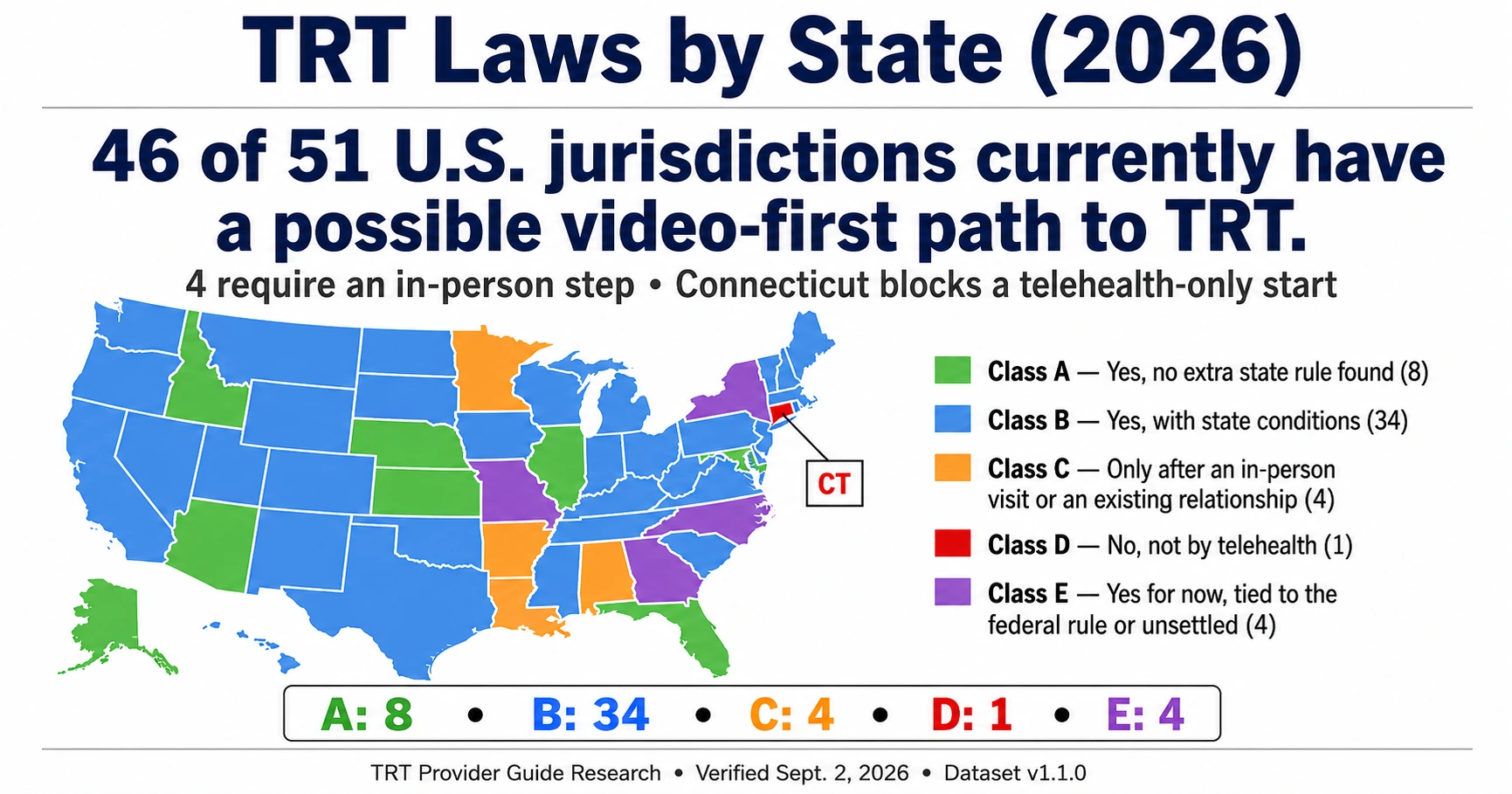
Source: TRT Provider Guide Research, TRT Laws by State (2026). The September 2, 2026 full review remains the baseline; version 1.1.1 contains targeted Connecticut and New York wording/source corrections checked October 3, not a full 51-row re-verification.
Last updated: October 12, 2026 · Last verified: October 12, 2026 · Selected factual corrections verified October 12, 2026 · Dataset version: 1.1.0 · Editorial research by TRT Provider Guide (not clinically reviewed)
Testosterone has been a federal Schedule III controlled substance since February 27, 1991. That federal classification applies nationwide; state classifications can differ. New York lists testosterone in state Schedule II. The federal telemedicine rule that lets a DEA-registered clinician prescribe it after a live video visit, with no prior in-person visit, "expires at the end of December 31, 2026," in the words of the Federal Register. And the permanent rule meant to replace it reached the White House for review on August 25, 2026 — 18 years after Congress first asked for it.
This page is the 51-row table behind those numbers, with the statute or board rule linked for every state, plus the federal rules that apply everywhere and what happens on January 1, 2027.
TRT Provider Guide Research is an independent research and reference library. We are not a clinic, pharmacy, lab, insurer or medical practice, and this page recommends none. It is educational, not legal or medical advice.
What we found, by the numbers
| What we measured | Result | Source and date |
|---|---|---|
| Jurisdictions reviewed (50 states + D.C.) | 51 | This review, Sept. 1–2, 2026 |
| States that ban prescription testosterone for adults | 0 | This review |
| Rows classified as requiring an in-person step or a qualifying relationship or assisted encounter (Class C, September 2 review) | 4 — AL, AR, LA, MN | State rules linked in the table below |
| States that bar telehealth prescribing of Schedule III drugs, including testosterone (Class D) | 1 — CT | Conn. Gen. Stat. §19a-906(c) |
| States whose answer is tied to the temporary federal rule or is unsettled (Class E) | 4 — GA, MO, NY, NC | State sources linked below |
| States where a video visit can be enough under state law (Classes A + B) | 42 (8 with no extra state rule; 34 with added conditions) | State sources linked below |
| Official source links in the dataset | 76 | Dataset v1.1.0 |
| Federal telehealth waiver for controlled substances expires | Dec. 31, 2026 | Federal Register, Dec. 31, 2025 (2025-24123) |
| Permanent federal rule (RIN 1117-AB40) received for White House review | Aug. 25, 2026 | reginfo.gov EO 12866 review record |
| Testosterone a federal Schedule III drug since | Feb. 27, 1991 | Federal Register, Dec. 4, 2009 (DEA) |
| Federal refill limit on a Schedule III prescription | 5 refills within 6 months | 21 CFR §1306.22 |
| States + D.C. where nurse practitioners can prescribe without a physician agreement | 27 + D.C. | AANP State Practice Environment map, May 2026 |
| States + D.C. with a mandatory prescription-database check law on the books | 48 + D.C. (not HI, SD) | PDMP TTAC listing, Oct. 29, 2025 |
Source: TRT Provider Guide Research, "TRT Laws by State (2026)," dataset v1.1.0, verified Sept. 2, 2026. Each row's primary source is linked in the state table below.
Scope, in one line: this page covers medically indicated testosterone treatment for adults, with a focus on a first prescription by telehealth. It does not cover bodybuilding use, minors, importation, compounding rules, pharmacy shipping, insurance, or every profession-specific rule.
What does this data show — and what doesn't it show?
Answer capsule: The table shows, for each state, whether a licensed clinician can start a new patient on testosterone through a telehealth visit without a prior in-person visit, and which state rule controls that answer. It does not say whether a person has low testosterone, whether treatment is right for them, whether a specific clinic follows the law, or whether a pharmacy may ship a specific product.
Two things trip people up here, so we will say them plainly.
First, "legal" and "available online" are different questions. Testosterone is legal to prescribe in every state. Whether a clinician can start it by video, with no in-person visit, is a separate question that state law answers differently.
Second, "allowed" never means "automatic." Even in a Class A state, the clinician still needs a legitimate medical purpose, enough information to meet the standard of care, the right state and federal authority, proper records, and a lawful pharmacy. A questionnaire-only website is not a medical visit in any state we reviewed.
How did we build this table?
Answer capsule: We asked one question in every jurisdiction: under the state's own law or medical-board rule, can a licensed clinician start a prescription for testosterone — a non-narcotic Schedule III controlled substance — by telehealth for an adult the clinician has never examined in person? We answered it from the statute or board rule itself, dated every read, and sorted the answers into five classes.
Here is exactly what we did, so anyone can repeat it.
Sources. For every state and D.C. we read at least one official source: a codified statute, an administrative rule, a licensing-board rule or policy, board meeting minutes, or a current agency page. Where the first source did not settle a key point, we added a second official source. The dataset holds 76 unique official links. We used the Center for Connected Health Policy's state entries as a map to the right statute, not as the source itself.
Dates. The state reads were done September 1–2, 2026. The federal reads were done September 1, 2026. Every row carries its verification date.
Classes. The letters describe the initial telehealth barrier only. They say nothing about the quality of care or whether a person qualifies for treatment.
| Class | What it means in plain words | Count |
|---|---|---|
| A | Yes — we found no state rule stricter than the federal baseline | 8 |
| B | Yes — a video visit can be enough, but the state adds conditions (a real evaluation, identity checks, a state database query, registration, e-prescribing, or limits on other drug classes) | 34 |
| C | An in-person step or a qualifying relationship or assisted encounter under the cited rule | 4 |
| D | No — routine new-patient Schedule III prescribing by telehealth is barred outside narrow exceptions | 1 |
| E | Conditional or unresolved — temporary policies, a new law, or conflicting legal text require attention | 4 |
Source: TRT Provider Guide Research, dataset v1.1.0, Sept. 2, 2026.
Coding rules.
- We treated testosterone as a Schedule III controlled substance under federal law (21 U.S.C. §812, Schedule III(e); 21 CFR §1308.13).
- We focused on ordinary adult medical treatment, not performance use and not laws about minors.
- For a restriction defined by a state's drug schedule, check testosterone's classification in that state rather than assume the federal Schedule III classification controls. New York lists testosterone in state Schedule II. Restrictions limited to opioids or narcotics do not apply to testosterone merely because it is a controlled substance; indication-specific rules must be assessed in their stated scope.
- Class C grouped rows with an in-person requirement or a specified relationship or assisted-encounter pathway. The exact exception and covered professional license type must be read in each cited rule; these pathways are not all equivalent to a prior examination by the prescribing clinician.
- A state entered Class D only when its text generally barred Schedule III telehealth prescribing in this scope.
- A state entered Class E when the answer depended on a temporary policy, a new change, or conflicting text.
- We did not turn silence into certainty. Medium-confidence rows say what we could not fully confirm.
Why this table exists. The Center for Connected Health Policy, the federally funded telehealth policy center, says in its Fall 2025 report that it "does not track a specific count of states" with telehealth prescribing requirements, because the rules vary so much. No agency keeps this count. We built it by reading the 51 sources ourselves.
What we cross-checked. Twenty states were read twice, by two separate research passes (September 1 and September 2, 2026). The two passes disagreed on one state — Georgia — and the disagreement was resolved by the Board's own January 8, 2026 meeting minutes, which we link in the table. That correction is noted in the update log.
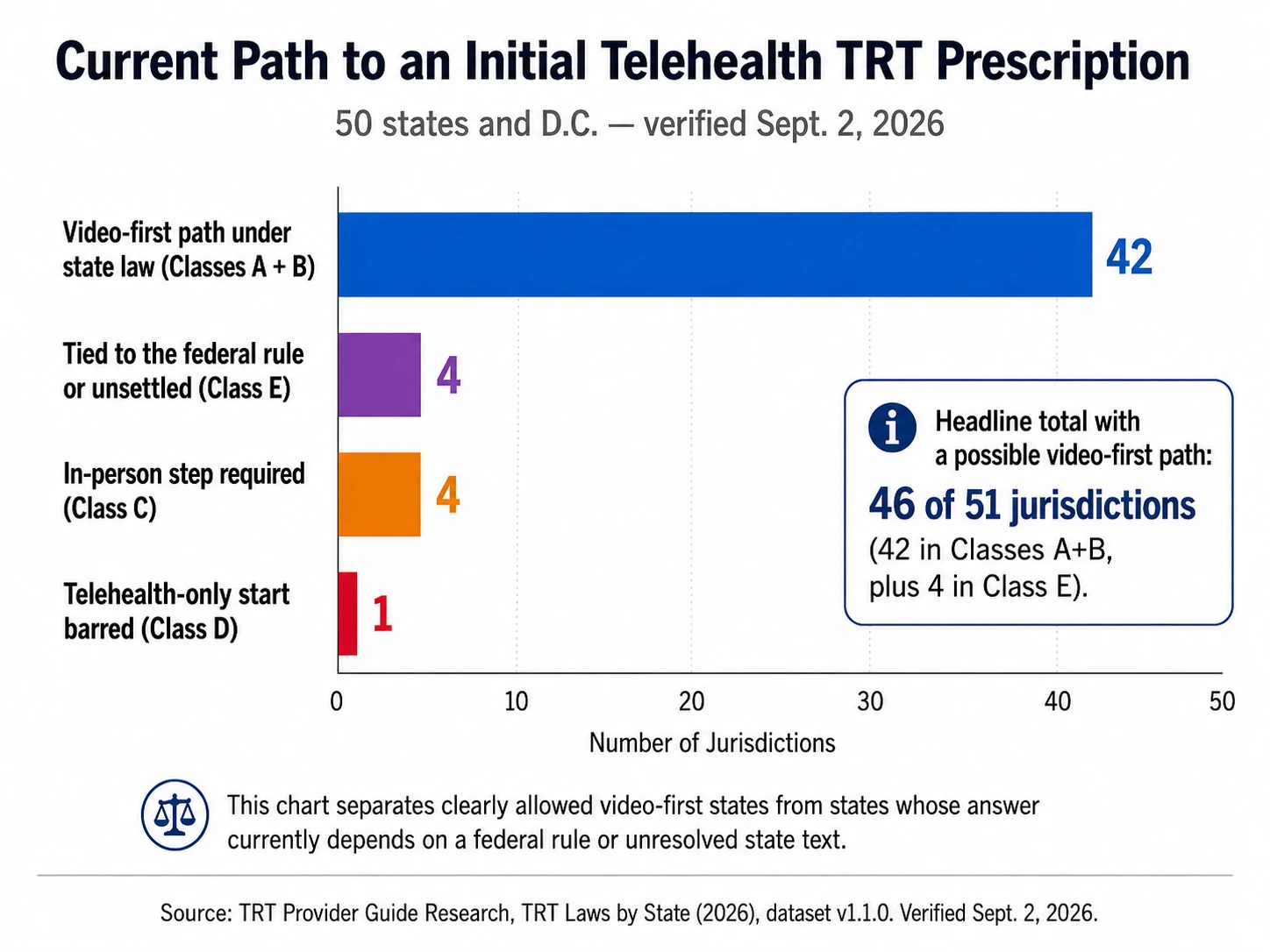
Source: TRT Provider Guide Research, TRT Laws by State (2026), dataset version 1.1.1 correction supplement. The full jurisdiction review remains dated September 2, 2026.
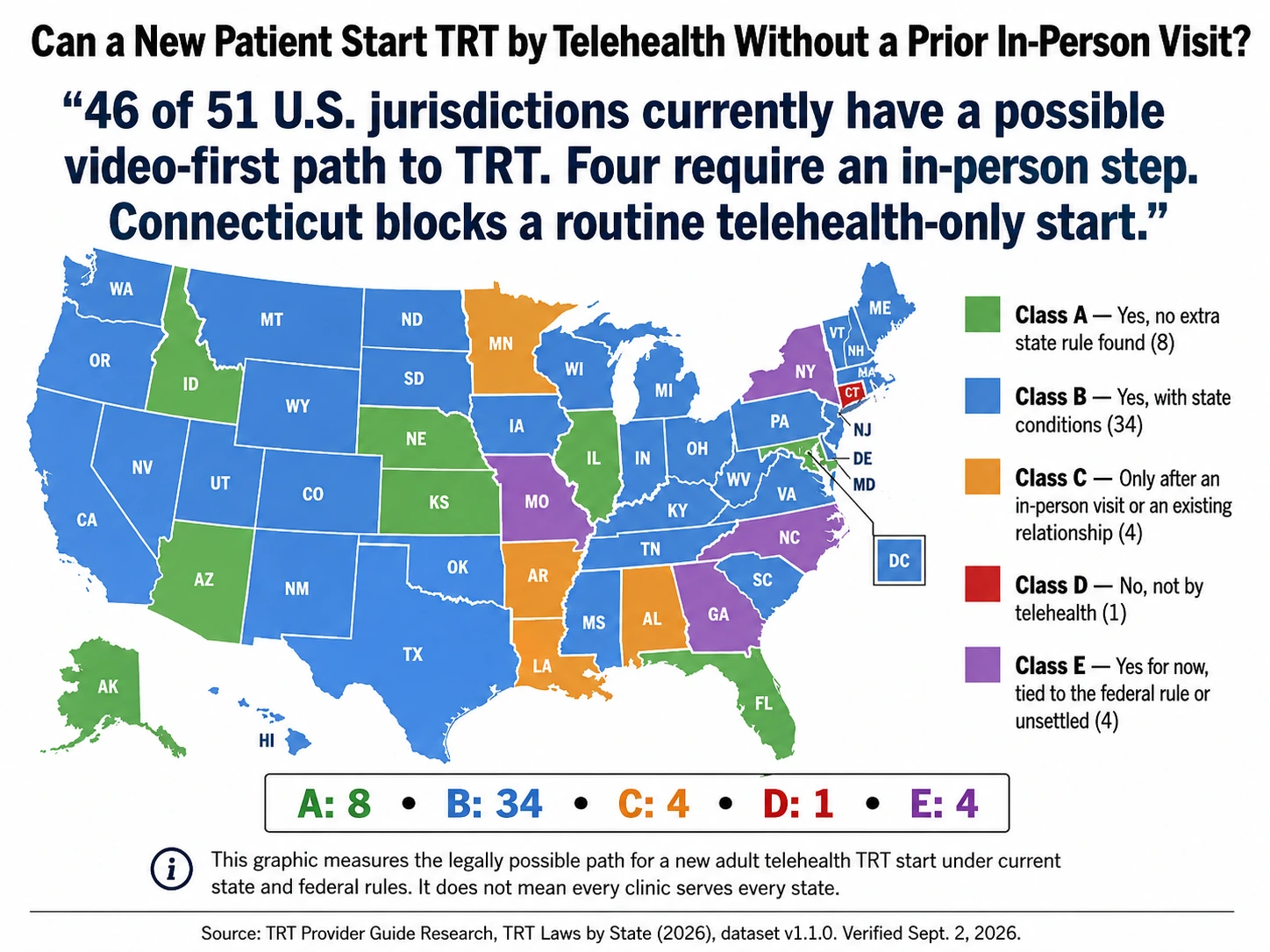
Source: TRT Provider Guide Research, TRT Laws by State (2026), dataset version 1.1.1 correction supplement. Connecticut and New York wording/source corrections checked October 3, 2026; all other row reviews remain dated September 2.
What are the TRT laws in every state?
Answer capsule: Every state and D.C. allows prescription testosterone for adults with a legitimate medical need. The rows below answer the narrower question that matters online: whether a licensed clinician can start a new patient by telehealth without an in-person visit, and which state rule decides it. Find your state, read the plain-words rule, and open the official source.
How to read the table: the wording and class codes summarize the September 2 source review. They do not establish current permission, authorize a clinic, or cover every professional license type. Read each row's rule, scope, exceptions and source date. For Schedule-based restrictions, check testosterone's state classification as well as its federal Schedule III status. Class E is conditional or unresolved and must not be read as a confirmed "Yes."
| State | Can a new patient start TRT by telehealth? | Class | The state rule in plain words | Official source | Verified |
|---|---|---|---|---|---|
| Alabama | Only after an in-person visit or an existing relationship | C | A telehealth prescription for a controlled drug needs a live audio or video visit, and the prescriber must have seen the patient in person within the past 12 months (a licensed clinician sitting with the patient can count). | Ala. Code §34-24-704(b); Alabama Board of Medical Examiners, Telemedicine · 2nd source | Sept. 2, 2026 |
| Alaska | Yes - no extra state rule found | A | Doctors, PAs and nurse practitioners may prescribe controlled drugs by telehealth if they follow state and federal law. No in-person rule. A questionnaire alone is not enough. | AS 08.02.130(e)-(f); AS 08.64.364; Alaska CBPL Telehealth Information · 2nd source | Sept. 2, 2026 |
| Arizona | Yes - no extra state rule found | A | The exam can be done by telehealth. Arizona's in-person-or-video exam rule applies to Schedule II drugs only. | A.R.S. §36-3602; §32-1401 · 2nd source | Sept. 2, 2026 |
| Arkansas | Only after an in-person visit or an existing relationship | C | A telemedicine prescriber may not write a Schedule II-V prescription unless the patient was examined in person, or a qualifying consult, referral, on-call or ongoing relationship already exists. | Arkansas State Medical Board telemedicine rule (17 CAR §140-3201, formerly Rule 38); Ark. Code §17-80-402 | Sept. 2, 2026 |
| California | Yes - with state conditions | B | An 'appropriate prior examination' is required and may be done by telehealth; the statute even allows a screening questionnaire for some drugs when the standard of care is met. For a controlled drug like testosterone, the federal live-video requirement controls. | Cal. Bus. & Prof. Code §2242; Medical Board of California, Internet Prescribing · 2nd source | Sept. 2, 2026 |
| Colorado | Yes - with state conditions | B | The relationship can be formed by telehealth. But an out-of-state 'telehealth registration' by itself does not let a clinician prescribe controlled drugs to Colorado patients. | Colorado DPO Telehealth FAQ; Colorado Medical Board Policy 40-27 | Sept. 2, 2026 |
| Connecticut | No - not by telehealth | D | Section 19a-906(c) generally bars Schedule I–III prescribing by telehealth. It permits specified Schedule II/III prescriptions used as part of medication-assisted treatment or for persons with psychiatric disabilities or substance use disorders, subject to federal requirements and electronic prescribing. The non-opioid limitation was removed effective June 30, 2025. Those exceptions do not establish a routine low-testosterone telehealth pathway. | Conn. Gen. Stat. §19a-906(c); OLR Report 2017-R-0174 · 2nd source | Sept. 2, 2026 |
| Delaware | Yes - with state conditions | B | Controlled drugs may be prescribed by telemedicine when a valid relationship exists and the same standard of care is met; a new relationship can start with an adequate live video exam. Out-of-state prescribers need a Delaware controlled-substance registration. | 24 Del. C. §1769D | Sept. 2, 2026 |
| District of Columbia | Yes - with state conditions | B | Telehealth prescribers must follow the District's PDMP law plus all District and federal controlled-substance rules. No separate in-person rule was found. | D.C. Code §3-1201.05 | Sept. 2, 2026 |
| Florida | Yes - no extra state rule found | A | Only Schedule II is barred by telehealth (with four exceptions). Schedule III-V, including testosterone, may be prescribed by telehealth since a 2022 change. Out-of-state clinicians must register with Florida. | Fla. Stat. §456.47(2)(c), (4) · 2nd source | Sept. 2, 2026 |
| Georgia | Yes for now - tied to the federal rule or unsettled | E | The Board's own rule treats prescribing controlled drugs based solely on an electronic consult as unprofessional conduct. On Jan. 8, 2026 the Board voted to extend telemedicine flexibilities to the end of 2026 in line with DEA/HHS. When the federal rule ends, the in-person rule returns. | Georgia Composite Medical Board minutes, Jan. 8, 2026; Ga. Comp. R. & Regs. 360-3-.02(6), 360-3-.07 · 2nd source | Sept. 2, 2026 |
| Hawaii | Yes - with state conditions | B | Telehealth is allowed, but Hawaii's controlled-substance law generally requires the prescriber to be physically located in Hawaii when writing a controlled-drug prescription, with statutory exceptions. | HRS §329-41; HRS §453-1.3 · 2nd source | Sept. 2, 2026 |
| Idaho | Yes - no extra state rule found | A | A provider-patient relationship can be formed through virtual care. A controlled-drug prescription is allowed when it complies with federal controlled-substance law. | Idaho Code §54-5707 | Sept. 2, 2026 |
| Illinois | Yes - no extra state rule found | A | Telehealth is held to the same standard of care as in-person care. No separate Illinois rule barring a Schedule III prescription after an adequate telehealth evaluation was found. | Illinois Telehealth Act, 225 ILCS 150 | Sept. 2, 2026 |
| Indiana | Yes - with state conditions | B | Controlled drugs may be prescribed by telehealth to a patient never seen in person if the prescriber holds an Indiana controlled-substance registration, follows federal law, uses real-time video, checks INSPECT (the state PDMP) and e-prescribes. Opioids are barred except partial agonists for opioid-use disorder. | Ind. Code §25-1-9.5-8; Indiana PLA Telehealth · 2nd source | Sept. 2, 2026 |
| Iowa | Yes - with state conditions | B | The relationship and exam can be completed by telemedicine when the technology supports an informed diagnosis. A static online questionnaire is not enough. | Iowa Admin. Code 653-13.9 | Sept. 2, 2026 |
| Kansas | Yes - no extra state rule found | A | The same prescribing laws apply to telemedicine as to in-person care, including for controlled drugs. | K.A.R. §100-77-3 | Sept. 2, 2026 |
| Kentucky | Yes - with state conditions | B | Telehealth prescribing is allowed with a valid relationship and adequate evaluation. Controlled drugs also require KASPER (the state PDMP), e-prescribing and federal compliance. | Kentucky Board of Pharmacy, Controlled Substances FAQ; KBML Telehealth · 2nd source | Sept. 2, 2026 |
| Louisiana | Only after an in-person visit or an existing relationship | C | No controlled drug by telemedicine unless the physician has had at least one in-person visit with the patient within the past year (exception for patients in a licensed, DEA-registered facility). Telemedicine also may not be used to treat obesity or chronic pain. | LAC 46:XLV.7513(C); La. R.S. 40:1223.4 · 2nd source | Sept. 2, 2026 |
| Maine | Yes - with state conditions | B | The relationship and exam can be done by telehealth when the technology is sufficient and the standard of care does not require an in-person visit. | 02-373 C.M.R. ch. 11, §3 (Board of Licensure in Medicine) | Sept. 2, 2026 |
| Maryland | Yes - no extra state rule found | A | Telehealth care and prescribing follow the same standard as in-person care. Prescribing from an online questionnaire alone is barred; only Schedule II opiates for pain are barred by telehealth. | Md. Health Occ. §1-1003; COMAR 10.32.05.06 · 2nd source | Sept. 2, 2026 |
| Massachusetts | Yes - with state conditions | B | Board policy does not require a face-to-face visit just because care is by telemedicine. The evaluation must meet the standard of care and state and federal controlled-substance rules. | Board of Registration in Medicine Policy 2020-01 | Sept. 2, 2026 |
| Michigan | Yes - with state conditions | B | A telehealth prescriber may prescribe, including controlled drugs, when authorized and with sufficient information. The required evaluation can be done in person or by telehealth. | MCL 333.16285; MCL 333.7303a | Sept. 2, 2026 |
| Minnesota | Only after an in-person visit or an existing relationship | C | A controlled-drug prescription is not valid unless based on a documented evaluation that includes an in-person exam by the prescriber, someone in the same group or clinic, or a consulting or referring clinician. The telehealth-only exception covers erectile-dysfunction drugs and opioid-use-disorder treatment, not testosterone. | Minn. Stat. §151.37, subd. 2(d)-(e) | Sept. 2, 2026 |
| Mississippi | Yes - with state conditions | B | An appropriate history and physical exam are required first, but the Board rule says the exam need not be in person if the technology gives the same information. | Miss. Admin. Code 30-2635-5.5 · 2nd source | Sept. 2, 2026 |
| Missouri | Yes for now - tied to the federal rule or unsettled | E | A law effective Aug. 28, 2026 lets a provider-patient relationship be formed by telemedicine, but a separate physician statute still says 'previously established and ongoing' for telemedicine-only prescriptions. A first-visit controlled-drug prescription is unclear until the two are reconciled. | RSMo §191.1146; RSMo §334.108 · 2nd source | Sept. 2, 2026 |
| Montana | Yes - with state conditions | B | The relationship can be formed and prescriptions written by telemedicine at the same standard of care. The rule expressly allows even Schedule II when federal and state rules are followed. | ARM 24.156.813; ARM 24.174.503 | Sept. 2, 2026 |
| Nebraska | Yes - no extra state rule found | A | The relationship can be formed by telehealth with an identity check, consent and the same standard of care. It cannot be created by questionnaire alone. | Neb. Rev. Stat. §38-1,143 | Sept. 2, 2026 |
| Nevada | Yes - with state conditions | B | The relationship can be formed by telehealth when the provider verifies identity and location, discloses credentials and obtains consent. The same prescribing rules apply. | NRS 629.515 | Sept. 2, 2026 |
| New Hampshire | Yes - with state conditions | B | Physicians and APRNs may prescribe Schedule II-IV controlled drugs by telemedicine. A follow-up evaluation is required as often as clinically appropriate and at least once a year (2025 SB 252 removed the older in-person wording). | RSA 329:1-d | Sept. 2, 2026 |
| New Jersey | Yes - with state conditions | B | The in-person examination rule applies to Schedule II only (reinstated Feb. 16, 2026 and amended July 2026). Testosterone is Schedule III, so it is not covered by that rule. | N.J.S.A. 45:1-62(e); P.L. 2017, c. 117 · 2nd source | Sept. 2, 2026 |
| New Mexico | Yes - with state conditions | B | An interactive encounter, adequate history and appropriate exam are required. Prescribing from an online questionnaire alone is unprofessional conduct. | NMAC 16.10.8 | Sept. 2, 2026 |
| New York | Yes for now - tied to the federal rule or unsettled | E | No controlled drug before an in-person evaluation, except by telemedicine when consistent with state law and current DEA rules (effective May 21, 2025). So New York's answer follows the federal rule. Prescribers must check the PMP for Schedule II-IV and e-prescribe. | 10 NYCRR §80.63(d)-(e); NYSDOH Bureau of Narcotic Enforcement · 2nd source | Sept. 2, 2026 |
| North Carolina | Yes for now - tied to the federal rule or unsettled | E | The Medical Board says the federal telemedicine flexibilities remain available through Dec. 31, 2026 (Aug. 27, 2026 Board article). A DEA-registered prescriber may use telemedicine without a prior in-person visit while the federal rule lasts; North Carolina standards still apply. | NC Medical Board, Aug. 27, 2026 article; Position Statement 5.1.4 · 2nd source | Sept. 2, 2026 |
| North Dakota | Yes - with state conditions | B | The relationship can be formed by telemedicine and prescribing is at the physician's discretion subject to federal law. The in-person limitation is aimed at opioids. | N.D. Admin. Code ch. 50-02-15 | Sept. 2, 2026 |
| Ohio | Yes - with state conditions | B | Telehealth prescribing is allowed at the same standard of care with required identity, location, consent and records steps. The initial in-person exam rule applies to Schedule II only (with exceptions). | OAC 4731-37-01; OAC 4731-11-09 · 2nd source | Sept. 2, 2026 |
| Oklahoma | Yes - with state conditions | B | The relationship can be formed by telemedicine. The special initial-relationship restriction names opioids, benzodiazepines and carisoprodol; testosterone is not on that list. | 59 O.S. §478.1 | Sept. 2, 2026 |
| Oregon | Yes - with state conditions | B | No ban on prescribing by telemedicine when the standard of care is met. The Oregon Medical Board warns that a questionnaire or weak electronic contact is not an adequate evaluation. | Oregon Medical Board, Prescribing; Telemedicine · 2nd source | Sept. 2, 2026 |
| Pennsylvania | Yes - with state conditions | B | A medical history and physical exam are required before a first controlled-drug prescription. The rule does not say the exam must be in the same room, so whether a telehealth exam is adequate depends on the facts and the standard of care. | 49 Pa. Code §16.92 | Sept. 2, 2026 |
| Rhode Island | Yes - with state conditions | B | A valid relationship, medical history and appropriate exam are required before prescribing. The exam may be electronic when it gives information equal to an in-person exam for the clinical issue. | 216-RICR-40-05-1 | Sept. 2, 2026 |
| South Carolina | Yes - with state conditions | B | Since Mar. 11, 2024 the telemedicine prescribing ban covers Schedule II-narcotic and Schedule III-narcotic drugs only; testosterone is not a narcotic. PDMP participation is required, and a relationship may not be formed by telemedicine when an in-person exam is needed for diagnosis. | S.C. Code §40-47-37(C) as amended by 2024 Act No. 120 | Sept. 2, 2026 |
| South Dakota | Yes - with state conditions | B | Controlled drugs may be prescribed by telehealth when a proper relationship exists and the practitioner follows state and federal law. | SDCL ch. 34-52 | Sept. 2, 2026 |
| Tennessee | Yes - with state conditions | B | Telehealth care and prescribing are allowed with an appropriate relationship at the same standard as in-person care. No testosterone-specific telehealth ban was found. | T.C.A. §63-1-155; Tenn. Comp. R. & Regs. 0880-02-.16 | Sept. 2, 2026 |
| Texas | Yes - with state conditions | B | A valid relationship can be formed by a telemedicine visit that meets the statutory safeguards. Prescriptions are judged by in-person standards; the only scheduled-drug limit is treatment of chronic pain. | Tex. Occ. Code §§111.005-111.006; 22 TAC §174.5 · 2nd source | Sept. 2, 2026 |
| Utah | Yes - with state conditions | B | The relationship can be formed during the telehealth visit. A diagnosis and contraindications must be documented before prescribing, and prescribing from a questionnaire alone is barred. (Utah separately bars Schedule II/III drugs for weight loss.) | Utah Code §26B-4-704; Utah Admin. Code R156-37-604 · 2nd source | Sept. 2, 2026 |
| Vermont | Yes - with state conditions | B | Telemedicine is practiced under the same standard as in-person care. No Vermont rule requiring a prior in-person visit for a Schedule III drug was found in the official sources reviewed. | Vermont Board of Medical Practice statutes and rules; 8 V.S.A. §4100k · 2nd source | Sept. 2, 2026 |
| Virginia | Yes - with state conditions | B | The relationship can be formed by real-time video (or store-and-forward) if listed conditions are met. For Schedule II-V by telemedicine, the prescriber must follow federal telemedicine rules and keep a physical practice location in Virginia or be able to refer the patient to a Virginia clinician for an in-person exam. | Va. Code §54.1-3303; §54.1-3408.01 · 2nd source | Sept. 2, 2026 |
| Washington | Yes - with state conditions | B | Telemedicine and in-person care carry the same standard. The Medical Commission points prescribers to federal controlled-substance rules; state e-prescribing and licensing rules also apply. | Washington Medical Commission FAQ; WA DOH Telehealth · 2nd source | Sept. 2, 2026 |
| West Virginia | Yes - with state conditions | B | The relationship can be formed by real-time telemedicine at the same standard of care. The telemedicine controlled-drug ban targets Schedule II drugs and pain-relieving drugs for chronic non-malignant pain, not testosterone. | W. Va. Code §30-3-13a | Sept. 2, 2026 |
| Wisconsin | Yes - with state conditions | B | The relationship can be formed by telemedicine when the physician meets the same standard of care as in person. Prescribing needs an adequate history and evaluation. | Wis. Admin. Code ch. Med 24 | Sept. 2, 2026 |
| Wyoming | Yes - with state conditions | B | Telemedicine is treated as the practice of medicine with the same standard of care, documentation and prescribing judgment as in person. No Wyoming rule requiring a prior in-person visit for a Schedule III drug was found. | Wyoming Board of Medicine rules · 2nd source | Sept. 2, 2026 |
Source: TRT Provider Guide Research, "TRT Laws by State (2026)," dataset v1.1.0, verified Sept. 2, 2026. State reads: Sept. 1–2, 2026. Each rule links to the official statute, rule, or board document it comes from.
Dataset downloads: Historical CSV, version 1.1.0 preserves the original September 2, 2026 snapshot. The separate targeted-correction CSV, version 1.1.1 and version 1.1.1 metadata correct Connecticut and New York wording/source details only. The other 49 rows were not reverified, and the class counts did not change. Each CSV carries the jurisdiction rows, source citations, confidence level, and the two overlay columns covered below (nurse-practitioner practice environment and prescription-database mandate).
How to cite this page: TRT Provider Guide Research. "TRT Laws by State (2026): Rules for All 50 States and D.C." Dataset v1.1.0. Last verified September 2, 2026. https://trtproviderguide.com/research/trt-laws-by-state/
Which states have the clearest barriers or date traps?
Answer capsule: The September 2 review placed Alabama, Arkansas, Louisiana and Minnesota in Class C and Connecticut in Class D. Their exact requirements, exceptions and professional-license scope matter. Georgia, Missouri, New York and North Carolina were grouped in Class E for different reasons: temporary policies or unresolved legal text. That category does not establish that all four permit a new-patient video start or share the same December 31 outcome.
Here is each one in plain words, with the date it will need rechecking.
| State | Class | What the rule says, in plain words | What to watch |
|---|---|---|---|
| Alabama | C | Telehealth prescriptions for controlled drugs need a live audio or video visit and an in-person encounter with the prescriber in the past 12 months. A licensed clinician physically with the patient during the video visit can satisfy the in-person part. (Ala. Code §34-24-704) | Any amendment to §34-24-704 |
| Arkansas | C | A telemedicine prescriber may not write Schedule II–V prescriptions unless the patient was seen in person, or a consult, referral, on-call or ongoing relationship already exists. (Arkansas State Medical Board telemedicine rule) | Board rule changes |
| Louisiana | C | No controlled drug by telemedicine unless the physician has had "at least one in-person visit with the patient within the past year," with an exception for patients being treated in a licensed, DEA-registered facility. Telemedicine also may not be used to treat obesity or chronic pain. (LAC 46:XLV.7513) | Board rule changes |
| Minnesota | C | A controlled-drug prescription is not valid unless it rests on a documented evaluation that includes an in-person exam by the prescriber, a clinician in the same group or clinic, a consulting clinician, or a referring clinician. The telehealth-only exception covers erectile-dysfunction drugs and opioid-use-disorder treatment — not testosterone. (Minn. Stat. §151.37, subd. 2) | Legislative changes to §151.37 |
| Connecticut | D | Section 19a-906(c) generally bars Schedule I–III prescribing by telehealth. It permits specified Schedule II/III prescriptions used as part of medication-assisted treatment or for the treatment of persons with psychiatric disabilities or substance use disorders, subject to federal requirements and electronic prescribing. These exceptions do not establish a routine low-testosterone telehealth pathway. (Conn. Gen. Stat. §19a-906(c)) | Any amendment to §19a-906(c). PA 25-168 §116 removed the non-opioid limitation effective June 30, 2025. (PA 25-168 §116) |
| Georgia | E | The Board's rule treats prescribing a controlled drug based solely on an electronic consult as unprofessional conduct. But on January 8, 2026 the Board voted to "extend telemedicine flexibilities until the end of 2026" in line with DEA and HHS. When the federal rule ends, Georgia's in-person expectation returns unless the Board acts again. (Board minutes, Jan. 8, 2026; Rule 360-3-.02) | Dec. 31, 2026, and every Board meeting after the federal final rule publishes |
| Missouri | E | A law effective August 28, 2026 lets a provider-patient relationship be formed by telemedicine. A separate physician statute still says "previously established and ongoing" for telemedicine-only prescriptions. Until the two are reconciled by authoritative guidance, a first-visit controlled-drug prescription is unclear. (RSMo §191.1146; §334.108) | Board guidance or a legislative fix |
| New York | E | No controlled drug before an in-person evaluation — except by telemedicine when consistent with state law and current DEA rules (effective May 21, 2025). New York's answer therefore follows the federal rule. Prescribers must check the state PMP for Schedule II, III and IV drugs and must e-prescribe. (10 NYCRR §80.63) | Dec. 31, 2026 — recheck the federal prescribing pathway. Section 80.63(e)(4) has no stated December 31 sunset; prescribing must remain consistent with applicable state and DEA rules. (10 NYCRR §80.63(e)(4)) |
| North Carolina | E | The Medical Board wrote on August 27, 2026 that the federal flexibilities remain available through December 31, 2026. A DEA-registered prescriber may use telemedicine without a prior in-person visit while the federal rule lasts; the Board's telemedicine position statement still applies. | Dec. 31, 2026 |
Source: TRT Provider Guide Research, dataset v1.1.0, Sept. 2, 2026; statutes and board documents as cited.
One row deserves a warning label of its own. South Carolina's telemedicine statute is often summarized as a ban on Schedule II and III drugs. Since March 11, 2024 the text says Schedule II-narcotic and Schedule III-narcotic. Testosterone is Schedule III but is not a narcotic, so that clause does not bar telehealth TRT in South Carolina. Older summaries still in circulation describe the pre-2024 rule.
Is TRT legal in all 50 states?
Answer capsule: Prescription testosterone can be lawful for adult medical treatment, but both federal and state requirements apply. Testosterone is federally Schedule III; states can classify it differently. New York, for example, lists testosterone in state Schedule II. A valid prescription or other lawful authority matters for possession, and the rules for starting treatment by telehealth vary by jurisdiction.
A "controlled substance" is a drug the federal government puts on one of five lists, called schedules, based on its medical use and its potential for misuse. Schedule III is the middle list. Testosterone sits there alongside ketamine and codeine-with-acetaminophen. Congress put it there with the Anabolic Steroids Control Act of 1990, signed November 29, 1990 and effective February 27, 1991. Two later laws widened the definition of "anabolic steroid" — in 2004 and again in 2014 — but testosterone's place on the list has not moved in 35 years.
Because the schedule is federal, no state can make testosterone legal without a prescription, and no state has made it illegal with one. Every rule in the state table sits on top of this federal floor.
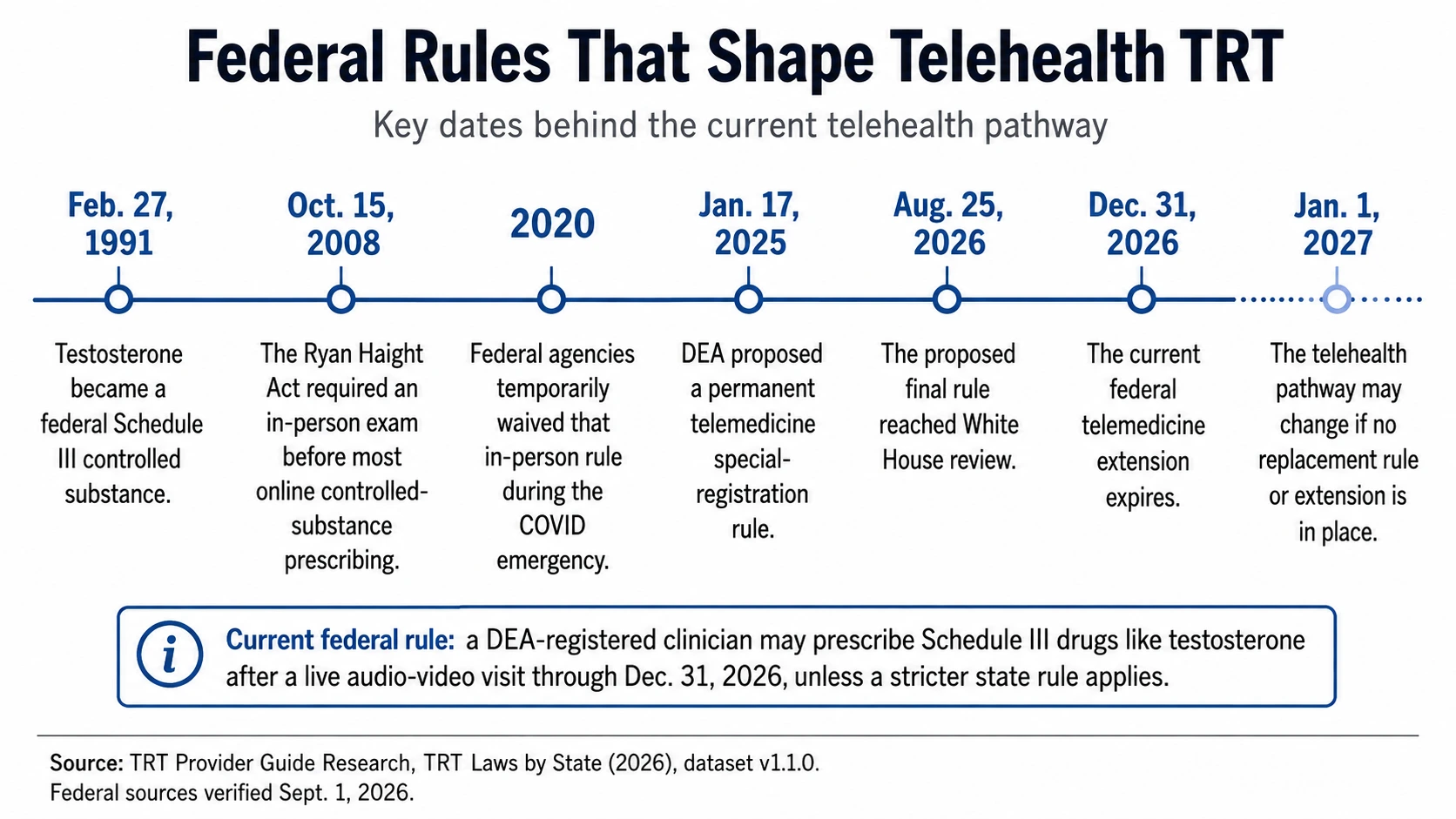
Source: TRT Provider Guide Research, TRT Laws by State (2026), dataset v1.1.0. Federal sources verified September 1, 2026.
The federal rules that apply in every state
| What the rule does | The rule | Date | Official source |
|---|---|---|---|
| Makes testosterone a Schedule III controlled substance nationwide | Anabolic Steroids Control Act of 1990 (Pub. L. 101-647, Title XIX); 21 U.S.C. §812(c) Schedule III(e); definition at 21 U.S.C. §802(41) | Signed Nov. 29, 1990; effective Feb. 27, 1991 | Federal Register, Dec. 4, 2009; H.R. 4658 text |
| Widens the definition of anabolic steroid | Anabolic Steroid Control Act of 2004 (Pub. L. 108-358) | Signed Oct. 22, 2004; effective Jan. 20, 2005 | Same Federal Register document |
| Adds "designer" steroids and a faster way to add more | Designer Anabolic Steroid Control Act of 2014 | Signed Dec. 18, 2014; DEA codified Aug. 1, 2023 | Federal Register, Aug. 1, 2023 |
| Lists testosterone in Schedule III in DEA's regulations | 21 CFR §1308.13(f) | Standing rule | eCFR §1308.13 |
| Limits refills | 21 CFR §1306.22 — a Schedule III prescription may be refilled no more than 5 times within 6 months of the date it was written | Standing rule | eCFR §1306.22 |
| Requires an in-person evaluation before prescribing a controlled drug by internet or telemedicine, with exceptions | Ryan Haight Online Pharmacy Consumer Protection Act of 2008; 21 U.S.C. §829(e); special registration at 21 U.S.C. §831 | Enacted Oct. 15, 2008 | 21 U.S.C. §829; 21 U.S.C. §831 |
| Waives that in-person requirement for now | Fourth Temporary Extension of COVID-19 Telemedicine Flexibilities; 21 CFR §1307.41 | Effective Jan. 1, 2026; expires end of Dec. 31, 2026 | Federal Register, Dec. 31, 2025 |
| Proposed permanent replacement | Special Registrations for Telemedicine and Limited State Telemedicine Registrations (RIN 1117-AB40) | Proposed Jan. 17, 2025; final rule received by OMB Aug. 25, 2026 | Proposed rule; OMB review record |
| Makes possession without a valid prescription a federal crime | 21 U.S.C. §844 (simple possession) | Standing rule | 21 U.S.C. §844 |
| Explains the federal telehealth pathway in plain language | HHS Telehealth.HHS.gov, "Prescribing controlled substances via telehealth" | Current | Telehealth.HHS.gov |
Source: TRT Provider Guide Research, verified Sept. 1, 2026, from the documents linked in each row.
Can testosterone be prescribed through telehealth?
Answer capsule: Under federal rules, yes through December 31, 2026. A DEA-registered clinician may prescribe a Schedule II–V drug after a live audio-video telehealth visit with no prior in-person visit, as long as the prescription is for a legitimate medical purpose and follows all other federal and state law. The state may add stricter rules, and in 5 states it does.
Here is how the two layers stack.
The federal layer starts with the Ryan Haight Act of 2008. That law said a controlled drug could not be prescribed over the internet without at least one in-person evaluation, with a few exceptions. It also told the DEA to create a "special registration" so telemedicine clinicians could prescribe without one. The DEA never finished that registration. During the COVID emergency in 2020, the in-person rule was waived nationwide. Since then the DEA and HHS have extended the waiver four times: in May 2023, October 2023, November 2024 and December 2025. The current extension runs through December 31, 2026.
What the waiver requires, in the DEA's words paraphrased: the prescription must be for a legitimate medical purpose, issued by a DEA-registered practitioner acting in the usual course of practice, after a real-time, two-way, interactive audio-video visit, consistent with all other prescription rules. For testosterone, that means a live video visit is the safe reading. A text exchange, a form, or an audio-only call should not be assumed to be enough, even in a state whose definition of "telehealth" is broad.
The state layer sits on top. When a state rule is stricter than the federal waiver, the stricter rule wins. That is why Louisiana can require an in-person visit in the past year while the federal government requires none, and why Connecticut can bar the whole practice.
Do you need an in-person visit before starting TRT?
Answer capsule: It depends on the state, the clinician's license type, the legal pathway and the examination needed for your care. The September 2 table grouped four states in Class C for in-person steps or qualifying relationship/assisted-encounter pathways, and Connecticut in Class D for its routine telehealth restriction. Class E includes unresolved cases, so this table does not establish that all other 46 jurisdictions permit a video start. Confirm the current rule and applicable exception before paying for an online-only program.
Two distinctions matter.
An "examination" is not the same as an "in-person visit." Iowa, Maine, Mississippi, New Mexico, Pennsylvania and Rhode Island all require a real examination before a controlled-drug prescription, but each says or allows that the exam can be done by telehealth when the technology gives the clinician the same information an in-person exam would. Pennsylvania's rule is the least explicit of that group, which is why we scored it medium-confidence.
"Someone must have seen you in person" is also not the same as "your prescriber must have seen you in person." Minnesota accepts an in-person exam by another clinician in the same group, or by a consulting or referring clinician. Alabama accepts a licensed clinician physically with you during the video visit. Louisiana does not: its rule names the prescribing physician.
Does the prescriber need a license in your state?
Answer capsule: Almost always, yes. Telehealth care is treated as happening where the patient is, so the clinician needs to be licensed or registered in the patient's state. For a controlled drug like testosterone, several states add a second layer: a state controlled-substance registration, a physical practice location, or a rule about where the prescriber must be sitting.
The state rules we found that go beyond a plain license:
| State | Extra requirement for a controlled-drug prescriber | Source |
|---|---|---|
| Colorado | An out-of-state "telehealth registration" alone does not authorize controlled-drug prescribing to Colorado patients | Colorado DPO Telehealth FAQ |
| Delaware | Out-of-state prescribers need a Delaware controlled-substance registration even if they qualify under a compact or telehealth registration | 24 Del. C. §1769D; CCHP Fall 2025 report |
| Florida | Clinicians not licensed in Florida must register with the state as telehealth providers; registered out-of-state providers may not open a Florida office | Fla. Stat. §456.47(4) |
| Hawaii | The controlled-substance law generally requires the issuing practitioner to be physically located in Hawaii when writing the prescription, with statutory exceptions | HRS §329-41 |
| Indiana | An Indiana controlled-substance registration is required, plus real-time video, an INSPECT (state database) check and e-prescribing | Ind. Code §25-1-9.5-8 |
| South Carolina | Out-of-state telehealth providers must hold a controlled-substance registration with the state's Bureau of Drug Control if prescribing controlled drugs; PDMP participation is required | S.C. Code §40-47-37 |
| Virginia | For Schedule II–V by telemedicine, the prescriber must keep a physical practice location in Virginia or be able to refer the patient to a Virginia clinician for an in-person exam when the standard of care requires one | Va. Code §54.1-3303 |
Source: TRT Provider Guide Research, dataset v1.1.0, Sept. 2, 2026. This list is limited to rules we read; other states may impose similar requirements through pharmacy or licensing law.
Who can prescribe testosterone in each state?
Answer capsule: The prescriber must have the required DEA authority for the drug, either through a qualifying registration or an applicable exemption. (21 CFR §1307.41(c)(3)(i)–(ii)) Physicians can prescribe testosterone in every state. Nurse practitioners can prescribe medications, including controlled substances, under the authority of the nursing board alone in 27 states and D.C.; 12 states require a career-long collaborative agreement with a physician; 11 states require physician supervision or delegation. Those counts come from the American Association of Nurse Practitioners' State Practice Environment map, updated May 2026.
Why this matters for TRT: a large share of online testosterone care is delivered by nurse practitioners and physician assistants. In a "full practice" state the NP can run the visit and write the prescription alone. In a "reduced" or "restricted" state a physician has to be in the picture by law, which is one reason some clinics serve some states and not others.
| Practice environment (AANP, May 2026) | States | Count |
|---|---|---|
| Full practice — NPs evaluate, diagnose, treat and prescribe, including controlled substances, under the state board of nursing alone | AK, AZ, CO, CT, DE, D.C., HI, ID, IA, KS, ME, MD, MA, MN, MT, NE, NV, NH, NM, NY, ND, OR, RI, SD, UT, VT, WA, WY | 27 + D.C. |
| Reduced practice — a career-long regulated collaborative agreement with another provider is required, or one element of practice is limited | AL, AR, IL, IN, KY, LA, MS, NJ, OH, PA, WV, WI | 12 |
| Restricted practice — career-long supervision, delegation or team management by another provider is required | CA, FL, GA, MI, MO, NC, OK, SC, TN, TX, VA | 11 |
Source: American Association of Nurse Practitioners, State Practice Environment map, updated May 2026 (aanp.org). Definitions are AANP's. The classification for each state is also a column in the downloadable dataset.
Three notes. New York is counted as full practice; its independent-practice law carried a July 1, 2026 sunset that was reported extended to July 1, 2030 by a May 28, 2026 budget action, which readers should confirm against the enacted bill. Wisconsin's APRN changes took effect September 1, 2026. Independent practice is available only to APRNs who meet the additional requirements, submit a complete application, and receive Board approval; it is not automatic for every APRN. DSPS says that approval is displayed on the license. The May 2026 AANP table above is a historical source snapshot and is not a current substitute for the individual license record. New Jersey's law of March 30, 2026 was reported to remove joint-protocol requirements for NPs with 5,000 or more practice hours; AANP's May map still lists New Jersey as reduced. We show AANP's classification as published.
Will a state database be checked before a testosterone prescription is filled?
Answer capsule: Probably, but it depends on the state. Every state runs a prescription drug monitoring program (PDMP), a database that records controlled-drug prescriptions. As of October 29, 2025, PDMP TTAC — the federally funded training center for these programs — lists mandatory-query conditions for 48 states and D.C.; Hawaii and South Dakota are not on that list. Whether the mandate reaches a Schedule III drug like testosterone varies: New York's does (Schedule II, III and IV), and Indiana requires the check for any controlled drug prescribed by telehealth.
Many state mandates were written for opioids and benzodiazepines and never mention Schedule III drugs. We did not verify the scope of all 49 mandates for testosterone, so the dataset column says only whether a mandate is on the books. Kansas and Nebraska appear on the list through Medicaid-program rules rather than a general statute. If you are a prescriber, treat the column as a prompt to check your state's rule, not as an answer.
How many refills can a testosterone prescription have?
Answer capsule: Under federal rules for Schedule III drugs, a testosterone prescription can be refilled no more than five times, and none of those refills can happen more than six months after the prescription was written (21 CFR §1306.22). After that, a new prescription is needed. A state, prescriber, pharmacy, or insurer can be stricter.
The six-month limit governs how long a prescription can be filled or refilled; it does not, by itself, require a clinical visit every six months. A new prescription is needed after the federal time or refill limit is reached. Your clinician sets appropriate follow-up, and state law may require different prescription or visit intervals.
What changes on January 1, 2027?
Answer capsule: The current temporary federal no-prior-in-person-evaluation authority is scheduled to expire at the end of December 31, 2026. As checked October 3, 2026, OIRA still listed the special-registration action as pending review, received August 25, 2026; a forecast is not effective law. If that temporary authority ends, a prescription must qualify under another lawful pathway, which can include an appropriate prior in-person evaluation or a statutory telemedicine exception. State requirements still apply. Class E includes both temporary policies and unresolved legal text, so the four rows should not be treated as having one automatic January 1 outcome.
The proposed permanent rule, published January 17, 2025, would create three special registrations. The one that matters for TRT is a "Telemedicine Prescribing Registration" that would let general clinicians prescribe Schedule III–V drugs by telemedicine, with PDMP checks, audio-video requirements and other conditions. That is a proposal. The final text is not public, and the White House review record on reginfo.gov shows only that the rule is at the final stage and is "economically significant."
Here is how the country got to this cliff.
| Date | What happened | Source |
|---|---|---|
| Oct. 15, 2008 | Ryan Haight Act: in-person evaluation required before internet or telemedicine prescribing of a controlled drug; DEA told to create a telemedicine special registration | Pub. L. 110-425; 21 U.S.C. §§829(e), 831 |
| Apr. 6, 2009 | DEA's implementing rule says the special registration will come in a separate rule | 74 FR 15603 |
| Oct. 24, 2018 | SUPPORT Act gives DEA one year to finish the registration; the deadline passes | 21 U.S.C. §831(h) |
| March 2020 | COVID public health emergency: in-person requirement waived nationwide | 21 U.S.C. §802(54)(D) |
| Feb. 24, 2023 | DEA proposes permanent rules; roughly 38,000 public comments follow | Federal Register, Mar. 1, 2023 |
| May 10, 2023 | First temporary extension | Federal Register, May 10, 2023 |
| Oct. 10, 2023 | Second temporary extension, through Dec. 31, 2024 | Federal Register, Oct. 10, 2023 |
| Nov. 15, 2024 | Third temporary extension, through Dec. 31, 2025 | Federal Register, Nov. 2024 |
| Jan. 17, 2025 | Special-registration proposed rule (RIN 1117-AB40) plus two final rules for buprenorphine and VA patients | Federal Register, Jan. 17, 2025 |
| Dec. 31, 2025 | Fourth temporary extension, through Dec. 31, 2026 | Federal Register, Dec. 31, 2025 (2025-24123) |
| Aug. 25, 2026 | Final special-registration rule received by OMB for Executive Order 12866 review | reginfo.gov, RIN 1117-AB40 |
| November 2026 | Justice Department's forecast date for the final rule | reginfo.gov Unified Agenda, RIN 1117-AB40 |
| Dec. 31, 2026 | Current waiver expires at end of day | 21 CFR §1307.41 |
Source: TRT Provider Guide Research, verified Sept. 1, 2026, from the Federal Register documents and the reginfo.gov records cited; the 2009–2023 history is also summarized on the Alliance for Connected Care's DEA policy page.
Is testosterone going to stay a controlled substance?
Answer capsule: Testosterone remains a Schedule III controlled substance under current federal rules. On December 10, 2025, FDA convened an expert panel on testosterone replacement therapy for men. That event did not change testosterone's controlled-substance status. The current federal listing, checked October 3, 2026, still includes testosterone at 21 CFR 1308.13(f)(84).
This matters for the whole page. If testosterone were ever removed from the schedules, the Ryan Haight Act, the refill limit, the PDMP mandates, and most of the state rules in the table would stop applying to it. Until then, they all do.
What does the internet get wrong about TRT laws by state?
Answer capsule: Three claims show up on page after page and do not survive a read of the statute. "Online TRT is legal in all 50 states" is wrong for Connecticut. "South Carolina bans telehealth prescribing of Schedule III drugs" describes the law before March 11, 2024. And Texas is often said to require an in-person visit for Schedule II drugs by telemedicine; the Texas Medical Board's rule limits telemedicine treatment of chronic pain with scheduled drugs, not Schedule II drugs as a class.
We are not naming the pages that carry these claims. We are noting them because a writer who copies one of them will be wrong, and the fix is a single click to the statute in our table.
Limitations
Answer capsule: This is a research reference, not legal or medical advice. It reads state law at a specific date, at the level of "can a first telehealth prescription happen," and it cannot capture every fact that changes a real case.
What the data does not do:
- It does not cover minors, non-medical use, importation, compounding pharmacies, drug shipping, or insurance.
- It reads statutes and board rules. It does not read every pharmacy rule, every profession-specific rule (physicians, nurse practitioners and physician assistants are sometimes governed by different boards), or any clinic's internal policy.
- Nine rows are rated medium confidence (Hawaii, Kentucky, Massachusetts, Missouri, Pennsylvania, Tennessee, Utah, Vermont, Wyoming). In each, the official source we read did not state a Schedule III telehealth rule as clearly as the others. The row says what we could not confirm.
- The PDMP column records whether a mandate exists, not whether it reaches testosterone.
- The nurse-practitioner column is AANP's classification as of May 2026, transcribed; three states have reported 2026 changes we describe but do not reclassify.
- Everything in the federal section can change on the day the DEA's final rule is published.
Laws change. If a row is going to affect a real prescription, the prescriber, pharmacy or patient should open the linked source and check the current text, and ask the state medical board or a licensed attorney when the text is unclear.
Frequently asked questions
Is TRT legal in all 50 states?
Prescription testosterone can be lawful for adult medical treatment, but both federal and state requirements apply. Testosterone is federally Schedule III; states can classify it differently. New York, for example, lists testosterone in state Schedule II. A valid prescription or other lawful authority matters for possession, and the rules for starting treatment by telehealth vary by jurisdiction.
Is testosterone a controlled substance?
Yes. Testosterone is listed in Schedule III of the federal Controlled Substances Act (21 U.S.C. §812, Schedule III(e); 21 CFR §1308.13). Congress put it there with the Anabolic Steroids Control Act of 1990, effective February 27, 1991.
Can a doctor prescribe testosterone online legally?
The current temporary federal no-prior-in-person-evaluation authority is scheduled to expire at the end of December 31, 2026. As checked October 3, 2026, OIRA still listed the special-registration action as pending review, received August 25, 2026; a forecast is not effective law. If that temporary authority ends, a prescription must qualify under another lawful pathway, which can include an appropriate prior in-person evaluation or a statutory telemedicine exception. State requirements still apply. Class E includes both temporary policies and unresolved legal text, so the four rows should not be treated as having one automatic January 1 outcome.
Do I need an in-person visit before starting TRT?
It depends on the state, the clinician's license type, the legal pathway and the examination needed for your care. The September 2 table grouped four states in Class C for in-person steps or qualifying relationship/assisted-encounter pathways, and Connecticut in Class D for its routine telehealth restriction. Class E includes unresolved cases, so this table does not establish that all other 46 jurisdictions permit a video start. Confirm the current rule and applicable exception before paying for an online-only program.
Can a nurse practitioner prescribe testosterone?
In many states, yes. The prescriber must have the required DEA authority for the drug, either through a qualifying registration or an applicable exemption. (21 CFR §1307.41(c)(3)(i)–(ii)) According to the AANP map updated May 2026, nurse practitioners have full practice authority — including controlled-substance prescribing under the nursing board alone — in 27 states and D.C.; 12 states require a collaborative agreement and 11 require physician supervision or delegation.
How many refills can a testosterone prescription have?
The six-month limit governs how long a prescription can be filled or refilled; it does not, by itself, require a clinical visit every six months. A new prescription is needed after the federal time or refill limit is reached. Your clinician sets appropriate follow-up, and state law may require different prescription or visit intervals.
Is it illegal to have testosterone without a prescription?
Yes, everywhere in the United States. Possessing a Schedule III controlled substance without a valid prescription is a federal crime under 21 U.S.C. §844, and states have their own penalties. Labels like "for research use only" do not change that.
Does an online questionnaire count as a TRT visit?
No state we reviewed treats a questionnaire alone as enough for a controlled-drug prescription. Alaska, Colorado, Iowa, Maryland, Nebraska, New Mexico, Oregon and Utah say so in their statutes, rules or board policies, and the federal waiver requires a real-time audio-video visit.
Can an out-of-state doctor prescribe testosterone to me?
Only if the clinician is licensed or registered to treat patients in your state and holds the controlled-substance registrations your state requires. Telehealth is treated as care delivered where the patient is. Hawaii goes further and generally requires the prescriber to be physically in Hawaii when writing a controlled-drug prescription.
Is TRT legal in Texas, Florida, California and New York?
Yes in all four, with a prescription. Texas allows a telemedicine start and limits only chronic-pain treatment with scheduled drugs. Florida bars only Schedule II by telehealth and requires out-of-state clinicians to register. California allows the required examination to be done by telehealth. New York permits telemedicine prescribing consistent with applicable state and DEA rules. If the current federal flexibility ends, the prescription must qualify under another lawful federal pathway; the state telemedicine exception does not itself expire on December 31, 2026. (10 NYCRR §80.63(e)(4))
Will TRT telehealth rules change in 2027?
The current temporary federal no-prior-in-person-evaluation authority is scheduled to expire at the end of December 31, 2026. As checked October 3, 2026, OIRA still listed the special-registration action as pending review, received August 25, 2026; a forecast is not effective law. If that temporary authority ends, a prescription must qualify under another lawful pathway, which can include an appropriate prior in-person evaluation or a statutory telemedicine exception. State requirements still apply. Class E includes both temporary policies and unresolved legal text, so the four rows should not be treated as having one automatic January 1 outcome.
How to cite this page
TRT Provider Guide Research. "TRT Laws by State (2026): Rules for All 50 States and D.C." Dataset version 1.1.0. Last verified September 2, 2026. https://trtproviderguide.com/research/trt-laws-by-state/
The version 1.1.0 CSV at the original URL remains the historical full-review snapshot. Version 1.1.1 is a separate targeted-correction file for Connecticut and New York, checked October 3, 2026; it does not reverify the other 49 rows or change the class counts.
Update log
- September 2, 2026 — version 1.1.0. First public release of the 51-jurisdiction table. Merged two independent research passes (September 1 and September 2, 2026). Corrected Georgia from "in-person required" to Class E after reading the Board's January 8, 2026 minutes. Confirmed the Virginia physical-location clause, the Louisiana one-year rule, and the Minnesota examination chain against statute text. Added the federal timeline, the nurse-practitioner overlay (AANP, May 2026) and the PDMP-mandate overlay (PDMP TTAC, Oct. 29, 2025).
- Version 1.1.1 correction package. Targeted Connecticut and New York wording/source corrections were checked October 3, 2026. The original September 2 full-review date and all class assignments remain unchanged; the other 49 rows were not reverified. The public-release date is set only when this package is published.
Sources
Federal
- Federal Register, "Classification of Three Steroids as Schedule III Anabolic Steroids," Dec. 4, 2009 (E9-28572) — dates of the 1990 and 2004 Acts.
- Congress.gov, H.R. 4658, Anabolic Steroids Control Act of 1990, bill text.
- Federal Register, "Implementation of the Designer Anabolic Steroid Control Act of 2014," Aug. 1, 2023 (2023-15747).
- eCFR, 21 CFR §1308.13 (Schedule III) and 21 CFR §1306.22 (refills).
- 21 U.S.C. §§802(41), 812, 829(e), 831, 844 (Legal Information Institute).
- Federal Register, "Fourth Temporary Extension of COVID-19 Telemedicine Flexibilities for Prescription of Controlled Medications," Dec. 31, 2025 (2025-24123).
- Federal Register, "Special Registrations for Telemedicine and Limited State Telemedicine Registrations," proposed rule, Jan. 17, 2025 (2025-01099).
- reginfo.gov, Pending EO 12866 Regulatory Review, RIN 1117-AB40, received Aug. 25, 2026; Unified Agenda entry for RIN 1117-AB40.
- DEA press release, Dec. 31, 2025; HHS press release, Jan. 2, 2026.
- Telehealth.HHS.gov, "Prescribing controlled substances via telehealth."
- FDA Expert Panel on Testosterone Replacement Therapy for Men, December 10, 2025, docket FDA-2025-N-6743.
State
- The statute, rule, or board document for each state is linked in its row of the state table. The dataset lists 76 unique official links.
Compilations used to locate sources
- Center for Connected Health Policy, State Telehealth Laws and Reimbursement Policies Report, Fall 2025, and the "Online Prescribing" topic entries.
- Alliance for Connected Care, "DEA Prescribing of Controlled Substances" (federal timeline summary).
- American Association of Nurse Practitioners, State Practice Environment map, updated May 2026.
- PDMP Training and Technical Assistance Center, "Listing of Mandatory Query Conditions," Oct. 29, 2025.
Related research from this library
For trip-specific security screening, border rules, storage and refill planning, read how to travel with your prescribed testosterone.