TRT Side Effects Statistics: Trial Rates, Placebo Gaps, and FDA Data
TRT side effects statistics make more sense when the testosterone rate sits next to the placebo rate. In the 5,198-man TRAVERSE safety trial, 45.7% of men on testosterone gel and 44.7% on placebo had at least one adverse event. Using the exact counts, that is an observed difference of 9.9 men per 1,000 over a mean follow-up of about 33 months.
The headline finding: “In the 5,198-man TRAVERSE safety trial, any adverse event occurred in 45.7% of men on testosterone gel and 44.7% on placebo—an observed difference of 9.9 men per 1,000 over a mean 33 months.”
Source: Lincoff et al., TRAVERSE, New England Journal of Medicine, 2023. The per-1,000 difference was calculated from 1,187 of 2,596 men on testosterone and 1,164 of 2,602 on placebo.
An adverse event is any health problem recorded during a study. It is not proof that the treatment caused the problem. That is why this page shows the placebo number, exact count, follow-up time, and study limits.
By TRT Provider Guide. Last verified: September 2, 2026. This is educational health information, not a personal risk estimate or medical advice.
TRT side effects statistics: the main numbers
| Outcome | Testosterone | Placebo | Observed difference per 1,000 |
|---|---|---|---|
| Any adverse event | 1,187/2,596 (45.7%) | 1,164/2,602 (44.7%) | +9.9 |
| Serious adverse event | 721/2,596 (27.8%) | 697/2,602 (26.8%) | +9.9 |
| Stopped treatment because of an adverse event | 244/2,596 (9.4%) | 226/2,602 (8.7%) | +7.1 |
| Heart-related death, heart attack, or stroke | 182/2,596 (7.0%) | 190/2,602 (7.3%) | −2.9 |
| Nonfatal irregular heartbeat needing treatment | 134/2,596 (5.2%) | 87/2,602 (3.3%) | +18.2 |
| Atrial fibrillation | 91/2,596 (3.5%) | 63/2,602 (2.4%) | +10.8 |
| Clinical fracture | 91/2,601 (3.50%) | 64/2,603 (2.46%) | +10.4 |
| Acute kidney injury | 60/2,596 (2.3%) | 40/2,602 (1.5%) | +7.7 |
| Any venous blood clot | 44/2,596 (1.7%) | 30/2,602 (1.2%) | +5.4 |
| Blood clot in the lung | 24/2,596 (0.9%) | 12/2,602 (0.5%) | +4.6 |
| Blood clot in the leg | 16/2,596 (0.6%) | 13/2,602 (0.5%) | +1.2 |
Source: Lincoff et al., TRAVERSE, 2023; fracture row from Snyder et al., TRAVERSE fracture substudy, 2024. Differences per 1,000 were calculated by TRT Provider Guide from the exact event counts. Fracture used the substudy denominators of 2,601 and 2,603. Last verified September 2, 2026.
The largest gap among the selected TRAVERSE outcomes above was 18.2 more nonfatal arrhythmias needing treatment per 1,000 men. The trial authors warned that the secondary and other safety comparisons were not adjusted for the many tests run. These are safety signals. They do not prove that testosterone caused every extra event.
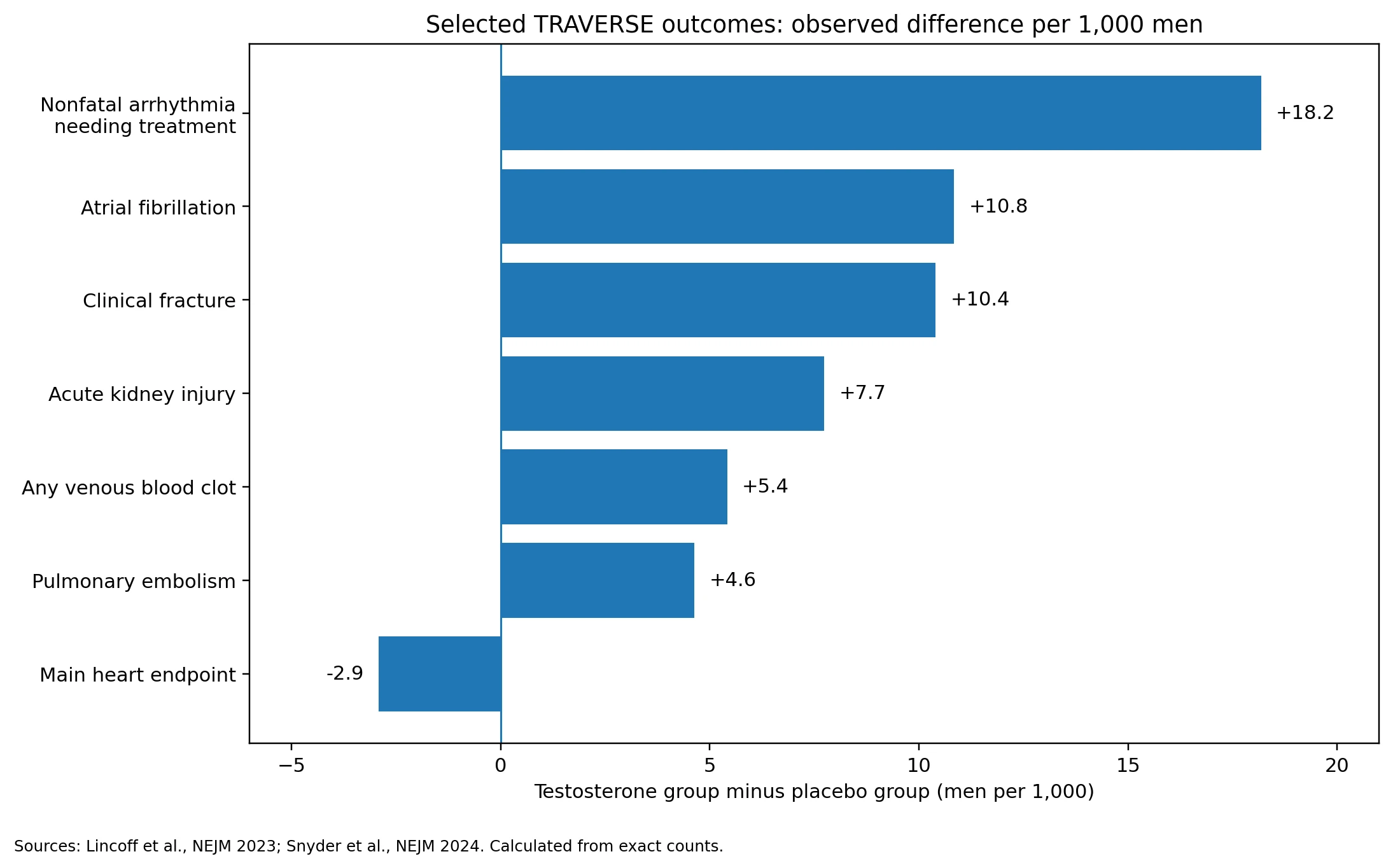
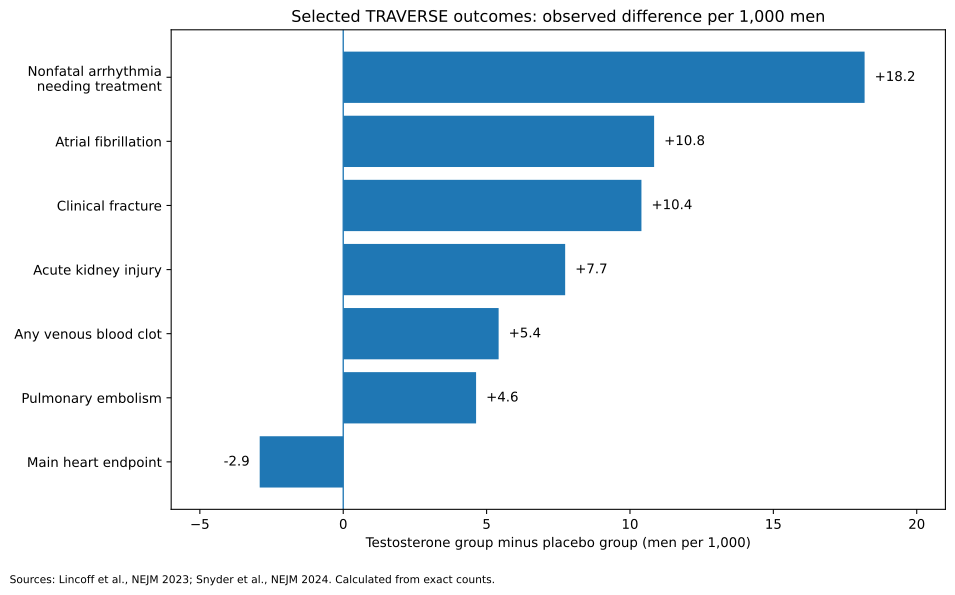
Source: Lincoff et al., NEJM 2023; Snyder et al., NEJM 2024. Calculated and charted by TRT Provider Guide from exact counts. This chart does not show confidence intervals and should not be read as proof of cause.
Data files: outcome ledger CSV · rounding audit CSV · formulation comparison CSV · 33-question label audit CSV
How common are TRT side effects?
There is no one honest percentage for every man, dose, product, and length of treatment.
The best controlled estimate comes from TRAVERSE. At least one adverse event was recorded in 45.7% of men on testosterone gel and 44.7% on placebo over a mean 33 months. Serious events were 27.8% vs 26.8%.
A separate 2025 survey asked 905 men in the United Kingdom about their own TRT experience. In the detailed results, 29% said they had no side effects. That means 71% reported at least one. The most common reports were testicular shrinkage or reduced sperm production (24%), acne (23%), nipple sensitivity or breast growth (18%), raised blood thickness or viscosity (16%), and fluid retention (15%). The survey had no placebo group.
The survey abstract lists acne as 24% and nipple or breast symptoms as 19%, one point higher than the detailed results section. This page uses the detailed results-section values and records the mismatch instead of silently choosing one.
| Evidence type | Example | Has a placebo group? | What it can answer |
|---|---|---|---|
| Randomized trial | TRAVERSE: any adverse event 45.7% vs 44.7% | Yes | What was observed with testosterone beyond what was observed with placebo in that trial |
| Product-label trial | Xyosted: “hematocrit increased” in 14.0% over one year | No | How often an event was recorded with that product under that study’s rules |
| User survey | 905 UK men: 71% reported at least one side effect | No | What users said they noticed, not what testosterone caused |
Sources: Lincoff et al., NEJM 2023; Xyosted prescribing information; El-Osta et al., Translational Andrology and Urology, 2025. The survey paper reports that several authors worked for Menwell Ltd, which supported development of the survey; it reports no study funding.
These numbers are not in conflict. They answer different questions. A three-year trial records health problems that happen in both groups. A survey records what users remember and connect to treatment. A label trial may use its own definition and follow-up period.
What TRAVERSE can—and cannot—tell us
TRAVERSE initially had 5,246 randomization records. Investigators found 42 records tied to 20 people who had enrolled more than once. After those duplicate records were removed, the full analysis set had 5,204 men. The safety set had 5,198 men who received at least one dose: 2,596 on testosterone and 2,602 on placebo.
The men were 45 to 80 years old. They had symptoms of low testosterone, two fasting testosterone tests below 300 ng/dL, and known heart disease or a high risk of it. Their mean age was 63.3 years. About 93% had high blood pressure, about 69% had diabetes, and the mean body mass index was about 35.
They used 1.62% testosterone gel or matching placebo gel. The dose was adjusted to keep testosterone between 350 and 750 ng/dL. The protocol also reduced or stopped treatment when hematocrit stayed above 54%.
| Trial fact | Verified number | Why it matters |
|---|---|---|
| Safety population | 5,198 men | This is the denominator for most safety rows |
| Mean treatment time | 21.8 months testosterone; 21.6 months placebo | Men were not on assigned gel for all 33 months of follow-up |
| Mean follow-up | About 33 months | The results do not settle risks that take many years to appear |
| Stopped assigned gel | 61.4% testosterone; 61.7% placebo | Long-term, uninterrupted exposure was limited |
| Share of possible treatment time on assigned gel | 67.5% testosterone; 67.3% placebo | The trial tested a monitored, dose-adjusted plan with substantial time off treatment |
| Hematocrit rule | Dose reduced or stopped above 54% | Persistent high hematocrit exposure was limited by the protocol |
Source: Lincoff et al., NEJM 2023 and Bhasin et al., JAMA Network Open, 2023. Last verified September 2, 2026.
The trial’s main heart endpoint was designed as a noninferiority test. The result supports cardiovascular noninferiority in this type of patient, with this gel, dose rules, monitoring, and follow-up. It is not a blanket finding that every TRT plan has no heart risk.
The study was funded by a group of testosterone manufacturers led by AbbVie. Academic investigators reported responsibility for analysis and the manuscript, and the sponsor reviewed the manuscript. That funding does not erase the randomized data. It is part of the record a reader should have.
Why the same clot result is called 50%, 80%, or double
Four statements can describe the same general clot signal and still use different math:
- Any venous blood clot: 44 vs 30 men. That is about a 47% relative increase and 5.4 more men per 1,000.
- Blood clot in the lung: 24 vs 12 men. The exact count ratio is about 2.00, or roughly double, and the absolute difference is 4.6 more men per 1,000.
- The rounded lung-clot percentages printed as 0.9% vs 0.5% give an 80% relative increase.
- In July 2026, the Endocrine Society summarized the finding as a “roughly a 50% relative increase in pulmonary embolism.” That is the Society’s wording, not the exact ratio from 24 vs 12.
The safest way to report the result is to name the outcome, show both event counts, and show the absolute difference.
| Outcome | Printed rates | Relative increase allowed by the printed rounding | Difference per 1,000 allowed by rounding | Exact result from counts |
|---|---|---|---|---|
| Blood clot in the lung | 0.9% vs 0.5% | 55% to 111% | 3 to 5 | +100%; +4.6 |
| Any venous blood clot | 1.7% vs 1.2% | 32% to 52% | 4 to 6 | +47%; +5.4 |
| Blood clot in the leg | 0.6% vs 0.5% | 0% to 44% | 0 to 2 | +23%; +1.2 |
| Atrial fibrillation | 3.5% vs 2.4% | 41% to 51% | 10 to 12 | +45%; +10.8 |
| Acute kidney injury | 2.3% vs 1.5% | 45% to 62% | 7 to 9 | +50%; +7.7 |
| Nonfatal arrhythmia needing treatment | 5.2% vs 3.3% | 54% to 62% | 18 to 20 | +54%; +18.2 |
| Clinical fracture | 3.50% vs 2.46% | 42% to 43% | 10.3 to 10.5 | +42%; +10.4 |
| High-grade prostate cancer | 0.19% vs 0.12% | 48% to 70% | 0.6 to 0.8 | +67%; +0.8 |
Method and source: A rate printed to one decimal place was tested within ±0.05 percentage point. A rate printed to two decimal places was tested within ±0.005 percentage point. Exact results use published counts. Sources: Lincoff et al., NEJM 2023; Snyder et al., NEJM 2024; Bhasin et al., JAMA Network Open 2023. Calculations by TRT Provider Guide, version 1.0, September 2, 2026.
The lung-clot row is the clearest reason to keep the counts. “0.9% vs 0.5%” looks exact, but rounding alone allows a wide range of relative statements. “24 vs 12, or 4.6 more per 1,000” is much harder to misunderstand.
Heart, rhythm, and blood clot side effects
TRAVERSE found no increase in its main combined endpoint of heart-related death, heart attack, or stroke: 182 men on testosterone vs 190 on placebo. The hazard ratio was 0.96, with a 95% confidence interval from 0.78 to 1.17. The trial met its planned test for noninferiority.
Several other events were observed more often with testosterone:
| Outcome | Testosterone | Placebo | Difference per 1,000 | Reported comparison |
|---|---|---|---|---|
| Main heart endpoint | 182/2,596 | 190/2,602 | −2.9 | HR 0.96; 95% CI 0.78–1.17 |
| Nonfatal arrhythmia needing treatment | 134/2,596 | 87/2,602 | +18.2 | P=.001 |
| Atrial fibrillation | 91/2,596 | 63/2,602 | +10.8 | P=.02 |
| Any venous blood clot | 44/2,596 | 30/2,602 | +5.4 | HR about 1.46; 95% CI 0.92–2.32 |
| Blood clot in the lung | 24/2,596 | 12/2,602 | +4.6 | Exact count ratio about 2.00 |
| Blood clot in the leg | 16/2,596 | 13/2,602 | +1.2 | Small event-count gap |
Source: Lincoff et al., NEJM 2023; venous-clot counts also appear in the AndroGel 1.62% label. Per-1,000 figures were calculated from exact counts. The non-primary comparisons were not adjusted for multiple testing.
This is the plain reading: the main heart endpoint met the trial’s safety test, while rhythm problems and several clot outcomes were numerically higher. The data support saying both things at once.
Can TRT raise blood pressure?
Yes. The FDA says every completed 24-hour ambulatory blood pressure study found an increase with testosterone products. The product studies below were separate. They did not compare one product against another, so the table is not a safest-to-riskiest order.
| Product | Overall change, systolic/diastolic | Already treated for high blood pressure | No history of high blood pressure | Measurement time |
|---|---|---|---|---|
| AndroGel 1.62% daily gel | +1.9/+1.3 mm Hg (n=169) | +3.0/+2.2 (n=72) | +1.2/+0.9 (n=91) | Week 16 |
| Aveed long-acting injection | +3.1/+2.0 mm Hg (n=139) | +2.1/+1.5 (n=73) | +3.3/+2.5 (n=65) | Week 16 |
| Xyosted weekly injection | +3.9/+1.5 mm Hg (n=62) | +3.9/+1.3 (n=33) | +4.1/+1.9 (n=28) | Week 12 |
| Jatenzo oral capsules | +4.9/+2.5 mm Hg (n=135) | +5.4/+3.2 (n=67) | +4.4/+1.8 (n=63) | Day 139 |
Sources: FDA prescribing information for AndroGel 1.62%, Aveed, Xyosted, and Jatenzo. Last verified September 2, 2026.
The subgroup pattern was not the same for every product. Men already taking blood pressure medicine had a larger rise in the AndroGel and Jatenzo studies, about the same rise in the Xyosted study, and a smaller rise in the Aveed study. The draft’s old claim that treated hypertension always meant a larger rise was wrong.
The labels also report treatment changes:
- AndroGel says 4 patients, printed as 2.8%, started or changed blood pressure medicine; the label does not make the denominator for that percentage clear.
- Aveed reports 2 patients, or 1.4%.
- Xyosted reports 10% during its one-year trial.
- Jatenzo reports 12 of 166 men, or 7.2%.
In TRAVERSE, which did have placebo, systolic pressure at 36 months was up 1.0 mm Hg with gel and down 0.5 mm Hg with placebo, a 1.5 mm Hg between-group difference.
How often does TRT raise hematocrit?
Hematocrit is the share of blood made of red blood cells. Testosterone can raise it. The rate looks very different across studies because the products, doses, follow-up times, and definitions were different.
| Product or study | What counted as the event | Testosterone | Comparator | Follow-up |
|---|---|---|---|---|
| T4DM, testosterone undecanoate injection | Hematocrit at least 54% | 106/491 (21.6%) | 6/484 (1.2%) | 2 years |
| Xyosted weekly injection | “Hematocrit increased” adverse reaction | 21/150 (14.0%) | No placebo | 1 year |
| Xyosted weekly injection | Hematocrit at least 55% | 12/283 (4.2%) | No placebo | Up to 1 year |
| Jatenzo oral capsules | “Hematocrit increased” adverse reaction | 8/166 (4.8%) | No placebo | About 4 months |
| AndroGel 1.62% daily gel | Hematocrit or hemoglobin increased | 5/234 (2.1%) | 0/40 (0%) | 182 days |
| Natesto nasal gel | Hematocrit above 55% | 4/306 (1.3%) | No placebo | Up to 360 days |
Sources: Wittert et al., T4DM trial, Lancet Diabetes & Endocrinology, 2021; FDA labels for Xyosted, Jatenzo, AndroGel 1.62%, and Natesto. Rates were recalculated from counts where counts were available.
The T4DM result is the clearest controlled estimate for this lab outcome: about 203.5 more men per 1,000 reached hematocrit 54% or higher with injected testosterone than with placebo. Twenty-five men in the testosterone group stopped treatment because of hematocrit.
T4DM did not test a normal, dose-adjusted TRT clinic plan. It used 1,000 mg testosterone undecanoate in the muscle at baseline, at 6 weeks, and then every 3 months for two years. Dose and interval were not titrated. The men were 50 to 74, overweight, in a lifestyle program, and did not have pathological hypogonadism. Those facts keep the 21.6% rate from being a universal injection rate.
The Endocrine Society’s 2018 guideline uses hematocrit above 54% as a point to stop treatment, look for causes such as low oxygen or sleep apnea, and restart at a lower dose when safe. The same guideline says the hematocrit level at which clot or heart risk rises is not known. Fifty-four percent is a management trigger, not a proven danger cliff.
Which common TRT side effects have no frequency in the AndroGel label?
We checked 33 side-effect questions readers commonly ask against the current AndroGel 1.62% prescribing information. The label gives an exact frequency for 16 of the 33 questions: 13 with a comparison group and 3 without one. For the other 17, the label gives a warning, postmarketing report, or related statement but no exact frequency.
This is a label-coverage audit. It is not a list of every event ever reported with testosterone.
| Side-effect question | Published number | Label location |
|---|---|---|
| Heart-related death, heart attack, or stroke | 7.0% vs 7.3% | 6.1, TRAVERSE |
| Nonfatal arrhythmia needing treatment | 5.2% vs 3.3% | 6.1, TRAVERSE |
| Atrial fibrillation | 3.5% vs 2.4% | 6.1, TRAVERSE |
| Acute kidney injury | 2.3% vs 1.5% | 6.1, TRAVERSE |
| Any venous blood clot | 1.7% vs 1.2% | 5.3, TRAVERSE |
| Blood clot in the lung | 0.9% vs 0.5% | 5.3, TRAVERSE |
| Blood clot in the leg | 0.6% vs 0.5% | 5.3, TRAVERSE |
| Clinical fracture | 3.5% vs 2.5% | 6.1, TRAVERSE |
| PSA increase | 11.1% vs 0% | 6.1, Table 4 |
| Mood swings or irritability | 2.6% vs 0% | 6.1, Table 4 |
| High blood pressure recorded as a reaction | 2.1% vs 0% | 6.1, Table 4 |
| Hematocrit or hemoglobin increased | 2.1% vs 0% | 6.1, Table 4 |
| Contact dermatitis | 2.1% vs 0% | 6.1, Table 4 |
| 24-hour blood pressure rise | +1.9/+1.3 mm Hg from baseline | 6.1, ABPM study |
| Application-site reaction | 2/234 (0.9%) | 6.1 |
| Stopped treatment because of an adverse reaction | 25/234 (10.7%) | 6.1 |
Source: current AndroGel 1.62% prescribing information. Audit method: a “frequency” had to include a count, percentage, measured mean change, or comparator result in the label. Audit version 1.0, September 2, 2026.
| Side-effect question | What the AndroGel label provides | A number found elsewhere, when available |
|---|---|---|
| Prostate cancer | Warning, no exact label rate | TRAVERSE substudy: 0.46% vs 0.42% |
| Acne | Postmarketing mention, no exact label rate | Xyosted: 2.7%; Aveed trial: 5.2%; UK survey results: 23% |
| Hair loss | Postmarketing mention | No controlled rate found in the reviewed sources |
| Breast growth or nipple tenderness | Warning and postmarketing mention | UK survey results: 18% |
| Testicle shrinkage | Postmarketing mention | UK survey grouped shrinkage/reduced sperm: 24% |
| Low sperm count or infertility | Warning | Contraceptive trial data are shown below |
| Sleep apnea | Warning and postmarketing mention | No frequency in the reviewed label sources |
| Lower sex drive | Postmarketing mention | No frequency in the reviewed label sources |
| Depression | Postmarketing mention | No frequency in the reviewed label sources |
| Anxiety, hostility, or nervousness | Postmarketing mention | No frequency in the reviewed label sources |
| Swelling or fluid retention | Warning and postmarketing mention | UK survey results: 15% |
| Cholesterol change | Warning and postmarketing mention | No frequency in the reviewed label sources |
| Worsening enlarged prostate | Warning and postmarketing mention | TRAVERSE prostate outcomes are shown below |
| Headache | Postmarketing mention | No frequency in the reviewed label sources |
| Insomnia | Postmarketing mention | No frequency in the reviewed label sources |
| Prolonged or frequent erections | Postmarketing mention | No frequency in the reviewed label sources |
| Transfer to a partner or child by skin contact | Boxed warning and warning | No frequency in the label |
Sources: AndroGel 1.62%, Xyosted, and Aveed FDA labels; El-Osta et al., 2025; Bhasin et al., 2023. The AndroGel label states that postmarketing reports come from an uncertain-size population, so their frequency cannot always be estimated reliably. Full row-level audit: CSV.
The old draft said acne had “no published number at all.” That was too broad. AndroGel gives no exact acne rate, but Xyosted reports 4 of 150 men, or 2.7%, and an Aveed trial reports 8 of 153, or 5.2%. Those are separate product trials without placebo acne rates.
Fertility, sperm count, and testicle size
Testosterone from outside the body can turn down the brain signals that tell the testicles to make sperm. The cleanest numbers come from male birth-control studies, not ordinary long-term TRT care.
In a World Health Organization trial, 271 healthy, fertile men received 200 mg of testosterone enanthate by muscle injection every week. A total of 157 men became azoospermic, meaning no sperm were seen. The study’s time-to-event estimate was 65% by six months. Those are not the same calculation: 157 divided by 271 is 57.9%, while the 65% figure came from the study’s cumulative analysis over time.
Among men who became azoospermic, the median time to return to at least 20 million sperm per milliliter after stopping was 3.7 months in that trial.
A later combined analysis of 30 studies included 1,549 healthy men ages 18 to 51. The modeled chance of returning to at least 20 million sperm per milliliter was 67% by 6 months, 90% by 12 months, 96% by 16 months, and 100% by 24 months.
| Question | Published result | Population and treatment |
|---|---|---|
| Became azoospermic | 157 men; cumulative estimate 65% by 6 months | 271 healthy fertile men; testosterone enanthate 200 mg weekly |
| Median recovery in the WHO trial | 3.7 months to at least 20 million/mL | Men who became azoospermic and then stopped injections |
| Recovery by 6 months | 67% | Integrated analysis of 1,549 healthy men in 30 studies |
| Recovery by 12 months | 90% | Same integrated analysis |
| Recovery by 16 months | 96% | Same integrated analysis |
| Recovery by 24 months | 100% | Same integrated analysis |
Sources: WHO Task Force, Lancet 1990; Liu et al., Lancet 2006. These studies involved healthy volunteers in controlled contraceptive trials. They do not guarantee the same recovery after years of TRT, older age, poor baseline fertility, or other fertility problems.
The current AndroGel label says large doses of outside androgens can suppress sperm production and that reduced fertility is seen in some men on TRT. A man who wants children should not treat the recovery percentages above as a promise about his own case.
Prostate cancer, PSA, and enlarged prostate
The TRAVERSE prostate substudy found low event rates and no statistically significant difference in its prostate outcomes. It also excluded men at higher prostate risk, and the number of cancers was small.
| Outcome | Testosterone | Placebo | Difference per 1,000 | Hazard ratio (95% CI) |
|---|---|---|---|---|
| Any prostate cancer | 12/2,596 (0.46%) | 11/2,602 (0.42%) | +0.4 | 1.07 (0.47–2.42) |
| High-grade prostate cancer | 5/2,596 (0.19%) | 3/2,602 (0.12%) | +0.8 | 1.62 (0.39–6.77) |
| Acute urinary retention | 20/2,596 (0.77%) | 16/2,602 (0.61%) | +1.6 | 1.25 (0.65–2.41) |
| Invasive prostate surgery | 23/2,596 (0.89%) | 12/2,602 (0.46%) | +4.2 | 1.91 (0.95–3.84) |
| Prostate biopsy | 16/2,596 (0.62%) | 14/2,602 (0.54%) | +0.8 | 1.13 (0.55–2.31) |
| New medicine for urinary symptoms | 101/2,596 (3.89%) | 87/2,602 (3.34%) | +5.5 | 1.16 (0.87–1.54) |
Source: Bhasin et al., JAMA Network Open 2023, 14,304 person-years of follow-up. Per-1,000 differences calculated by TRT Provider Guide. None of the listed between-group comparisons was statistically significant. Last verified September 2, 2026.
The surgery row needs careful wording. Surgery occurred in 23 men on testosterone and 12 on placebo. The hazard ratio was 1.91, but the 95% confidence interval was 0.95 to 3.84 and crossed 1. The study did not establish a difference.
The trial excluded men with a PSA above 3.0 ng/mL, or above 1.5 ng/mL while taking a 5-alpha-reductase inhibitor. It also excluded men with an International Prostate Symptom Score above 19, a prostate nodule or induration, or a history of prostate cancer. The authors said the cancer event counts were too small to treat the groups as proven equivalent.
PSA rose more with testosterone early in the study. The between-group difference was 0.11 ng/mL at 3 months and 0.15 ng/mL at 12 months. It did not keep widening after month 12.
Can TRT increase fracture risk?
In the TRAVERSE fracture substudy, yes: the prespecified clinical-fracture endpoint was higher with testosterone.
Clinical fractures occurred in 91 of 2,601 men on testosterone and 64 of 2,603 on placebo. That was 3.50% vs 2.46%, a hazard ratio of 1.43 with a 95% confidence interval of 1.04 to 1.97. The observed absolute difference was 10.4 more men with a fracture per 1,000.
A broader analysis that also included fracture sites excluded from the primary endpoint found 109 vs 72 events, with a hazard ratio of 1.52.
| Fracture definition | Testosterone | Placebo | Difference per 1,000 | Hazard ratio |
|---|---|---|---|---|
| Primary clinical-fracture endpoint | 91/2,601 (3.50%) | 64/2,603 (2.46%) | +10.4 | 1.43 (1.04–1.97) |
| Broader set of all clinical fractures | 109/2,601 (4.19%) | 72/2,603 (2.77%) | +14.2 | 1.52 |
Source: Snyder et al., NEJM 2024. Median follow-up was 3.19 years. Most fractures were linked to trauma, especially falls. The study did not establish why fractures were higher.
This result should not be turned into a claim that testosterone weakens every man’s bones. The cause was not resolved, and the trial population had a high burden of obesity and other illness. It is still a real randomized finding that belongs in a complete side-effect summary.
Do side effects differ by TRT formulation?
The route changes which problems are possible. It does not give us one proven order from safest to riskiest. No trial in this evidence set randomized men head to head across gel, weekly injection, long-acting injection, nasal gel, and oral capsules with the same rules and follow-up.
| Formulation | Route-specific issue | Verified label number or rule |
|---|---|---|
| AndroGel 1.62% | Skin transfer to women or children | Boxed warning; wash hands, cover the site, and wash before skin contact |
| AndroGel 1.62% | Application-site reaction | 2/234 (0.9%) in its six-month trial |
| Xyosted | Injection-site reaction | 36/283 (12.7%) across its two trials |
| Aveed | Pulmonary oil microembolism, or POME | 9 events in 8 patients among 3,556 patients across 18 trials |
| Aveed | Anaphylaxis | 2 events among 3,556 patients across 18 trials |
| Aveed | Observation after every injection | 30 minutes in a healthcare setting; product has a REMS |
| Natesto | Nasal reactions | Nasal discomfort, scab, runny nose, and nosebleed are listed reactions |
| Jatenzo | Blood pressure | +4.9/+2.5 mm Hg mean 24-hour change at day 139 |
Sources: FDA prescribing information for AndroGel 1.62%, Xyosted, Aveed, Natesto, and Jatenzo. For Aveed, 8 affected patients among 3,556 equals about 2.25 patients per 1,000; the label reports 9 POME events because one patient may have had more than one event.
The hematocrit and blood pressure tables on this page can help show what each label reported. They cannot prove that one route is safer because the studies did not use the same men, dose targets, definitions, or time periods.
What changed in FDA testosterone warnings?
The latest label story has two separate steps, and they should not be blended together.
| Date | What happened | Status on September 2, 2026 |
|---|---|---|
| February 28, 2025 | FDA recommended adding TRAVERSE results, retaining the age-related limitation, and removing boxed-warning language about increased cardiovascular outcomes. FDA also required product-specific blood-pressure information and a blood-pressure warning. | Implemented in updated labels such as AndroGel’s July 2025 revision |
| June 18, 2026 | HHS announced that FDA requested manufacturers remove the age-related limitation and update prostate-cancer and enlarged-prostate language. | A request to manufacturers, not proof that every label had changed |
| September 2, 2026 | The current AndroGel label still states that safety and efficacy for age-related hypogonadism have not been established. | The June request was not yet reflected in that current label |
Sources: FDA, February 28, 2025; HHS, June 18, 2026; current AndroGel 1.62% prescribing information. Last verified September 2, 2026.
The key correction is tense. The June 2026 announcement described changes the FDA requested. It did not show that every maker had already filed, received approval for, and published a revised label.
What this data does not answer
This page does not produce one personal risk score. It does not show that the same rate applies to a younger man, a man without heart risk, a different testosterone product, a higher dose, or ten years of treatment.
It also does not turn every difference into cause. Small event counts can move relative percentages sharply. Secondary outcomes can look important by chance when many outcomes are checked. Confidence intervals show that some results are still compatible with little or no difference.
The main gaps are clear:
- No large head-to-head safety trial compares all common TRT formulations under the same rules.
- TRAVERSE followed men for about 33 months and had high treatment discontinuation.
- Prostate cancer can take longer to develop than the trial lasted.
- Fertility recovery data come mainly from younger, healthy contraceptive-study volunteers.
- Acne, hair loss, breast symptoms, sleep apnea, mood symptoms, and sexual changes still lack strong placebo-controlled frequency data.
- Product-label rates often use different definitions, so they should not be pooled into one average.
Methodology: how this dataset was built
This is an assembled, versioned dataset. It combines published counts without pretending the studies were one study.
Source order. We used peer-reviewed randomized trial reports first, then current FDA-approved prescribing information, official FDA or HHS announcements, society guidelines or statements, and the original survey paper.
Denominators. Each row keeps the denominator used by its source. TRAVERSE safety outcomes usually use 2,596 and 2,602. The fracture substudy uses 2,601 and 2,603. T4DM rows use the number of men with data for that exact outcome.
Calculation. The observed difference per 1,000 is:
(testosterone events / testosterone total − comparator events / comparator total) × 1,000
A positive result means more events were observed with testosterone. A negative result means fewer were observed. It does not prove cause.
Exact counts beat rounded percentages. When a source gave both, we used the counts for calculated results. The rounding audit tested one-decimal rates within ±0.05 percentage point and two-decimal rates within ±0.005 percentage point.
No pooling. We did not combine products into a single estimated rate. We did not fit a model, adjust the trial results, or create a meta-analysis.
Label audit. We used a fixed checklist of 33 reader questions. A question counted as having an exact AndroGel frequency only when the current label printed a count, percentage, mean measured change, or direct comparison.
Conflict rule. When the 905-man survey abstract and detailed results differed by one percentage point, we used the detailed results and disclosed the mismatch.
Version. Dataset version 1.0. Sources and current labels were last checked September 2, 2026. The full approach follows the site’s research and data methodology and editorial standards.
How to cite this page
This block gives neutral source details for readers who need a formal reference.
Page citation: TRT Provider Guide. “TRT Side Effects Statistics: Trial Rates, Placebo Gaps, and FDA Data.” Published and last verified September 2, 2026. https://trtproviderguide.com/research/trt-side-effects-statistics/
Dataset citation: TRT Provider Guide. “TRT Side Effects Statistics Dataset, version 1.0.” September 2, 2026. https://trtproviderguide.com/research/trt-side-effects-statistics/
Questions people ask about TRT side effect statistics
What percentage of men get side effects from TRT?
There is no single rate for every kind of TRT. In TRAVERSE, 45.7% of men on testosterone gel and 44.7% on placebo had at least one adverse event over a mean 33 months. In a 2025 survey, 71% of 905 UK users reported at least one side effect, but that survey had no placebo group.
What was the largest side-effect gap in TRAVERSE?
Among the selected outcomes on this page, nonfatal arrhythmia needing treatment had the largest observed gap: 134 men on testosterone vs 87 on placebo, or 18.2 more men per 1,000. This was not the trial’s primary endpoint, and the safety comparisons were not adjusted for multiple testing.
Does TRT double the risk of a blood clot?
The pulmonary-embolism counts in TRAVERSE were 24 vs 12, so the exact count ratio was about two. The absolute difference was 4.6 more men per 1,000 over about 33 months. For all venous blood clots combined, the observed relative increase was about 47%, not double.
Does TRT increase heart attack or stroke risk?
TRAVERSE found 182 main heart events on testosterone and 190 on placebo. The hazard ratio was 0.96, and testosterone met the study’s noninferiority test in men with confirmed hypogonadism and known or high heart risk. That finding does not cover every product, dose, patient, or treatment length.
How common is high hematocrit on TRT?
Published rates range widely because studies use different products and definitions. In T4DM, hematocrit reached at least 54% in 21.6% on injected testosterone and 1.2% on placebo. In labels without placebo groups, reported rates ranged from 1.3% with Natesto under a different cutoff to 14.0% for “hematocrit increased” with Xyosted.
Can TRT raise blood pressure?
Yes. The FDA says all completed 24-hour studies confirmed a class-wide increase. Mean systolic changes in four product studies were +1.9 mm Hg for AndroGel, +3.1 for Aveed, +3.9 for Xyosted, and +4.9 for Jatenzo. These were separate studies, not head-to-head comparisons.
Does TRT affect fertility?
Yes. Outside testosterone can suppress sperm production. In a WHO contraceptive trial, 157 of 271 healthy fertile men became azoospermic, and the cumulative estimate was 65% by six months. Recovery was common after stopping in controlled trials, but those results do not guarantee recovery after long-term TRT.
Does TRT cause prostate cancer?
TRAVERSE did not find a statistically significant difference: 12 prostate cancers on testosterone and 11 on placebo. The study excluded men at higher prostate risk, had only 23 cancers, and followed men for about three years, so it does not settle long-term risk.
Does the AndroGel label give an acne rate?
No. The current AndroGel label mentions acne after marketing but gives no exact frequency. Other product trials do: Xyosted reports 2.7% and an Aveed trial reports 5.2%. The 905-man survey’s detailed results report 23%, without a placebo group.
Are injections riskier than gel?
The available studies do not prove a simple safest-to-riskiest order. Injection, gel, nasal, and oral studies used different patients, doses, definitions, and follow-up. Each route also has different route-specific problems, such as gel transfer, injection-site reactions, or Aveed’s POME risk.
Did the FDA remove the age-related TRT limitation?
On June 18, 2026, HHS said the FDA requested that manufacturers remove it. That was a requested label change. The current AndroGel label still carried the limitation on September 2, 2026.
Related research from TRT Provider Guide
- Research and data hub
- Testosterone levels by age: study data and ranges
- enclomiphene side effects
- Research and data methodology
- Editorial standards
- Authors and medical reviewers
Primary sources
- Lincoff AM, et al. Cardiovascular Safety of Testosterone-Replacement Therapy. New England Journal of Medicine. 2023.
- Snyder PJ, et al. Testosterone Treatment and Fractures in Men With Hypogonadism. New England Journal of Medicine. 2024.
- Bhasin S, et al. Prostate Safety Events During Testosterone Replacement Therapy in Men With Hypogonadism. JAMA Network Open. 2023.
- Wittert G, et al. Testosterone treatment to prevent or revert type 2 diabetes in men enrolled in a lifestyle programme. Lancet Diabetes & Endocrinology. 2021.
- El-Osta A, et al. A cross-sectional survey of experiences and outcomes of using testosterone replacement therapy in UK men. Translational Andrology and Urology. 2025.
- WHO Task Force. Contraceptive efficacy of testosterone-induced azoospermia in normal men. Lancet. 1990.
- Liu PY, et al. Rate, extent, and modifiers of spermatogenic recovery after hormonal male contraception. Lancet. 2006.
- Bhasin S, et al. Testosterone Therapy in Men With Hypogonadism: An Endocrine Society Clinical Practice Guideline. Journal of Clinical Endocrinology & Metabolism. 2018.
- AndroGel 1.62% prescribing information. DailyMed.
- Xyosted prescribing information. DailyMed.
- Aveed prescribing information. DailyMed.
- Jatenzo prescribing information. DailyMed.
- Natesto prescribing information. DailyMed.
- FDA. Class-wide labeling changes for testosterone products. February 28, 2025.
- HHS. Requested updates to testosterone therapy product labels. June 18, 2026.
- Endocrine Society. Statement on Testosterone Replacement Therapy. July 16, 2026.
Who made this page
TRT Provider Guide is an independent publishing and research resource. It is not a clinic, pharmacy, laboratory, insurer, or drug maker.
For this page, TRT Provider Guide read the trial papers and current labels, copied the published counts, recalculated every displayed difference, tested rounded rates against their possible ranges, and recorded source conflicts instead of smoothing them over. No clinic, provider, or manufacturer supplied the analysis or paid for this page. The page contains no product recommendation.