Enclomiphene Side Effects: Rates From 10 Human Trials
By TRT Provider Guide · Updated September 2026
Headaches were recorded in 35 of 490 men (7.1%) in ZA-300's eight-month record of enclomiphene side effects. In EMA's 2018 safety pool, only 116 of 1,403 men (8.3%) reached at least 12 full months of treatment, according to TRT Provider Guide's September 2026 analysis. The study-by-study rates and limits are below.
Below: side-effect rates trial by trial, how they stack up against placebo, the blood-clot count behind Europe's refusal, and 14 developer trials with no results posted on the U.S. trial registry as of September 29, 2026.
The finding to cite: "Only 116 of the 1,403 men in EMA's 2018 enclomiphene phase 2 and 3 safety pool (8.3%) reached at least 12 full months of treatment, according to TRT Provider Guide's September 2026 analysis of the report's exposure table." Source: EMA, Table 67.
A side effect recorded during a study isn't proof the drug caused it. This page reports what studies recorded. It isn't medical advice.
Key enclomiphene side effect statistics
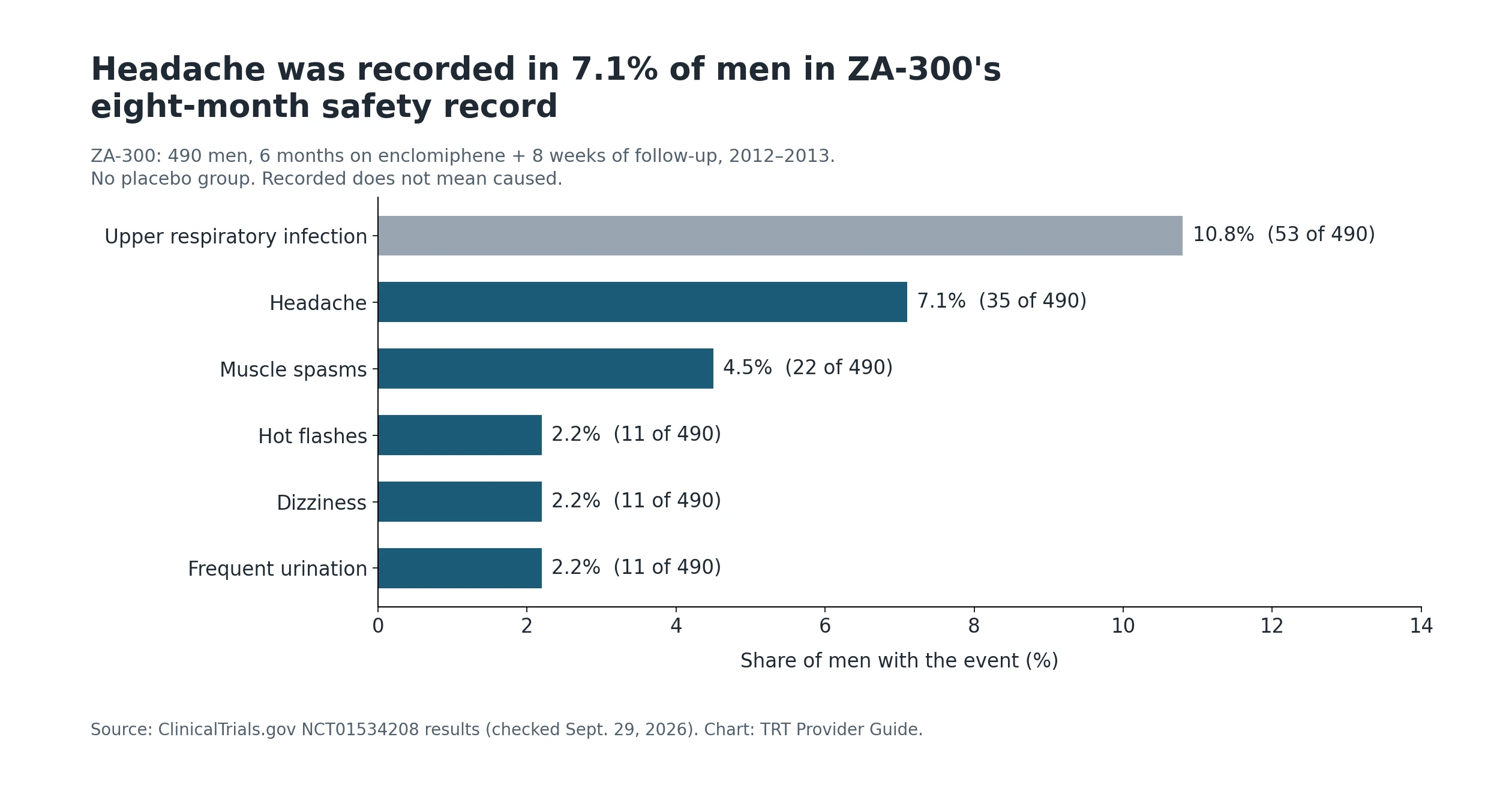
- Headache was recorded in 35 of 490 men (7.1%) in ZA-300, the largest of the 10 Repros trials with posted results, over 6 months of treatment plus 8 weeks of follow-up, with no placebo group (ClinicalTrials.gov NCT01534208).
- Only 116 of the 1,403 men (8.3%) in EMA's 2018 enclomiphene phase 2 and 3 safety pool reached at least 12 full months of treatment; 482 (34.4%) reached at least 6 full months (TRT Provider Guide analysis, September 2026; EMA Table 67).
- In ZA-300's eight-month safety record, muscle spasms were recorded in 4.5% of men (22 of 490), hot flashes in 2.2% (11 of 490), and dizziness in 2.2% (11 of 490) (ClinicalTrials.gov NCT01534208).
- 23 of the 499 men who started ZA-300 (4.6%) did not complete the study because of an adverse event (ClinicalTrials.gov NCT01534208, participant-flow record).
- In EMA's published comparison table, headache was recorded in 15 of 324 men on enclomiphene (4.6%) and 8 of 168 on placebo (4.8%); these are recorded events, not proved drug effects (EMA 2018, Table 68).
- In two phase 3 registry records, 48 of 247 men on enclomiphene (19.4%) and 14 of 85 on placebo (16.5%) had a listed non-serious event; these are unadjusted totals from ZA-301 and ZA-302, not a fixed-period risk estimate (TRT Provider Guide analysis, September 2026).
- EMA described 4 men with clot-related events among 1,403 enclomiphene-treated men: vein clots in 3 and a fatal ischemic stroke in 1. That is about 2.9 per 1,000 in this historical, mixed-duration pool, not a personal risk estimate (EMA 2018, pp.93-94; calculation by TRT Provider Guide).
- The European Union refused to approve enclomiphene, proposed as EnCyzix, on April 6, 2018, after the drug committee cited no proof it eased symptoms and a risk of blood clots in the veins (EMA).
- In ZA-205, 2 of 18 men in the 12.5 mg enclomiphene group had a serious event (1 heart attack, 1 ischemic stroke), versus 0 of 15 on placebo. Treatment lasted up to 12 months and safety follow-up about 13 months; results were posted in June 2019 (ClinicalTrials.gov NCT02651688).
- In EMA's phase 2 and 3 safety pool, blurred vision was reported by 14 of 1,403 men on enclomiphene (1.0%) versus 3 of 391 on placebo (0.8%); 12 of the 14 enclomiphene reports came during the 12.5 mg dose (EMA 2018, p.94).
- Hot flashes judged at least possibly drug-related were reported in 16 of 1,403 men on enclomiphene (1.1%); EMA reports 0.5% on placebo and 0% on AndroGel testosterone gel (EMA 2018, Table 69 and p.95).
- In ZA-203, decreased sperm concentration was logged as an adverse event in 0 of 60 men on enclomiphene, 8 of 33 on testosterone gel (24.2%), and 0 of 28 on placebo. This does not mean no man's sperm count fell (ClinicalTrials.gov NCT01270841).
- Gynecomastia (breast tissue growth) was reported in 0.07% of men on enclomiphene, 0.7% on AndroGel, and 0% on placebo in EMA's phase 2 and 3 safety review (EMA 2018, p.95).
- 14 of the 24 enclomiphene trials registered by developer Repros Therapeutics (58%), including 6 of 9 phase 3 trials, have no results posted on ClinicalTrials.gov (TRT Provider Guide registry review, September 29, 2026). No registry results does not mean no journal or regulator report exists.
- Enclomiphene is not FDA-approved: Repros reported a Complete Response Letter in November 2015, FDA's compounding advisers voted 8 to 4 against adding it to the 503A bulks list in June 2022, and the May 14, 2026 list shows it under evaluation (Repros; FDA minutes; FDA list).
On this page: The trial ledger · Most common side effects · Vs. placebo · Blood clots · Long-term use · Vision · Blood counts and PSA · Gyno, mood, acne, sleep, hair · Dose · Vs. clomiphene · Vs. testosterone · Popular numbers checked · Missing results · FDA and EMA status · Method · Cite · Data · FAQ
Which human trials measured enclomiphene side effects?
Enclomiphene's developer, Repros Therapeutics, registered 24 enclomiphene trials on ClinicalTrials.gov, and 10 of them posted results. Those 10 list 991 participant records for men who received enclomiphene, and 19 (1.9%) had a serious adverse event. ZA-109 includes the same men's placebo periods. This descriptive total spans different study lengths; it is not an enclomiphene-caused risk. The table below is the full set, trial by trial.
We call it the Enclomiphene Trial Safety Ledger. It's the table you'd otherwise build by opening ten registry records and a 111-page European report.
Two terms first. An adverse event is any health problem logged during a study, whether or not the drug caused it. A serious adverse event is one that led to a hospital stay, disability, or death, or was life-threatening.
| Trial | Design | Treatment / safety window | Men who received enclomiphene | Comparison group | Serious events: enclomiphene vs. comparison | What stands out |
|---|---|---|---|---|---|---|
| ZA-300 | Open-label safety study (everyone knew they got the drug) | 6 months + 8 weeks follow-up | 490 | None | 15 of 490 (3.1%) | Headache 7.1%; vein clots in 2 men, a lung clot in 1, a mini-stroke in 1 |
| ZA-302 | Randomized vs. placebo | Treatment 12-18 weeks; safety window not stated | 134 | Placebo, 47 men | 1 of 134 vs. 0 of 47 | Headache 7 of 134 vs. 1 of 47 |
| ZA-301 | Randomized vs. placebo | 13 to 19 weeks | 113 | Placebo, 38 men | 0 of 113 vs. 0 of 38 | Headache 5 of 113 vs. 2 of 38 |
| ZA-202 | Randomized vs. placebo, men with type 2 diabetes | 3 months | 76 | Placebo, 43 men | 1 of 76 vs. 1 of 43 | Bypass surgery on enclomiphene (investigator judged it unrelated); chest pain (angina) on placebo |
| ZA-203 | Randomized vs. placebo and testosterone gel | 3 months | 60 | Placebo, 28; Testim gel, 33 | 0 of 60 vs. 0 of 28 vs. 1 of 33 | Sperm drop logged in 0 of 60 vs. 8 of 33 on gel |
| ZA-204 | Randomized vs. AndroGel | 6 weeks | 46 | AndroGel, 14 men | 0 vs. 0 | Few events in any group |
| ZA-205 | Randomized vs. placebo, all with diet and exercise | Up to 12 months treatment; about 13 months safety follow-up | 35 | Placebo, 15 men | 2 of 35 vs. 0 of 15 | Heart attack 1 and ischemic stroke 1, both in the 12.5 mg group of 18 men |
| ZA-110 | Crossover test of two capsule versions | Single doses | 16 | Other capsule version | 0 | Headache |
| ZA-201 | Randomized vs. Testim gel | Not stated in results | 12 | Testim gel, 5 men | 0 | Blurred vision 1, flushing 1, worsening depression 1 |
| ZA-109 | Single doses up to 250 mg | 1 day per dose | 9 | Placebo (same men) | 0 | Headache 1, anxiety 1 |
| All 10 | 991 participant records | 19 of 991 (1.9%) |
Source: ClinicalTrials.gov results for each trial, checked September 29, 2026. Totals by TRT Provider Guide. "Participant records" can repeat a man who joined more than one trial. Each registry record has a reporting threshold for non-serious event types (0%, 3%, or 5% in a group). Listed types can still show zero or below-threshold counts in other groups. Missing types are not proved absent.
The enrollment headers in ZA-202 and ZA-203 also conflict with their adverse-event tables: 102 enrolled versus 119 in the event denominators, and 83 versus 121, respectively. We preserve each record as printed rather than invent a fix.
That last point matters more than it looks. If a trial only lists events that hit 5% of a group, a problem that hit 1 man in 40 can vanish from the record. So a blank isn't a zero.
Look up a side effect across every study
Pick a symptom and the lookup shows every record we found for it: which study, which group, how many men, over what time, and the source. It reads straight from the downloadable data, so every number matches the tables on this page. If nothing turns up, it says so plainly and never shows 0%.
What are the most common side effects of enclomiphene?
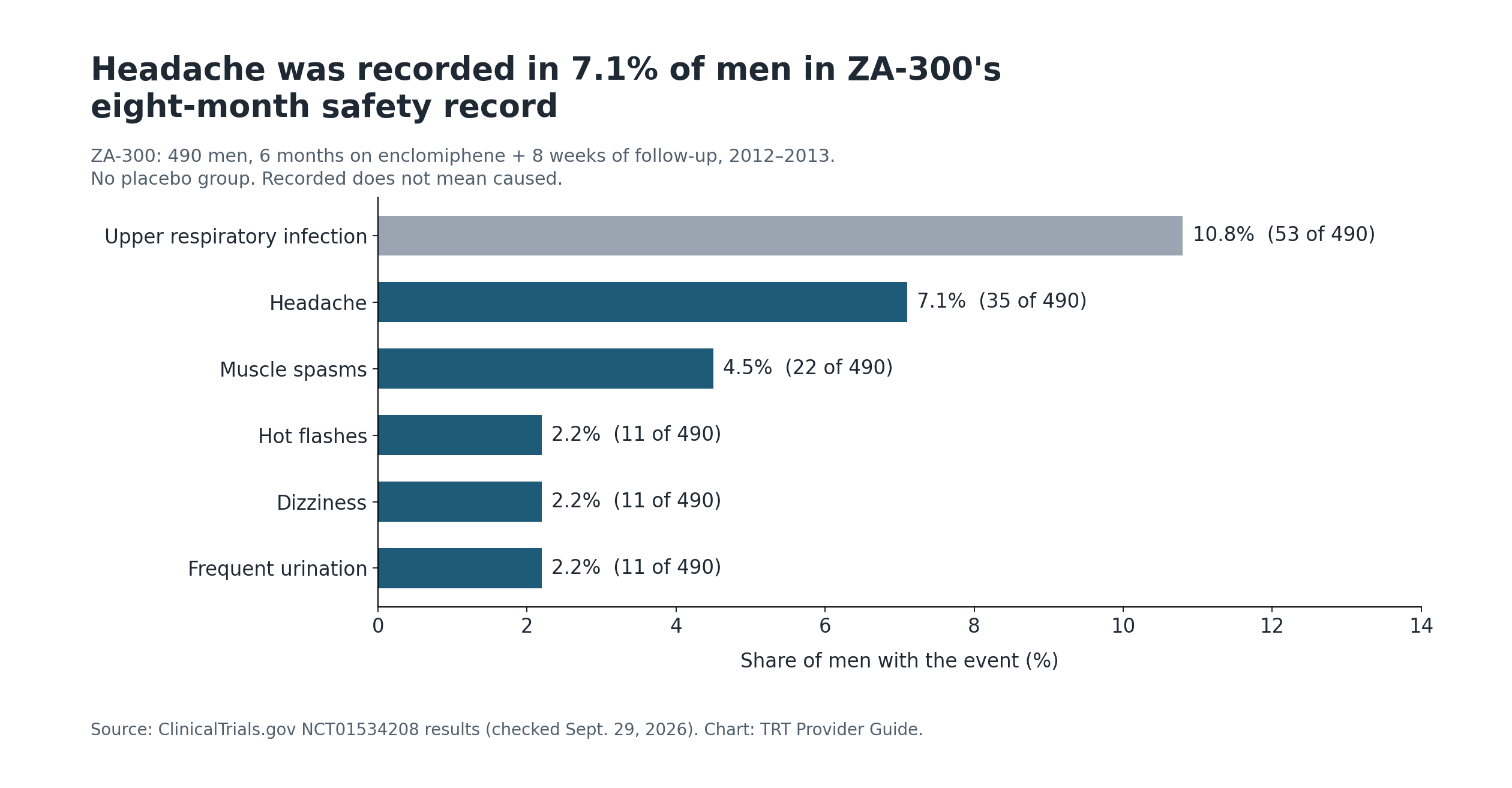
In ZA-300, the largest of the 10 Repros trials with posted results, headache was recorded in 35 of 490 men (7.1%) over 6 months on the drug plus 8 weeks of follow-up. Muscle spasms were recorded in 4.5%; hot flashes, dizziness, and frequent urination in 2.2% each. The trial had no placebo group, so it cannot show how much of each rate was caused by the drug.
Picture a city bus with 50 men on it. A 7.1% share is about 3 or 4 of those seats. That shows the scale of the trial finding; it is not a prediction for a new group of men.
Upper respiratory infections, such as colds, showed up even more often, in 10.8% of men. The record does not show that the pill caused them—or prove it could not. We show them so the chart doesn't pretend headache was the top event of all.
| Event | 12.5 mg group (207 men) | 25 mg group (283 men) | Both groups (490 men) |
|---|---|---|---|
| Upper respiratory infection | 26 (12.6%) | 27 (9.5%) | 53 (10.8%) |
| Headache | 12 (5.8%) | 23 (8.1%) | 35 (7.1%) |
| Muscle spasms | 10 (4.8%) | 12 (4.2%) | 22 (4.5%) |
| Sinusitis | 7 (3.4%) | 6 (2.1%) | 13 (2.7%) |
| Flu | 7 (3.4%) | 5 (1.8%) | 12 (2.4%) |
| Hot flashes | 2 (1.0%) | 9 (3.2%) | 11 (2.2%) |
| Dizziness | 6 (2.9%) | 5 (1.8%) | 11 (2.2%) |
| Frequent urination | 6 (2.9%) | 5 (1.8%) | 11 (2.2%) |
| Any serious event | 6 (2.9%) | 9 (3.2%) | 15 (3.1%) |
| Quit because of an adverse event | 15 of 216 (6.9%) | 8 of 283 (2.8%) | 23 of 499 (4.6%) |
Source: ClinicalTrials.gov NCT01534208 results, checked September 29, 2026. Percentages by TRT Provider Guide. Men started at 12.5 mg and could move up to 25 mg, so the dose groups weren't chosen at random. The "quit" row uses the trial's enrollment count; the other rows use its adverse-event count.
Why does ZA-300 count 490 men in one place and 499 in another?
ZA-300 enrolled 499 men: 216 in the 12.5 mg group and 283 in the 25 mg group. Its adverse-event tables list 207 and 283, or 490 men. All nine missing men are in the 12.5 mg group, and the record doesn't say why.
So we use 490 for side-effect rates and 499 for who quit. Mixing them would shift a percentage by a hair, but it would also make the math impossible to check.
Are enclomiphene side effects more common than placebo?
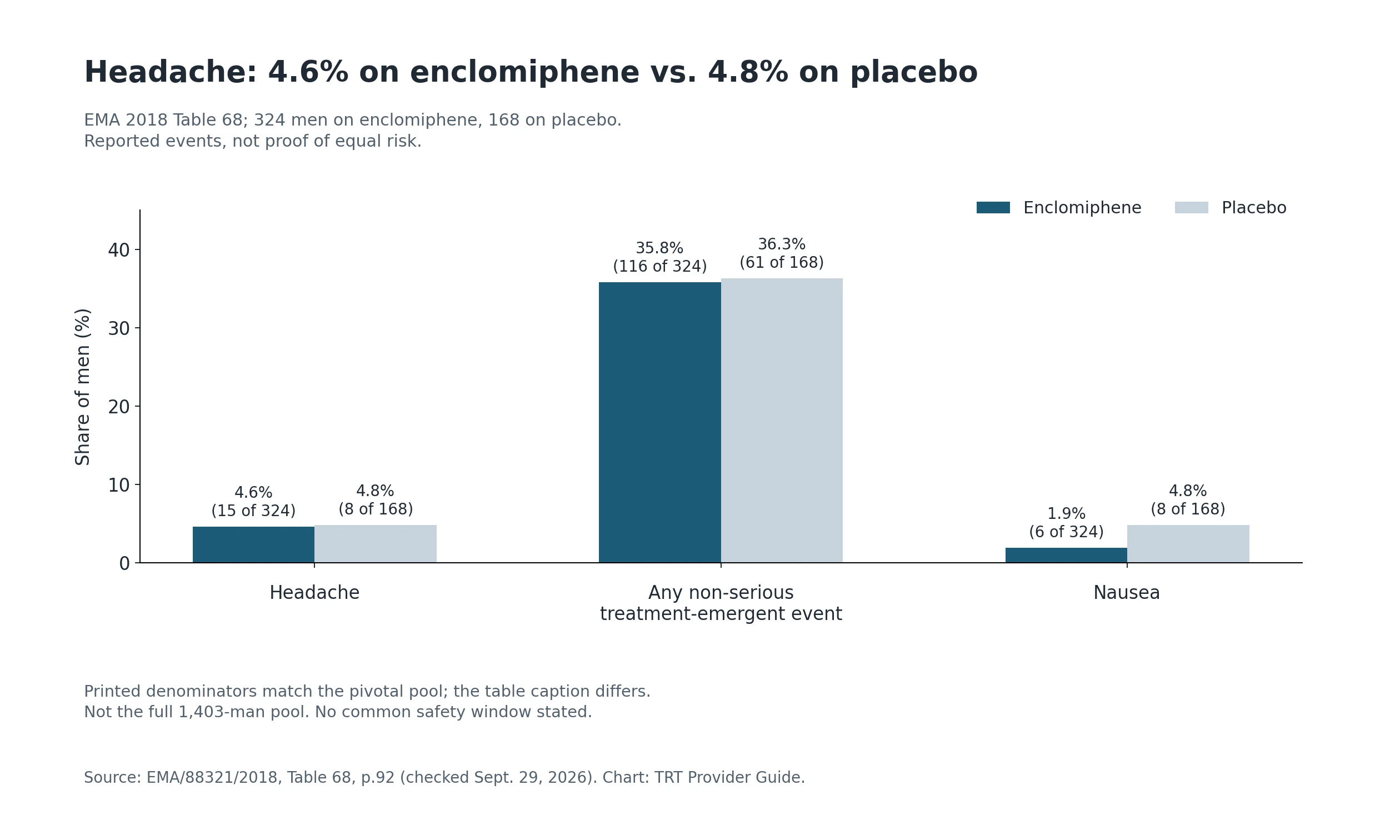
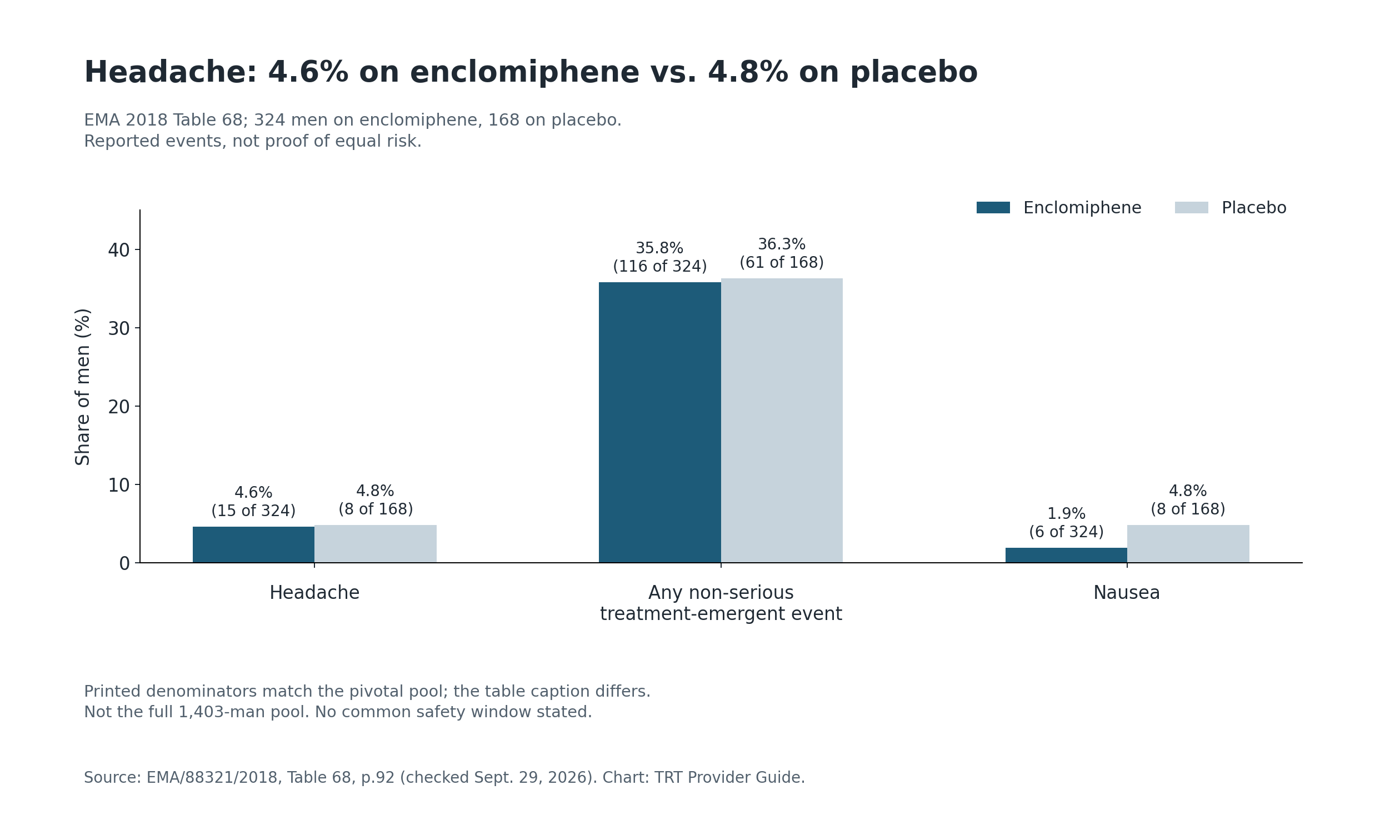
Not consistently. In EMA's published comparison table, headache was recorded in 4.6% of men on enclomiphene versus 4.8% on placebo. Any non-serious treatment-emergent event was recorded in 35.8% versus 36.3%. These figures do not prove the two treatments have equal risks.
A placebo is a dummy pill. It's the yardstick. Some headaches and colds happen without the study drug, so the useful comparison keeps the same event definition and study setting on both sides.
| What was counted | Enclomiphene (324 men) | Placebo (168 men) | AndroGel (85 men) |
|---|---|---|---|
| Headache | 15 (4.6%) | 8 (4.8%) | 4 (4.7%) |
| Any non-serious treatment-emergent event | 116 (35.8%) | 61 (36.3%) | 38 (44.7%) |
| Nausea | 6 (1.9%) | 8 (4.8%) | 1 (1.2%) |
Source: EMA 2018 assessment, Tables 66 and 68, checked September 29, 2026. Table 66 identifies 324 enclomiphene participants and 168 placebo participants as the pivotal-trial pool. Table 68 uses those denominators but calls itself the phase 2 and 3 pool. We keep the printed counts and disclose that labeling mismatch; this is not the full 1,403-person pool. Dose columns overlap and must not be added. The table does not state one common safety window.
Why the registry totals give different percentages
The registry lets you check individual trials rather than one regulator table. The following sums are reproducible, but they mix follow-up periods and reporting practices. They are not a three-month risk estimate or a pooled treatment effect.
| What was counted | Trials | Enclomiphene | Placebo | Arithmetic difference per 1,000 |
|---|---|---|---|---|
| Headache | ZA-301, ZA-302, ZA-205 | 14 of 282 (5.0%) | 3 of 100 (3.0%) | +19.6 |
| At least one listed non-serious event; 3% reporting threshold | ZA-301, ZA-302 | 48 of 247 (19.4%) | 14 of 85 (16.5%) | +29.6 |
| At least one serious event | ZA-301, ZA-302, ZA-202, ZA-203, ZA-205 | 4 of 418 (0.96%) | 1 of 171 (0.58%) | +3.7 |
Sources: ClinicalTrials.gov ZA-301, ZA-302, ZA-205, ZA-202, and ZA-203, checked September 29, 2026. Calculations by TRT Provider Guide. Difference per 1,000 = (enclomiphene share − placebo share) × 1,000. This is arithmetic, not a forecast of extra cases caused by treatment.
Here's the plain version. The headache gap scales to about 20 per 1,000 in these records. But ZA-301 observed events for 13 or 19 weeks, ZA-302 does not state its adverse-event window, and ZA-205 followed safety for about 13 months. Giving a new group the drug for three months would not reproduce this calculation by definition. The placebo headache total also rests on just 3 men.
Why you'll see both "1 to 3%" and "19%" for the same drug
They can count different things. EMA separates events judged at least possibly related to the drug from all recorded events. A treatment-emergent event is one that begins or worsens after treatment starts; that timing does not prove the drug caused it.
| Event | Men | Share |
|---|---|---|
| Headache | 23 of 1,403 | 1.6% |
| Hot flashes | 16 of 1,403 | 1.1% |
| Nausea | 14 of 1,403 | 1.0% |
| Muscle spasms | 12 of 1,403 | 0.9% |
| Dizziness | 10 of 1,403 | 0.7% |
| Fatigue | 9 of 1,403 | 0.6% |
| Blurred vision | 7 of 1,403 | 0.5% |
| Acne | 7 of 1,403 | 0.5% |
| Irritability | 7 of 1,403 | 0.5% |
Source: EMA 2018, Table 69, p.92, visually checked September 29, 2026. One man may appear under more than one symptom. Do not add these counts into a total number of people or compare them directly with ZA-300's all-recorded rates.
The registry totals in Table 3b count men with listed events, whatever caused them. That is why "any listed event" and "a possibly related headache" can have very different percentages. Both need their definition attached.
Does enclomiphene cause blood clots or strokes?
EMA identified a risk of vein clots. It described 4 men with clot-related events among 1,403 on enclomiphene: vein clots in 3 men and a fatal ischemic stroke in 1, about 2.9 per 1,000 in this historical pool. No vein clots were reported on placebo or testosterone gel. A heart attack was reported on placebo; the committee said it should not be classified as a thromboembolic event. All four enclomiphene cases had other risk factors.
A few definitions. A deep vein thrombosis (DVT) is a clot in a deep vein, usually in the leg. A pulmonary embolism (PE) is a clot that travels to the lungs. An ischemic stroke is a stroke caused by a blocked artery in the brain. A transient ischemic attack (TIA), or mini-stroke, is a short blockage that clears on its own.
2.9 per 1,000 is about 1 man in 350 in that pool, across different treatment lengths—not a personal risk forecast. The EMA's worry was the pattern: in men who already had a high background risk, the vein-clot cases appeared only in the enclomiphene groups. The agency said the true size of the risk remains unknown, partly because so few men took the drug for long.
| Source | Who was counted | On enclomiphene | In comparison groups |
|---|---|---|---|
| EMA assessment report | 1,403 men in phase 2 and 3 trials | 4 clot-related events: 1 DVT plus lung clots, 2 DVT, 1 fatal ischemic stroke | No vein clots on placebo or testosterone gel; 1 heart attack on placebo |
| ZA-300 registry | 490 men; 26-week treatment and eight-month safety window; no comparison group | Serious DVT in 2 men, a lung clot in 1, a mini-stroke in 1 | No comparison group |
| ZA-205 registry | 50 men; up to 12 months treatment and about 13 months safety follow-up; posted June 2019 | 12.5 mg: 1 heart attack and 1 ischemic stroke among 18 men; 25 mg: 0 of 17 | Placebo: 0 of 15 |
Sources: EMA, EnCyzix public assessment report EMA/88321/2018; ClinicalTrials.gov NCT01534208 and NCT02651688; all checked September 29, 2026. The EMA describes one ZA-300 patient who had both a DVT and clots in both lungs, and whose hematocrit was high before the event. ZA-205 reported no deaths.
The ZA-205 results reached the registry in June 2019, more than a year after Europe's decision. Two serious events in 18 men is an observed 11.1%, but such a small group cannot give a precise general risk or show that the drug caused the events. They are the kind of events the EMA flagged, though, and they belong in the record.
For comparison with testosterone therapy, see our testosterone cardiovascular risk data. Those trials used different men and much longer follow-up, so the numbers don't line up one to one.
Get urgent medical help for new trouble breathing or chest pain when breathing. A new swollen, tender, painful leg also needs prompt assessment. These are general clot warning signs, not a diagnosis of an enclomiphene reaction (NHLBI).
How long has anyone taken enclomiphene in a study?
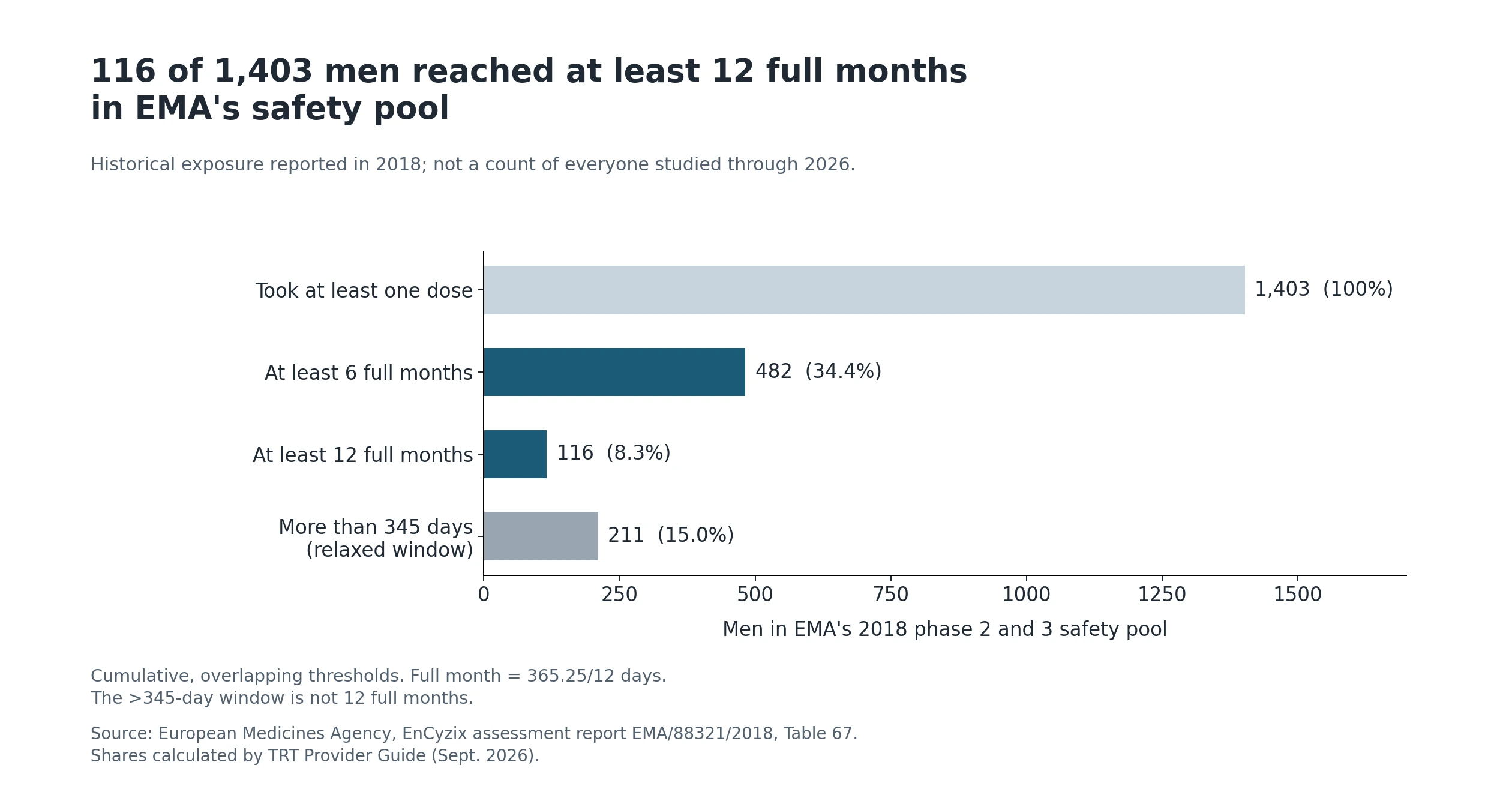
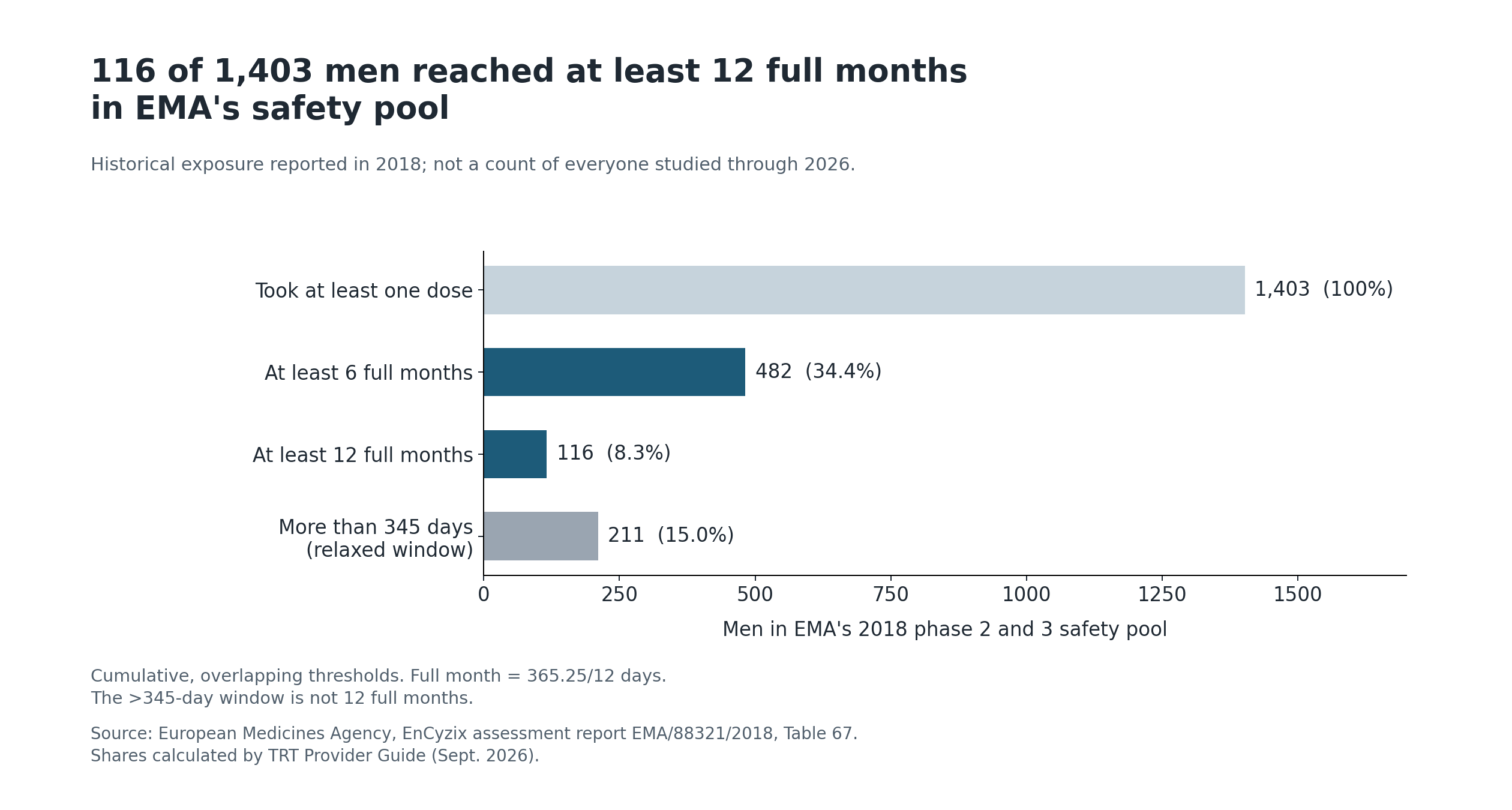
In EMA's 2018 phase 2 and 3 safety pool, 482 of 1,403 men (34.4%) reached at least 6 full months and 116 (8.3%) reached at least 12 full months. The pivotal trials treated men for 12 to 18 weeks. These are historical exposure counts, not a count of everyone studied through 2026.
Twelve to eighteen weeks is about one season. That can reveal common short-term events; it cannot settle risks that may emerge over years. EMA said the ability to spot rare reactions was limited, especially after long use.
| Time on enclomiphene | Men | Share of 1,403 |
|---|---|---|
| At least one dose | 1,403 | 100% |
| At least 6 full months | 482 | 34.4% |
| At least 12 full months | 116 | 8.3% |
| More than 345 days (relaxed window) | 211 | 15.0% |
Source: EMA, EnCyzix assessment report EMA/88321/2018, Tables 66-67, p.91, visually checked September 29, 2026. Shares by TRT Provider Guide. Table 67 says 'at least' and defines a month as 365.25/12 days. Later prose says 'more than 12 months'; we use the table's definition and disclose the difference. The report also rounds counts elsewhere to '500 and 100'; we use the exact counts.
Count everyone past 345 days, just under a year, and it is 211 men (15.0%). That is a different cutoff, not another 211 people.
The longest placebo-controlled trial with posted results in the developer's registry set, ZA-205, treated 35 men with enclomiphene for up to 12 months and tracked safety for about 13 months. A 300-man trial of bone density, ZA-303, has no results posted on the registry.
Can enclomiphene affect your vision?
Eye problems were uncommon, and in placebo-controlled trials they weren't more frequent than on placebo: 1.6% vs. 2.4%. Blurred vision was reported by 14 men on enclomiphene (1.0%) vs. 3 on placebo (0.8%). It was still among the most common reasons men quit.
Vision gets extra attention for a reason. Enclomiphene is one of the two forms that make up clomiphene (Clomid), and the EMA notes that Clomid is known to cause short-lived vision disturbances.
| What was counted | Enclomiphene | Placebo | AndroGel | Which trials |
|---|---|---|---|---|
| Any eye problem | 56 (4.0%) | 9 (2.3%) | 4 (2.7%) | All phase 2 and 3 trials |
| Any eye problem | 1.6% | 2.4% | Not reported | Placebo-controlled trials only |
| Blurred vision | 14 (1.0%) | 3 (0.8%) | Not reported | Phase 2 and 3 pool |
Source: EMA, EnCyzix assessment report EMA/88321/2018, effects table and "Ophthalmic changes," checked September 29, 2026. The two "any eye problem" rows come from different groups of trials, which is why they point in opposite directions.
One more detail: 12 of the 14 blurred-vision reports came while men were taking 12.5 mg, the lower dose. Any new or sudden change in vision deserves a prompt check with a clinician. A sudden shower of floaters, flashes, or a curtain-like shadow needs an eye doctor or emergency department right away (National Eye Institute). That is general eye-safety advice, not proof that enclomiphene causes retinal detachment.
Does enclomiphene affect blood counts or PSA?
Yes, changes were recorded. EMA reports a shift from normal hematocrit to above 54% in 3% of enclomiphene patients, 6.1% on AndroGel, and 0.3% on placebo. Its PSA table reports a mean rise of 0.3 micrograms/L on enclomiphene, 0.1 on AndroGel, and 0.0 on placebo. A separate PSA threshold row has an unclear cutoff.
Hematocrit is the share of your blood made up of red blood cells. Higher testosterone can push it up, and thicker blood may raise clot risk; the EMA noted that one of the clot cases happened in a man with increased hematocrit. PSA is a blood test for a prostate protein. It can rise when testosterone rises, and it's also used to screen for prostate cancer.
| What was counted | Enclomiphene | AndroGel (testosterone gel) | Placebo |
|---|---|---|---|
| Hematocrit shifted from normal baseline to above 54% (EMA-reported rates) | 3% | 6.1% | 0.3% |
| Hematocrit rise judged at least possibly drug-related | 0.6% | 1.4% | 0% |
| Mean PSA change from baseline | +0.3 micrograms/L | +0.1 micrograms/L | 0.0 micrograms/L |
| PSA threshold category printed as ">75 μg/L"; cutoff unclear | 131 of 1,403 (9.3%) | 9 of 147 (6.1%) | 20 of 391 (5.1%) |
Source: EMA, EnCyzix assessment report EMA/88321/2018, checked September 29, 2026. Table 77 prints ">75 μg/L" for the threshold row. We cannot resolve that cutoff and have not changed it to ">0.75" or called it any PSA rise. The hematocrit percentages are kept as reported because their applicable denominators are not clear enough to reproduce. EMA said the clinical relevance of the PSA increases is unknown.
For the normal ranges shown on a lab report, see our TRT bloodwork reference ranges.
Can enclomiphene cause gyno, mood changes, acne, sleep problems, or hair loss?
Some were recorded, but the evidence differs by symptom. Gynecomastia (breast tissue growth) was reported in 0.07% of men on enclomiphene versus 0.7% on AndroGel. Two registry trials logged no acne on enclomiphene, but EMA's larger pool recorded 7 possibly related cases among 1,403 men (0.5%). None of the 10 developer trials with posted results listed hair loss.
That last line has a catch. A missing event may fall below the reporting threshold or may not have been captured. "Not listed" does not mean "impossible," and it does not establish a frequency.
| Symptom | What the records show | Source |
|---|---|---|
| Gynecomastia | 0.07% on enclomiphene vs. 0.7% on AndroGel and 0% on placebo | EMA, 2018 |
| Breast enlargement (judged possibly drug-related) | 0.2% on enclomiphene vs. 0% on AndroGel and placebo | EMA, 2018 |
| Erectile dysfunction | 0.6% on enclomiphene vs. 0% on AndroGel and placebo | EMA, 2018 |
| Aggression (judged possibly drug-related) | 0.5% on enclomiphene vs. 0% on placebo | EMA, 2018 |
| Anxiety | 0.4% on enclomiphene and 0.4% on placebo | EMA, 2018 |
| Acne | 0 of 106 on enclomiphene vs. 3 of 47 on testosterone gel in two registry trials; separately, 7 of 1,403 (0.5%) judged possibly related in the EMA pool | ZA-203 and ZA-204 registry results; EMA Table 69 |
| Trouble sleeping | 1 of 18 on 12.5 mg vs. 0 of 15 on placebo (ZA-205); 1 of 16 on 6.25 mg (ZA-204) | Registry results |
| Hair loss | Not listed in any of the 10 trials with posted results | Registry results |
| Mood changes vs. clomiphene | 0% after switching to enclomiphene vs. 9.1% on clomiphene | Saffati et al., 2024 |
Sources: EMA, EnCyzix assessment report EMA/88321/2018; ClinicalTrials.gov NCT01270841, NCT01386606, NCT02651688; Saffati et al., Translational Andrology and Urology, 2024. All checked September 29, 2026.
Are side effects worse at 25 mg than at 12.5 mg?
ZA-300 does not establish a clear dose effect. Men weren't randomly assigned a dose in that trial; they started at 12.5 mg and some moved up. In ZA-300, hot flashes were more common at 25 mg (3.2% vs. 1.0%), while more men at 12.5 mg quit because of side effects (6.9% vs. 2.8%).
| What was counted | 12.5 mg | 25 mg | Source |
|---|---|---|---|
| Hot flashes | 2 of 207 (1.0%) | 9 of 283 (3.2%) | ZA-300 |
| Headache | 12 of 207 (5.8%) | 23 of 283 (8.1%) | ZA-300 |
| Any non-serious event above the 3% line | 66 of 207 (31.9%) | 92 of 283 (32.5%) | ZA-300 |
| Quit because of an adverse event | 15 of 216 (6.9%) | 8 of 283 (2.8%) | ZA-300 |
| Blurred-vision reports | 12 of 14 | 2 of 14 | EMA pool |
Sources: ClinicalTrials.gov NCT01534208; EMA, EnCyzix assessment report. Checked September 29, 2026. ZA-300 planned 26 weeks of treatment for both reporting groups; moving up a dose depended on response, not random assignment. EMA's blurred-vision row counts 14 reports across its pool, not all men at each dose. It cannot give a dose-specific risk.
This page doesn't give dosing advice. Dose decisions belong with the prescriber.
Does enclomiphene have fewer side effects than clomiphene?
One clinic reported fewer documented effects after men switched: 31 on clomiphene and 8 on enclomiphene. Its table prints 47.0% and 13.8%, but the enclomiphene percentage does not fit its stated 66-man cohort. It wasn't randomized, and those percentages do not establish a reliable percent reduction in risk.
Clomiphene (Clomid) is a mix of two forms of the same molecule: same atoms, different shape. Enclomiphene is one of them. The other, zuclomiphene, acts more like estrogen and lingers in the body longer. That's the usual explanation for why the purified form might cause fewer side effects.
| Side effect | Clomiphene (66 men) | Enclomiphene (as published) |
|---|---|---|
| Any documented side effect | 31 (47.0%) | 8 (13.8%) |
| Decreased libido | 22 (33.3%) | 5 (8.6%) |
| Erectile dysfunction | 12 (18.2%) | 5 (8.6%) |
| Fatigue | 12 (18.2%) | 4 (6.9%) |
| Decreased energy | 11 (16.7%) | 3 (5.2%) |
| Mood changes | 6 (9.1%) | 0 (0%) |
| Weakness | 4 (6.1%) | 1 (1.7%) |
| Agitation | 4 (6.1%) | 1 (1.7%) |
| Depressive thoughts | 3 (4.5%) | 0 (0%) |
| Gynecomastia | 2 (3%) | 0 (0%) |
| Median change in estradiol | +17.5 pg/mL | −5.92 pg/mL |
Source: Saffati et al., "Safety and efficacy of enclomiphene and clomiphene for hypogonadal men," Translational Andrology and Urology, 2024, Tables 2 and 3, checked September 29, 2026. Baylor College of Medicine clinic records, 2021 to 2022.
Three things keep this from being a clean win:
- Same men, one after the other. Everyone took clomiphene first, then switched, with no break in between. Leftover clomiphene could have colored the enclomiphene results.
- Different lengths of time. Men were on clomiphene for a median of 18.7 months and on enclomiphene for 8.9 months. More time means more chances to log a problem.
- A group-size puzzle. The paper reports 66 men. The nonzero enclomiphene percentages fit a group of 58 after rounding (8 ÷ 58 = 13.8%), not 66. The paper does not explain the difference. We show its numbers as published, leave the enclomiphene denominator unresolved, and do not treat 58 as a verified group size.
Why an odds ratio is not "80% fewer side effects"
The paper reports an odds ratio of 0.18. An odds ratio compares the odds of something happening, not the chance of it, and it isn't the same as a percent drop. An odds ratio of 0.18 is 82% lower odds (1 − 0.18), not 82% fewer people affected. Dividing the paper's rounded percentages would also ignore its unresolved denominator and unequal treatment periods. Neither calculation establishes how much safer one drug is.
For a head-to-head on cost, access, and fertility, see our enclomiphene vs. clomiphene comparison.
Enclomiphene vs. testosterone: which side effects differ?
One clear difference in the registry is the coded sperm event. In ZA-203, decreased sperm concentration was logged as an adverse event in 0 of 60 men on enclomiphene versus 8 of 33 (24.2%) on testosterone gel. That code is not the same as measuring every fall in sperm count. EMA's other figures below describe separate outcomes and do not produce one overall safety winner.
That fits how each works. Testosterone from outside the body can suppress the brain's signals needed for sperm production. Enclomiphene blocks estrogen's feedback on those signals, which can raise the body's own testosterone. Preserving sperm concentration in some trials is not a promise of preserved fertility.
| What was counted | Enclomiphene | Testosterone gel | Source |
|---|---|---|---|
| Sperm concentration drop logged as an adverse event | 0 of 60 | 8 of 33 (24.2%) | ZA-203 (placebo: 0 of 28) |
| Acne | 0 of 106 | 3 of 47 | ZA-203 and ZA-204 |
| Gynecomastia | 0.07% | 0.7% | EMA |
| Normal-baseline hematocrit shifted above 54% (reported rates) | 3% | 6.1% | EMA |
| Hot flashes (judged possibly drug-related) | 1.1% | 0% | EMA |
| Erectile dysfunction | 0.6% | 0% | EMA |
| Clot-related events | 4 of 1,403 | 0 | EMA |
Sources: ClinicalTrials.gov NCT01270841 and NCT01386606; EMA, EnCyzix assessment report EMA/88321/2018. Checked September 29, 2026. Testosterone gel was Testim in ZA-203 and AndroGel in the EMA comparisons.
The measured sperm results show why the definition matters. In ZA-301's intent-to-treat analysis, a fall in sperm concentration of at least 50% was found in 16 of 113 men on enclomiphene (14.2%) and 1 of 38 on placebo (2.6%) after 12 weeks (EMA 2018, pp.79-80). Those are semen-test outcomes, not the adverse-event code in ZA-203 or pregnancy outcomes.
There's also a big difference in the available safety evidence. TRAVERSE had 5,198 treated participants across testosterone and placebo groups, ages 45-80 with existing or high cardiovascular risk. Mean follow-up was 33.0 months; mean treatment was 21.7 months. EMA's historical enclomiphene pool had 116 men reach at least 12 full months of exposure. Follow-up and time taking a drug are different measures. See our TRT side effect rates from TRAVERSE and sperm recovery after testosterone for the testosterone side.
If fertility is the reason you're looking at enclomiphene, our fertility-first TRT guide and enclomiphene vs. TRT comparison walk through the tradeoffs.
If you're weighing enclomiphene for yourself, bring these numbers to a clinician. Our questions to ask a TRT clinic cover how side effects, blood work, and clot risk should be checked.
Where do the popular enclomiphene side-effect numbers come from?
Several numbers used in side-effect summaries need their definitions attached. EMA's possibly related symptom rates are not a total side-effect rate. The 21% figure cited through a later review was not verified in the original trial paper. An odds ratio is not a percentage reduction in the number of people affected.
| What you'll often read | Where it traces | What it actually measures | A better number |
|---|---|---|---|
| "Side effects in 1 to 3% of men" | EMA has specific related-symptom rates, but this audit does not prove it is the source of every online 1-3% claim | One symptom and definition at a time, not all effects | Table 3c: related headache 23 of 1,403 (1.6%); Table 3: all-recorded headache 15 of 324 (4.6%) |
| "21% of patients had side effects" | Kim et al. 2016 (trials ZA-304 and ZA-305), as summarized in a 2025 meta-analysis | Original safety table was not accessible in this audit; scope and denominator are not independently verified | Excluded from the clinical dataset; use the primary-source group counts in Tables 2 and 3 |
| "About 80% fewer side effects than Clomid" | Saffati et al. 2024, odds ratio 0.18 | Odds, from a nonrandomized, same-men comparison | 31 documented cases then 8; published percentages have an unresolved enclomiphene denominator |
| "No known long-term complications" | No source we could find | Nothing measured | 116 of 1,403 in EMA's 2018 safety pool reached at least 12 full months |
Sources: EMA, EnCyzix assessment report; Hohl et al., Archives of Endocrinology and Metabolism, 2025; Saffati et al., 2024; ClinicalTrials.gov. Checked September 29, 2026.
Some are published numbers stripped of their context; others could not be verified at their original source. Put the definition, denominator, and follow-up back, and the story changes.
How many enclomiphene trials have no posted results?
As of September 29, 2026, 14 of the 24 enclomiphene trials Repros Therapeutics registered on ClinicalTrials.gov (58%) have no posted results, including 6 of 9 phase 3 trials. Two of those phase 3 trials were published in a journal instead; the 300-man bone-density trial has no posted results.
A phase 3 trial is a later-stage study intended to gather evidence about benefits and safety for a possible approval application. The phase label alone does not tell you the size or quality of a study.
| Phase | Registered | Results posted | No results posted |
|---|---|---|---|
| Phase 1 | 9 | 2 | 7 |
| Phase 2 | 6 | 5 | 1 |
| Phase 3 | 9 | 3 | 6 |
| Total | 24 | 10 | 14 |
Source: ClinicalTrials.gov records sponsored by Repros Therapeutics, checked September 29, 2026; the sponsor's unrelated Proellex studies are excluded. Count by TRT Provider Guide.
The six phase 3 trials without posted results are ZA-003 (194 men enrolled), its extension (104), the ZA-301 extension (300, listed as an estimate), ZA-303 (300), ZA-304 (120), and ZA-305 (120). ZA-304 and ZA-305 were published together as Kim et al. 2016. The full list, with links, is in the trials download.
A missing registry result is not a missing study. Some results appear in journal papers or the EMA assessment instead. Our ledger checks the original registry entries directly and keeps them separate from regulator pools and published papers. It does not measure how often other writers have used them.
Is enclomiphene FDA approved, and why did Europe refuse it?
No. FDA turned down the application in November 2015, and the European Union refused it in 2018, citing no proof it eased symptoms and a risk of blood clots in the veins. FDA's May 14, 2026 compounding list still shows enclomiphene citrate as "under evaluation."
A Complete Response Letter is FDA's way of saying an application can't be approved as submitted. Compounding means combining or changing ingredients to make a medicine for a patient. FDA's Category 1 is a holding list of ingredients it's still evaluating for that use. Being on it isn't approval.
| Date | What happened | Source |
|---|---|---|
| Nov. 30, 2015 | Repros receives FDA's Complete Response Letter. It says the phase 3 design was "no longer adequate" to show clinical benefit and flags entry criteria, dose titration, and lab-method validation. | Repros: Dec. 1 release; Jan. 4 follow-up confirming Nov. 30 receipt |
| Jan. 25, 2018 | EMA's drug committee recommends refusal: the 4 main studies (588 patients) showed higher testosterone but didn't test symptom relief, and there is a risk of venous blood clots. | EMA |
| Apr. 6, 2018 | The EU refuses marketing authorization for EnCyzix. | EMA |
| June 8, 2022 | FDA's Pharmacy Compounding Advisory Committee votes 8 to 4 against adding enclomiphene citrate to the 503A bulks list, a list used under the patient-specific compounding rules; several members cite a lack of efficacy evidence. | FDA summary minutes |
| May 14, 2026 | FDA's latest list still places enclomiphene citrate in Category 1, "under evaluation." | FDA 503A categories list |
All sources checked September 29, 2026.
This is why the old trial record still matters. It remains a substantial part of the human safety evidence checked here. Neither an old refusal nor an ingredient's current evaluation status supplies a personal safety answer.
What newer human research adds
A May 2026 case series followed 15 men for 60 days after they received a multi-ingredient sublingual formulation containing enclomiphene. No serious adverse events were documented. It had no comparison group, relied on passive event monitoring, and did not isolate enclomiphene from the other ingredients. The author disclosed commercial ties to the formulation. This adds a short real-world report, not long-term safety proof (Warren 2026).
What this data does and doesn't show
- Recorded isn't caused. An adverse event is anything that happened during the study. Placebo groups show how much happens anyway.
- Blanks aren't zeros. Registry records use thresholds for listing non-serious event types (0%, 3%, or 5% in a group); collection can also miss events.
- Short trials, specific men. Most trials lasted 6 weeks to 6 months. Many enrolled overweight men with low testosterone caused by a brain-signal problem (secondary hypogonadism). Results may not fit younger, leaner, or older men.
- Not today's products. The developer's trials used Repros's capsules. They do not verify the quality or contents of today's compounded products. The separate 2026 case series used a multi-ingredient formulation, not those capsules.
- Small counts swing hard. With 1 or 3 events in a group, one extra case changes the percentage a lot.
- Overlap. The EMA's 1,403-man pool includes men from the registry trials. Never add the two together.
- Unmatched cases. We couldn't match each of the EMA's clot cases to a specific registry entry, except the one ZA-300 patient the EMA describes.
How we built this
What we collected. The 24 enclomiphene trial records returned by the Repros sponsor-and-intervention search, results for the 10 that have them, EMA's 2018 EnCyzix assessment, FDA's 2022 committee minutes and current compounding category list, Repros's SEC-filed releases, Saffati's 2024 paper, Hohl's 2025 meta-analysis, the original TRAVERSE paper, and Warren's 2026 case series. Kim's 2016 abstract was checked, but its full safety table was not accessible. The 24-record developer inventory does not count every human study worldwide.
When. The source audit was completed on September 29, 2026. Historical observations keep their actual period. A targeted search for human enclomiphene safety research published in 2025-2026 added the Warren report; this was not an exhaustive systematic review.
How we processed it. We read each posted trial's adverse-event module and the participant-flow records needed for withdrawals. The event CSV keeps selected outcomes used on this page, not every symptom in every source. All 280 registry rows in the draft were checked against original counts and group sizes; none needed a numeric correction. Missing ZA-110 rows and the verified regulator findings were added. Dose-group sums use separate groups only; the ZA-110 crossover periods are not added as different people. ZA-109's combined placebo/enclomiphene record stays labeled as mixed exposure.
Percentages. We divide men with an event by the source's corresponding group size. Calculated dataset percentages use one decimal place, rounded half up. Table 3b shows two decimals for its small serious-event shares. Published percentages keep their source precision and are labeled as published. An unclear source denominator stays blank; it is not back-calculated. Hormone changes have their own value and unit fields, not a percent field.
The math. Headache in ZA-300: (12 + 23) ÷ (207 + 283) = 35 ÷ 490 = 7.1%. Full-year exposure: 116 ÷ 1,403 = 8.3%; the relaxed >345-day window is 211 ÷ 1,403 = 15.0%. The unadjusted registry headache difference is (14 ÷ 282 − 3 ÷ 100) × 1,000 = 19.6. That last calculation mixes follow-up windows and is not a forecast or a treatment-effect estimate. The summary-metrics CSV contains each shared chart value and the raw-total formulas.
What we checked directly. Every retained registry count against its original result. EMA text and the relevant table images, including Tables 66-69, 73, 77-79, against the original PDF. Saffati's tables and design against the publisher's full text. Hohl is the original source for its own pooled estradiol estimate; we did not rerun that meta-analysis or use its summary of Kim as primary safety data. FDA status and vote counts were checked in the agency's own documents; the exact 2015 receipt date was checked in Repros's January 2016 SEC-filed release.
What remains unclear. EMA Table 68's caption differs from the pool indicated by its denominators. Table 77 prints an unresolved PSA cutoff. Saffati's enclomiphene percentages do not reproduce from the stated 66-person cohort. These are shown, not silently repaired. Sources labeled as published can support what a report says without supporting a newly calculated clinical rate.
What we didn't do. We did not obtain private patient records, rerun a meta-analysis, or build a personal risk score. We did not combine overlapping regulator and registry populations, infer that zero reports means zero risk, or turn a laboratory result into a fertility guarantee. This is public-source analysis, not our own study of patients. Our standards are in the research and data methodology and editorial standards.
How to cite this page
Page: TRT Provider Guide. "Enclomiphene Side Effects: Rates From 10 Human Trials." Updated September 2026. https://trtproviderguide.com/research/enclomiphene-side-effects/
Headline finding: Only 116 of the 1,403 men in EMA's 2018 enclomiphene phase 2 and 3 safety pool (8.3%) reached at least 12 full months of treatment (TRT Provider Guide analysis of EMA Table 67, September 2026).
Headache finding: Headache was recorded in 35 of 490 men (7.1%) in ZA-300 over 26 weeks of treatment plus 8 weeks of follow-up, with no placebo group (TRT Provider Guide calculation from ClinicalTrials.gov NCT01534208, checked September 29, 2026).
Dataset: TRT Provider Guide. "Enclomiphene Trial Safety Ledger," version 1.1. September 2026. https://trtproviderguide.com/research/enclomiphene-side-effects/
You may reuse our original wording, calculations, and chart designs with credit to TRT Provider Guide. Underlying source content keeps its own attribution and license terms; we do not grant rights we do not hold.
Download the data
All three files are free, with no sign-up. Every row carries its source link and check date.
- enclomiphene-trials.csv: all 24 registered trials, with design, enrollment, and results status.
- enclomiphene-side-effect-records.csv: 403 source-linked event, exposure, and laboratory records, group by group, from the registry, the EMA report, and journal sources.
- enclomiphene-summary-metrics.csv: 28 chart values and unadjusted registry totals, with formulas and limits.
Questions people ask about enclomiphene side effects
Is enclomiphene safer than TRT?
The evidence does not establish one overall safer choice. ZA-203 logged decreased sperm concentration as an adverse event in 0 of 60 enclomiphene patients, but that does not mean no sperm counts fell. EMA identified a vein-clot risk; its historical pool had 116 of 1,403 men reach at least 12 full months. TRAVERSE followed 5,198 testosterone-or-placebo participants for a mean 33 months, a different population and measure (EMA; TRAVERSE).
What happens when you start taking enclomiphene?
The posted records do not give a reliable week-by-week symptom timeline. Headache was recorded in 7.1% over ZA-300's eight-month safety window; muscle spasms, hot flashes, and dizziness were also recorded (ZA-300). New trouble breathing or chest pain when breathing needs urgent care; a newly swollen, tender leg needs prompt assessment (NHLBI).
Is it bad to take enclomiphene every day?
Repeated-dose trials used daily treatment, but that does not tell one person whether daily use is suitable. In EMA's 2018 pool, 116 of 1,403 men reached at least 12 full months (Table 67). Ask the prescriber how long treatment is planned and how blood work and new symptoms will be checked.
What should you avoid while taking enclomiphene?
There is no FDA-approved enclomiphene label with a complete approved interaction list. That does not mean interactions have not been studied: EMA reviews interaction studies and clot risks. A prescriber should review other medicines and any history of clots, clotting disorders, or recent surgery; do not add hormone or estrogen-blocking products on your own (EMA).
Can enclomiphene cause hair loss?
None of the 10 developer trials with posted results listed hair loss in the adverse-event tables checked here. It may not have been captured or may have fallen below a reporting threshold. Missing from a table is not proof it cannot happen; this review did not establish a reliable hair-loss rate (trial ledger).
Does enclomiphene cause gyno?
EMA reports gynecomastia in 0.07% of men on enclomiphene versus 0.7% on AndroGel and 0% on placebo (EMA). One clinic's records documented 0 cases after switching to enclomiphene versus 2 of 66 during clomiphene treatment. The clinic paper's enclomiphene denominator remains unclear (Saffati 2024).
Does enclomiphene raise estrogen?
It depends on the study. In one clinic's records, estradiol (the main estrogen in men) fell slightly after men switched from clomiphene to enclomiphene: a median change of −5.92 pg/mL vs. +17.5 pg/mL on clomiphene. A 2025 meta-analysis that pooled clomiphene and enclomiphene trials reported an estimated mean difference of 33.99 pg/mL versus placebo, about 34 pg/mL. That is not an enclomiphene-only estimate (Saffati 2024; Hohl 2025).
Can enclomiphene affect sleep?
Insomnia was recorded in 1 of 18 men in ZA-205's 12.5 mg group versus 0 of 15 on placebo, over about 13 months of safety observation. In ZA-204, it was recorded in 1 of 16 men in the 6.25 mg group. These small counts do not establish a general sleep-problem rate (ZA-205; ZA-204).
Does enclomiphene cause acne?
Acne was reported in EMA's larger pool: 7 of 1,403 men (0.5%) had cases judged at least possibly related (EMA Table 69). Separately, ZA-203 and ZA-204 logged 0 of 106 on enclomiphene versus 3 of 47 on testosterone gel. Those zero entries do not rule out acne (comparison table).
Do enclomiphene side effects go away after you stop?
The records checked here do not give one reliable time-to-recovery number. ZA-300 tracked men for 8 weeks after treatment, but its posted results do not say when each problem ended (ZA-300). Ask the prescriber what to watch for after stopping.
What are the long-term side effects of enclomiphene?
Long-term risk is not well quantified. In EMA's 2018 safety pool, 116 of 1,403 men (8.3%) reached at least 12 full months; the report said limited longer exposure left the size of the clot risk unclear. Using its relaxed >345-day window gives 211 men (15.0%), not a larger full-year cohort (EMA Table 67 and safety discussion).
Is enclomiphene FDA approved?
No. Repros received an FDA Complete Response Letter on November 30, 2015, and its compounding advisers voted 8 to 4 against listing enclomiphene citrate in June 2022. FDA's list updated May 14, 2026 still shows it "under evaluation," which is not approval (Repros receipt date; FDA minutes; FDA list).
Sources
-
ClinicalTrials.gov. ZA-300, NCT01534208: Safety Study of Enclomiphene Citrate in the Treatment of Men With Secondary Hypogonadism. Results posted July 24, 2014. Checked September 29, 2026.
-
ClinicalTrials.gov. ZA-301, NCT01532414. Results posted May 27, 2015. Checked September 29, 2026.
-
ClinicalTrials.gov. ZA-302, NCT01739595. Results posted May 27, 2015. Checked September 29, 2026.
-
ClinicalTrials.gov. ZA-202, NCT01191320. Results posted July 24, 2014. Checked September 29, 2026.
-
ClinicalTrials.gov. ZA-203, NCT01270841. Results posted July 28, 2014. Checked September 29, 2026.
-
ClinicalTrials.gov. ZA-204, NCT01386606. Results posted September 23, 2015. Checked September 29, 2026.
-
ClinicalTrials.gov. ZA-205, NCT02651688. Results posted June 14, 2019. Checked September 29, 2026.
-
ClinicalTrials.gov. ZA-201, NCT00706719. Results posted October 8, 2010. Checked September 29, 2026.
-
ClinicalTrials.gov. ZA-109, NCT01959685. Results posted August 11, 2014. Checked September 29, 2026.
-
ClinicalTrials.gov. ZA-110, NCT01984398. Results posted May 6, 2019. Checked September 29, 2026.
-
ClinicalTrials.gov. ZA-303, NCT01619683. No results posted. Checked September 29, 2026.
-
ClinicalTrials.gov. Studies sponsored by Repros Therapeutics. Checked September 29, 2026.
-
European Medicines Agency. EnCyzix: EPAR public assessment report, EMA/88321/2018. 2018. Checked September 29, 2026.
-
European Medicines Agency. EnCyzix: refusal of marketing authorisation. Opinion January 25, 2018; refusal April 6, 2018. Checked September 29, 2026.
-
U.S. Food and Drug Administration. Pharmacy Compounding Advisory Committee, June 8, 2022: summary minutes. Checked September 29, 2026.
-
U.S. Food and Drug Administration. FDA briefing information for the June 2022 Pharmacy Compounding Advisory Committee. Background reference. Full briefing access was incomplete in this audit; no numerical finding or quotation on this page depends on it.
-
U.S. Food and Drug Administration. Bulk drug substances nominated for use in compounding under section 503A. Updated May 14, 2026. Checked September 29, 2026.
-
Repros Therapeutics. Repros Therapeutics receives Complete Response Letter from FDA for enclomiphene. December 1, 2015. Checked September 29, 2026.
-
Saffati G, et al. Safety and efficacy of enclomiphene and clomiphene for hypogonadal men. Translational Andrology and Urology. 2024;13(9):1984-1990. Checked September 29, 2026.
-
Hohl A, et al. Clomiphene or enclomiphene citrate for the treatment of male hypogonadism: a systematic review and meta-analysis of randomized controlled trials. Archives of Endocrinology and Metabolism. 2025. Checked September 29, 2026.
-
Kim ED, et al. Oral enclomiphene citrate raises testosterone and preserves sperm counts in obese hypogonadal men, unlike topical testosterone. BJU International. 2016. Original abstract checked September 29, 2026; full safety table inaccessible. The secondary 53-men/21% claim is not clinical data in this page.
-
Wiehle RD, et al. Enclomiphene citrate stimulates testosterone production while preventing oligospermia: a randomized phase II clinical trial comparing topical testosterone. Fertility and Sterility. 2014. Publication identity checked September 29, 2026; this page uses the original ZA-203 registry for its event counts, not an assumed full-paper safety extraction.
-
Lincoff AM, et al. Cardiovascular Safety of Testosterone-Replacement Therapy (TRAVERSE). New England Journal of Medicine. 2023. Checked September 29, 2026.
-
Repros Therapeutics. Repros Updates Enclomiphene Program. January 4, 2016; confirms receipt of the Complete Response Letter on November 30, 2015. Checked September 29, 2026.
-
Warren S. Changes in Serum Testosterone After Sublingual Enclomiphene Citrate Combined With a Mineral Oxide Delivery System: A Retrospective Case Series of 15 Men. Cureus. May 20, 2026;18(5):e109299. Full text and disclosures checked September 29, 2026.
-
National Heart, Lung, and Blood Institute. Venous Thromboembolism: Symptoms. General symptom guidance, checked September 29, 2026.
-
National Eye Institute. Retinal Detachment. General urgent eye-symptom guidance, checked September 29, 2026.
TRT Provider Guide is an independent publishing and research resource. It is not a clinic, pharmacy, laboratory, insurer, or drug maker.