FDA-Approved Testosterone Brands: 2026 Data and Complete List
By TRT Provider Guide
Key finding: “As of September 2, 2026, FDA records show 12 current named testosterone brands in the United States. Those brands span 13 application/formulation records and 6 delivery types.”
This count uses current FDA product records, not old brand lists. AndroGel counts once as a brand but twice in the product-record count because its 1% and 1.62% products have separate FDA applications.
*Editorial research by TRT Provider Guide (not clinically reviewed) · Last verified: September 2, 2026
Key finding: "As of September 2, 2026, the current FDA Orange Book brand-name index contained 12 named testosterone brands. Our normalized dataset splits them into 13 brand-and-formulation application records across 6 delivery types."
The extra record comes from AndroGel. It is one brand name, but AndroGel 1% and AndroGel 1.62% have separate FDA applications. This page counts named brands and application-level formulations. It does not mix in generic copies, every strength, every package, every NDC code, compounded testosterone, or old brands that now sit only on FDA's discontinued list.
The second thing to know: every modern testosterone product on this list was approved on a blood test, not a symptom test. FDA's own slide from 2019 puts it plainly: "FDA does NOT require demonstration of benefit by any clinical efficacy measure." The bar FDA's review division wrote down is that at least 75% of men must land in the normal testosterone range. We explain what that means below.
| Counted unit | Finding | What it means |
|---|---|---|
| Unique named brands | 12 | One count for each proprietary name in the current FDA index |
| Brand/formulation application records | 13 | AndroGel 1% and 1.62% are separate records because they have separate FDA applications |
| Normalized delivery types | 6 | Skin gel, oral capsule, intramuscular injection, subcutaneous autoinjector, nasal gel, and implant pellet |
| Named oral brands | 3 | Jatenzo, Kyzatrex, and Tlando |
| Newest brand-name approval | Kyzatrex, July 27, 2022 | The newest brand-name testosterone application we could document |
| Oldest form still approved | Pellet, 1942 | FDA says the testosterone pellet was approved in 1942, before the 1962 law that required proof a drug works |
Source: FDA Orange Book Appendix A (file served September 2, 2026), Drugs@FDA, DailyMed, and FDA presentation slides; compiled and verified by TRT Provider Guide.
Two more things are moving right now. On February 28, 2025, FDA ordered changes to every testosterone label. On June 18, 2026, HHS and FDA asked every maker to remove the line that says these products have not been proven safe or effective for "age-related" low testosterone. Labels are changing one product at a time. We read the newest ones so you can see where things stand.
Data files: CSV · XLSX · JSON · Regulatory timeline CSV · Label-status tracker CSV
This is an independent research and reference page from TRT Provider Guide. It is not a product ranking. It does not tell any person which medicine or dose to use.
FDA-Approved Testosterone Brands: 2026 Statistics
The current count is 12 brand names, 13 application/formulation records, and 6 delivery types. The table below shows the records behind that count.
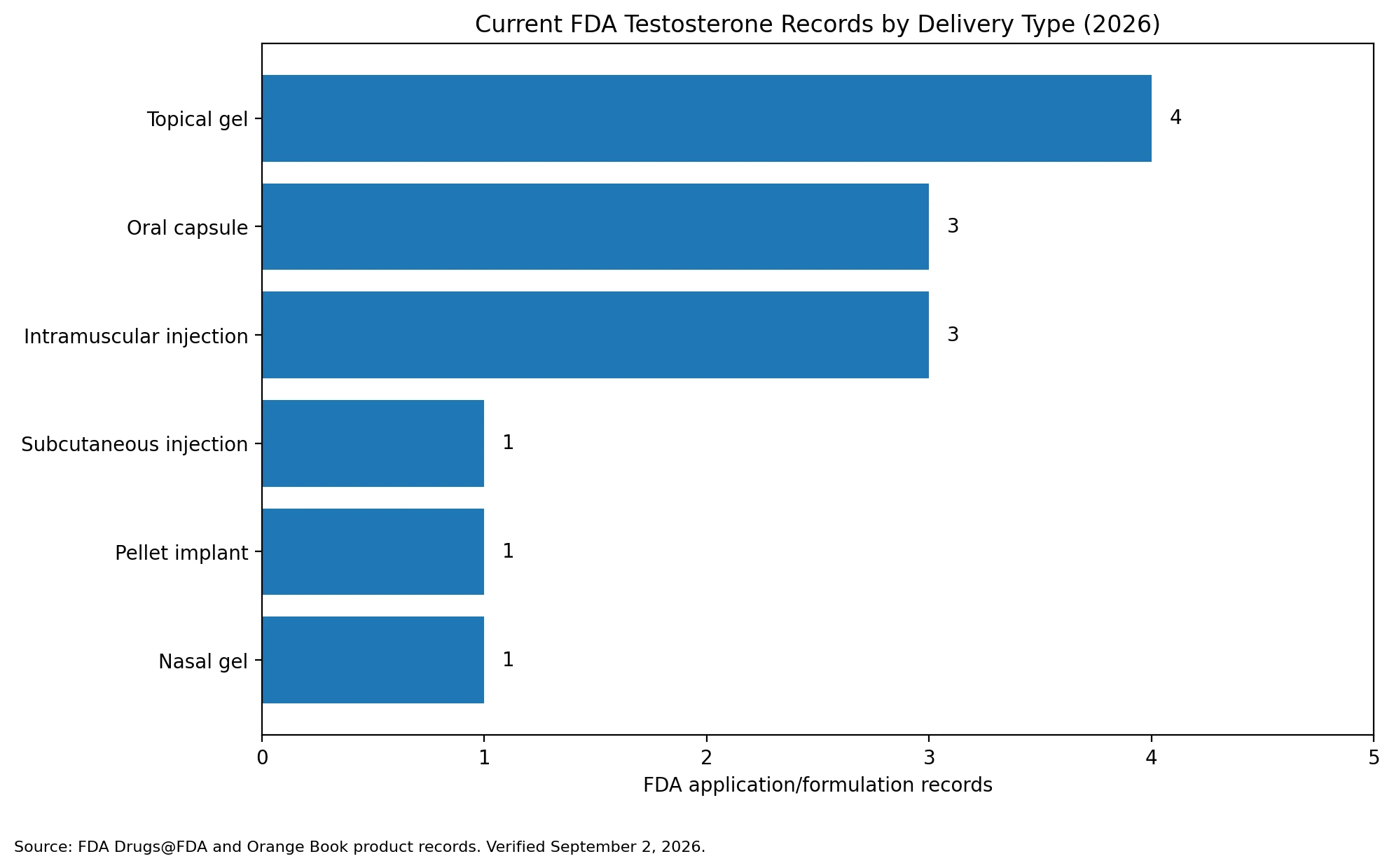
Chart source: FDA Drugs@FDA and Orange Book product records. Verified September 2, 2026. Counts use application/formulation records, not prescriptions or sales.
What testosterone products are FDA approved in 2026?
The current FDA Orange Book name index contains the 12 named brands shown below. We split AndroGel into two rows because its 1% and 1.62% forms have separate application numbers, so the full table has 13 records. Every row links to the FDA approval record and to a label reference.
A few words you will see in the table. An NDA is a New Drug Application — the full application a company files to get a new drug approved. An ANDA is an Abbreviated New Drug Application — the shorter application usually used for generic copies. Two of the 12 current brands, Depo-Testosterone and Testopel, were approved decades ago under application numbers that FDA's database lists as ANDAs. That is a quirk of history, not a mark against them.
| Brand/formulation record | Active ingredient | Delivery type | Listed strengths | Plain-language label schedule | First approved | FDA record and label |
|---|---|---|---|---|---|---|
| AndroGel 1% | testosterone | Topical skin gel | 12.5 mg per pump actuation; 25 mg/2.5 g packet; 50 mg/5 g packet | Applied once daily; dose is adjusted by the prescriber | 2000 | NDA 021015; Label reference |
| AndroGel 1.62% | testosterone | Topical skin gel | 20.25 mg per pump actuation; 20.25 mg/1.25 g packet; 40.5 mg/2.5 g packet | Applied once daily; labeled starting dose is 40.5 mg and may be adjusted | 2011 | NDA 022309; Label reference |
| Aveed | testosterone undecanoate | Intramuscular injection | 750 mg/3 mL (250 mg/mL) | At the start, again after 4 weeks, then every 10 weeks | 2014 | NDA 022219; Label reference |
| Azmiro | testosterone cypionate | Intramuscular injection | 200 mg/mL (vial and prefilled syringe) | Usually every 2 to 4 weeks; dose is individualized | 2022 (application); brand name added 2024; sold since December 2024 | NDA 216318; Label reference |
| Depo-Testosterone | testosterone cypionate | Intramuscular injection | 100 mg/mL; 200 mg/mL | Usually every 2 to 4 weeks; dose is individualized | July 25, 1979 | ANDA 085635; Label reference |
| Jatenzo | testosterone undecanoate | Oral capsule | 158 mg; 198 mg; 237 mg | Taken twice daily with food; dose may be adjusted | 2019 | NDA 206089; Label reference |
| Kyzatrex | testosterone undecanoate | Oral capsule | 50 mg; 150 mg; 200 mg (100 mg is still in labeling but is listed as discontinued by FDA) | Taken with food; frequency and dose follow the individualized prescription | July 27, 2022 | NDA 213953; Label reference |
| Natesto | testosterone | Nasal gel | 5.5 mg per actuation | 11 mg per dose, used three times daily | 2014 | NDA 205488; Label reference |
| Testim 1% | testosterone | Topical skin gel | 50 mg/5 g packet | Applied once daily; labeled starting dose is 50 mg | 2002 | NDA 021454; Label reference |
| Testopel | testosterone | Subcutaneous implant pellet | 75 mg per pellet | The label describes 150 to 450 mg every 3 to 6 months; a clinician implants the pellets | July 13, 1972 (ANDA 080911); pellet-form history dates to 1942 | ANDA 080911; Label reference |
| Tlando | testosterone undecanoate | Oral capsule | 112.5 mg per capsule | 225 mg, or two capsules, twice daily with food | 2022 | NDA 208088; Label reference |
| Vogelxo 1% | testosterone | Topical skin gel | 12.5 mg per pump actuation; 50 mg/5 g packet | Applied once daily; labeled starting dose is 50 mg | June 4, 2014 | NDA 204399; Label reference |
| Xyosted | testosterone enanthate | Subcutaneous autoinjector | 50 mg/0.5 mL; 75 mg/0.5 mL; 100 mg/0.5 mL | Used once weekly; labeled starting dose is 75 mg | 2018 | NDA 209863; Label reference |
Source: FDA Orange Book Appendix A (file served September 2, 2026); Drugs@FDA application records; DailyMed label references; FDA approval letters and review documents for approval years. Compiled by TRT Provider Guide. Table: FDA Testosterone Product Status Index (2026), version 1.0.0.
How to read the table: "Listed strengths" and "label schedule" are short summaries for identification. They are not dosing advice. The linked FDA application is the approval record. The DailyMed link is a label reference. "First approved" is the year of the original FDA approval of that application; day-level dates are in the data file. A prescriber or pharmacist should use the current product-specific label for care decisions.
How many FDA-approved testosterone products are there?
There is no honest single number until the counted unit is named. Under this page's rule, the answer is 12 current named brands or 13 brand/formulation application records. Counting every generic, strength, package, or NDC would give a much larger number and would answer a different question.
Here is how far apart those numbers can be. On September 2, 2026, a search of DailyMed — the National Library of Medicine's database of current drug labels — for label names containing "testosterone" returned 160 results. That list includes generic copies, repackaged versions of the same products, and methyltestosterone (a different molecule). Same day, same government data, one search returns 12 and another returns 160. The unit is everything.
| Question being counted | Answer on September 2, 2026 | Rule |
|---|---|---|
| How many unique named brands are in the current FDA brand index? | 12 | Count each proprietary name once |
| How many records are in this research dataset? | 13 | Split a brand when a separate formulation has a separate FDA application |
| How many named oral brands are in the index? | 3 | Count Jatenzo, Kyzatrex, and Tlando |
| How many named injection records are in the dataset? | 4 | Three intramuscular records plus one subcutaneous autoinjector |
| How many brand names have been approved and later dropped off the current list? | At least 6 | Androderm, Axiron, Striant, Fortesta, Delatestryl, Testoderm (see the history section) |
| How many current DailyMed labels have "testosterone" in the name? | 160 | Includes generics, repackagers, and methyltestosterone; not a count of approvals |
| How many generic copies of Depo-Testosterone existed at FDA's 2022 review? | 9 | FDA review of NDA 216318 |
| How many strengths, packages, or NDC listings exist? | Not counted here | Different units; a much larger, fast-changing number |
Source: FDA Orange Book Appendix A; Drugs@FDA; DailyMed search "NAME:(testosterone)" on September 2, 2026; FDA multidisciplinary review of NDA 216318 (2022). Compiled by TRT Provider Guide.
A writer can quote the 12-brand number when the subject is current named brands. The 13-record number is better when comparing formulations and routes.
| Normalized delivery type | Records | Share of the 13 records |
|---|---|---|
| Topical skin gel | 4 | 30.8% |
| Oral capsule | 3 | 23.1% |
| Intramuscular injection | 3 | 23.1% |
| Subcutaneous autoinjector | 1 | 7.7% |
| Nasal gel | 1 | 7.7% |
| Subcutaneous implant pellet | 1 | 7.7% |
Source: FDA Testosterone Product Status Index (2026), TRT Provider Guide.
How does the FDA decide a testosterone product works?
By TRT Provider Guide
This is the most misunderstood fact about "FDA-approved testosterone," so here it is in FDA's words and numbers.
In April 2019, an FDA deputy division director presented the agency's approach to a pediatric advisory committee. Her slides state that "FDA requires Sponsors to demonstrate only that a T product reliably and safely increases serum T concentrations into the normal range for healthy, eugonadal men," that the "primary efficacy measure" is a pharmacokinetic assessment of serum testosterone, and that "for the current T replacement indication, FDA does NOT require demonstration of benefit by any clinical efficacy measure." The stated reason: replacement therapy in men with specific hypogonadal conditions "is long-accepted, efficacious therapy."
The numbers behind that rule appear in an FDA clinical review from December 2010. The reviewing division wrote down what it "currently considers" acceptable evidence of efficacy for a testosterone replacement product:
| What FDA measures | The bar FDA's review division stated in 2010 | What it means in plain words |
|---|---|---|
| Primary endpoint: Cavg (average blood testosterone over 24 hours) | At least 75% of men in the normal range, with the lower bound of the 95% confidence interval above 65% | Three out of four men must land in the normal zone, and the result must be statistically solid |
| Secondary endpoint: Cmax (the peak) | At least 85% of men with a peak of 1,500 ng/dL or less | Most men's highest reading must stay under 1,500 |
| Secondary endpoint: high peaks | Fewer than 5% of men with a peak between 1,800 and 2,500 ng/dL | Very few men may spike that high |
Source: FDA Clinical Review, NDA 21-463 (Fortesta), Guodong Fang, MD, December 2010, section 1.2.2; FDA Pediatric Advisory Committee slides, Christine P. Nguyen, MD, April 8, 2019. Compiled by TRT Provider Guide.
A worked example from a current label: Kyzatrex's July 2025 prescribing information reports that 88% of men (122 of 139) had an average blood testosterone in the normal range on day 90, with a 95% confidence interval of 82% to 93%. That is how an approval is earned.
Two exceptions prove the rule. FDA's 2019 slides note that testosterone enanthate injection was approved in 1953 and the testosterone pellet in 1942 — both "prior to the 1962 Kefauver-Harris Drug Control Act requiring that approved drugs be efficacious as well as safe." Both stayed approved after FDA's later Drug Efficacy Study Implementation (DESI) review. FDA also says it is "unclear if there was clinical trial evidence" supporting their pediatric approvals at the time, and that the evidence "is unlikely to align with current standards." Those two products are also the only testosterone products approved for use in boys with delayed puberty.
Editorial note (our judgment, not FDA's): none of this means the products do not help men who truly have low testosterone. It means "FDA-approved" tells you the product works as a testosterone delivery system, and that FDA reviewed its safety. It does not tell you the product was proven to fix a particular symptom. That is a different question, answered by clinical trials, and we keep those on a separate page: Testosterone replacement therapy clinical trials.
What does this FDA testosterone dataset show — and what does it not show?
This dataset shows a dated map from a current named brand to its FDA application, active ingredient, delivery type, listed strengths, approval year, and a label reference. It is built to answer "what is on the current named-brand list?" without turning unlike units into one misleading total.
It shows:
- named proprietary entries found in the current FDA Orange Book Appendix A;
- separate FDA applications when one brand has more than one formulation application;
- a common route label so records can be counted and compared;
- direct links to FDA application records and label references;
- the year each application was first approved;
- the date on which every row was checked.
It does not show:
- every approved generic testosterone product or ANDA;
- every strength, bottle, packet, syringe, package, or NDC;
- live pharmacy stock or proof that a product is being shipped today;
- insurance coverage, price, prescribing rate, sales, or market share;
- which product is safer, stronger, easier, or better for one patient;
- compounded testosterone products;
- products found only in the Orange Book's discontinued product list (we cover the main ones in the history section, but they are not in the count).
FDA explains that the Orange Book is an approval database and that discontinued products are handled in a separate list. A current name-index entry is useful proof of approval status, but it is not a live inventory feed.
How was this FDA testosterone dataset built?
We used one rule for every row. We started with FDA's current Orange Book Appendix A (FDA's product-name index), then checked each included record in Drugs@FDA (FDA's application database) and used DailyMed as the label reference. For approval years, we opened FDA approval letters and review documents. The method can be repeated without private data or judgment calls about which brand "counts more."
Inclusion rule
A record had to meet all of these tests:
- A proprietary name appeared in the current FDA Orange Book Appendix A file served on September 2, 2026.
- The indexed active ingredient was testosterone, testosterone cypionate, testosterone enanthate, or testosterone undecanoate.
- An FDA application record could be tied to the brand and formulation.
- A separate row was created when a different formulation used a different FDA application number.
Exclusion rule
We removed:
- rows where the listed product name was only the generic ingredient name;
- individual generic ANDA products;
- package and NDC rows;
- compounded testosterone;
- dietary supplements and non-drug "testosterone boosters";
- methyltestosterone and fluoxymesterone, which are different molecules (17-alpha-alkylated androgens), not testosterone or a testosterone ester;
- products found only in the Orange Book discontinued list;
- a second copy of the same brand unless a separate formulation had a separate application.
Normalization rule
FDA labels can describe routes in different ways. For a clean count, we placed every record into one of six plain groups: topical skin gel, nasal gel, oral capsule, intramuscular injection, subcutaneous autoinjector, or subcutaneous implant pellet.
Source order
- FDA Orange Book Appendix A defined the current named-brand universe.
- Drugs@FDA supplied the application-level approval record.
- FDA approval letters, labels, and review documents supplied approval years, the approval standard, and label-change details.
- DailyMed supplied a readable label reference for form, strength, and schedule fields.
- FDA and HHS class pages and announcements supplied current class-wide regulatory context.
DailyMed is not used as stand-alone proof of approval. FDA says DailyMed provides recent "in use" labels submitted to FDA, while the Orange Book and Drugs@FDA are the approval sources used here.
What we read in full
For the label-change section, we read the complete current prescribing information for three records — Kyzatrex (revised July 2025), Azmiro (revised July 2025), and one generic testosterone cypionate label (revised September 2021) — plus FDA's 2019 advisory committee slides and the FDA clinical review for NDA 21-463 in full. We also read the June 18, 2026 HHS announcement and FDA's February 28, 2025 announcement in full.
Reproducibility note
The FDA-served Appendix A file is cumulative, and internal page headers can show different 2026 supplement months. We used the file reached from FDA's current Appendix A link on the verification date and cross-checked the application records in Drugs@FDA, whose data page showed a September 2, 2026 data date. FDA's public Drugs@FDA search pages block automated tools, so every approval year on this page is tied to a static FDA document (an approval letter, label, or review) rather than a scraped search result.
What forms of testosterone are FDA approved?
The named records in this dataset cover six delivery types. Skin gel is the largest single group with four records. Oral capsules and intramuscular injections each have three records, while the nasal gel, implant pellet, and subcutaneous autoinjector each have one.
| Normalized delivery type | Records | Brands | Share of the 13 records |
|---|---|---|---|
| Topical skin gel | 4 | AndroGel 1%, AndroGel 1.62%, Testim, Vogelxo | 30.8% |
| Oral capsule | 3 | Jatenzo, Kyzatrex, Tlando | 23.1% |
| Intramuscular injection | 3 | Aveed, Azmiro, Depo-Testosterone | 23.1% |
| Subcutaneous autoinjector | 1 | Xyosted | 7.7% |
| Nasal gel | 1 | Natesto | 7.7% |
| Subcutaneous implant pellet | 1 | Testopel | 7.7% |
Source: FDA Testosterone Product Status Index (2026), TRT Provider Guide.
The ingredients also differ. Plain testosterone appears in the skin gels, nasal gel, and pellet. Testosterone cypionate appears in two intramuscular brands. Testosterone enanthate appears in Xyosted. Testosterone undecanoate appears in Aveed and all three oral brands. An "ester" (cypionate, enanthate, undecanoate) is a chemical tail attached to testosterone that slows its release; the body clips the tail off and what is left is plain testosterone.
Notice what is missing from the current list: no patch, no buccal (gum) tablet, and no topical underarm solution under a brand name. FDA's own information page, updated June 23, 2026, still says approved formulations "include the topical gel, transdermal patch, buccal system (applied to upper gum or inner cheek), and injection." That sentence describes approval history, not what is on the current brand list. It also leaves out the oral capsules, the nasal gel, and the pellet. If you need the current list, use the table above, not the class page.
Which FDA-approved testosterone products are oral?
The current named-brand index includes three oral testosterone brands: Jatenzo, Kyzatrex, and Tlando. All three use testosterone undecanoate and were approved between 2019 and 2022, but their strengths and label instructions differ, and the Kyzatrex label states it "is not substitutable with other oral testosterone undecanoate products."
| Brand | Ingredient | First approved | Strengths in this dataset | Label pattern |
|---|---|---|---|---|
| Jatenzo | testosterone undecanoate | 2019 | 158 mg; 198 mg; 237 mg | Taken twice daily with food; dose may be adjusted |
| Tlando | testosterone undecanoate | 2022 | 112.5 mg per capsule | 225 mg, or two capsules, twice daily with food |
| Kyzatrex | testosterone undecanoate | July 27, 2022 | 50 mg; 150 mg; 200 mg (100 mg is still in labeling but is listed as discontinued by FDA) | Taken with food; frequency and dose follow the individualized prescription |
Source: Drugs@FDA; DailyMed label references; Kyzatrex prescribing information revised July 2025. Compiled by TRT Provider Guide.
Kyzatrex’s August 2026 label lists 50, 100, 150 and 200 mg capsules. Drugs@FDA lists 50, 150 and 200 mg as prescription products and 100 mg as discontinued. The 50 mg product’s listed marketing start date is August 18, 2026; this does not confirm pharmacy stock. Kyzatrex labeling rechecked October 3, 2026.
Older oral products were different molecules. Methyltestosterone tablets and capsules (brands such as Android, Testred, and Methitest appeared in FDA's 2010 product table) are 17-alpha-alkylated androgens, a chemical family linked in FDA labeling to serious liver problems. The Kyzatrex label draws that line itself, noting it "is not a 17-alpha-alkyl androgen and is not known to cause hepatic adverse effects." Because methyltestosterone is not testosterone, it is outside this dataset.
This table is descriptive. It is not a claim that an oral product is better than an injection, gel, nasal product, or pellet.
Which FDA-approved products are injections, skin gels, nasal gel, or pellets?
The current named-brand records include four injection records, four skin-gel records, one nasal-gel record, and one pellet record. "Injection" includes three intramuscular products and one subcutaneous autoinjector. Generic copies exist for some of them and not others.
Intramuscular injections
- Depo-Testosterone — testosterone cypionate, 100 and 200 mg/mL. Drugs@FDA records the original approval of ANDA 085635 on July 25, 1979. It is the reference product that generic copies are measured against; FDA's 2022 review of a newer cypionate application counted nine generic testosterone cypionate products on the market at that time.
- Azmiro — testosterone cypionate, 200 mg/mL, in single-dose vials and prefilled syringes. The application (NDA 216318) was approved on June 2, 2022 under the 505(b)(2) pathway, which lets a company rely partly on FDA's earlier findings for Depo-Testosterone. The Azmiro brand name was added by a supplement in 2024, and the product went on sale on December 11, 2024. Its maker says the single-dose formulation is meant to avoid the crystals that can form in multi-dose cypionate when stored cold.
- Aveed — testosterone undecanoate, 750 mg every 10 weeks after the first two doses. Approved in 2014. Its label requires the injection to be given in a health care setting with observation afterward because of rare but serious immediate reactions described in the prescribing information.
Subcutaneous autoinjector
- Xyosted — testosterone enanthate in a once-weekly, single-dose autoinjector, approved in 2018. It is the only named subcutaneous testosterone autoinjector in the current index. The same ester has been given as a deeper intramuscular injection since 1953.
Topical skin gels
- AndroGel 1% (2000) and AndroGel 1.62% (2011) — one brand, two applications. Generic 1% and 1.62% gels exist; FDA approved a generic 1.62% gel in 2015.
- Testim 1% (2002).
- Vogelxo 1% (June 4, 2014) — approved under 505(b)(2) using Testim as its reference product; FDA's review found the two bioequivalent.
All four gels carry the same boxed warning about secondary exposure: children who touch an unwashed application site can be exposed to testosterone. FDA required that warning and a Medication Guide for every topical testosterone gel and solution after a June 23, 2009 pediatric advisory committee meeting.
Nasal gel
- Natesto — metered testosterone gel used in the nose, 11 mg per dose three times a day. Approved in 2014.
Implant pellet
- Testopel — 75 mg testosterone pellets placed under the skin by a clinician, typically every three to six months. FDA says the testosterone pellet form was approved in 1942, which makes it the oldest approved form still on the current list.
Which testosterone brands were approved before but are not on the current list?
At least six brand names were FDA-approved in the past and no longer appear in the current Orange Book brand index (checked September 2, 2026): Androderm, Axiron, Striant, Fortesta, Delatestryl, and Testoderm. None was pulled for safety or effectiveness reasons as far as the public record shows; they were discontinued by their makers or replaced by generics. This is why older lists and FDA's own class page still mention a "patch" and a "buccal system."
| Former brand | Form | First approved | What happened | Generic version of the molecule/form still listed? |
|---|---|---|---|---|
| Androderm | Transdermal patch | 1995 | Discontinued by its maker; drug-availability listings marked all formulations discontinued as of June 2026, and reports date the halt to 2023 | No — as far as we could find, no generic testosterone patch was ever approved, so no patch is on the current list |
| Axiron | Topical underarm solution | 2010 | FDA posted a discontinuation notice in September 2017; per that notice it was not withdrawn for safety or efficacy reasons | Yes — generic testosterone topical solution labels are current on DailyMed |
| Striant | Buccal (gum) system | 2003 | Discontinued; no brand or generic buccal product is on the current list | No |
| Fortesta | Topical gel, 2% | 2010 | Not in the current brand index | Generic testosterone gels are current on DailyMed |
| Delatestryl | Testosterone enanthate injection | 1953 | Brand not in the current brand index | Yes — generic testosterone enanthate injection is current (and Xyosted uses the same ester) |
| Testoderm | Scrotal patch | 1993 | Discontinued; not on the current list | No |
Source: FDA Orange Book Appendix A (current brand index, September 2, 2026); Drugs.com approval history for Axiron (citing FDA's September 2017 notice); Drugs.com Androderm availability page (June 11, 2026); DailyMed current labels; FDA 2019 slides for the 1953 date. First-approved years for Androderm, Axiron, Striant, Fortesta, and Testoderm are from Drugs@FDA records. Compiled by TRT Provider Guide.
Two points matter for a writer. First, "discontinued" in FDA's database means an approved product is not being marketed; it is not the same as a safety withdrawal. Second, the patch story is the clearest example of why a current list beats a historical one: the only approved testosterone patch left the market in 2023, and because no generic patch was ever approved, there is now no way to get a testosterone patch in the United States. A page that still lists "patch" as an option is out of date.
When were the FDA-approved testosterone products approved? (1942–2026 timeline)
The first testosterone product on today's list was approved in 1942, and the newest brand-name approval came on July 27, 2022. Most of the rules that shape how these products are labeled and prescribed came in a cluster: 1991 (controlled substance), 2015 (the "age-related" limitation), 2025 (heart-risk warnings rewritten), and 2026 (the request to remove the age-related limitation).
| Date | Event | Why it matters |
|---|---|---|
| 1942 | Testosterone pellet approved | Oldest approved form still on the list (FDA) |
| 1953 | Testosterone enanthate injection approved | Approved before the 1962 effectiveness law; kept after FDA's DESI review (FDA) |
| July 25, 1979 | Depo-Testosterone (cypionate) approval on FDA's record | Original approval of ANDA 085635. |
| Feb 27, 1991 | Testosterone becomes a Schedule III controlled substance | Prescriptions capped at five refills in six months (see TRT laws by state) |
| 1995 | Androderm patch approved | Discontinued 2023 |
| 2000 | AndroGel 1% approved | First testosterone gel |
| 2002 | Testim approved | Second gel |
| 2003 | Striant buccal system approved | Later discontinued |
| Jun 23, 2009 | FDA pediatric advisory committee on child exposure to gels | Led to the boxed warning and Medication Guide on every topical gel and solution |
| 2010 | Axiron and Fortesta approved; FDA review states the 75% / 65% / 85% / 5% approval standard | Both brands later left the list; the standard is still the one FDA describes |
| 2011 | AndroGel 1.62% approved | Second AndroGel application |
| 2014 | Aveed, Natesto, and Vogelxo (June 4) approved | Three new products in one year |
| Sep 17, 2014 | Joint FDA advisory committee on testosterone | FDA's summary: the panel voted 20 to 1 to limit the indication to "classic" hypogonadism |
| Feb 9, 2015 | FDA sends safety-labeling letters to every testosterone maker | Added the "age-related hypogonadism" limitation, removed the word "idiopathic," and required confirming low testosterone by blood test before starting (current labels specify morning tests on at least two separate days) |
| Sep 2017 | Axiron discontinued | FDA notice; not for safety or efficacy |
| 2018 | Xyosted approved | First subcutaneous autoinjector |
| 2019 | Jatenzo approved; FDA slides state that no clinical benefit measure is required for approval | First of three modern oral capsules |
| 2022 | Tlando (March), NDA 216318/Azmiro (June 2), and Kyzatrex (July 27) approved | Newest approvals on the current list |
| 2023 | Androderm discontinued; TRAVERSE trial results published | Last patch leaves the market; largest heart-safety trial ever done on testosterone |
| Dec 11, 2024 | Azmiro goes on sale | First prefilled single-dose cypionate syringe |
| Feb 28, 2025 | FDA class-wide labeling change | TRAVERSE added to every label; heart-outcome language removed from boxed warnings; blood-pressure warnings added |
| Jul 2025 | Kyzatrex and Azmiro labels updated | Kyzatrex's boxed warning removed entirely |
| Dec 10, 2025 | FDA Expert Panel on Testosterone Replacement Therapy for Men | Panel members urged wider eligibility and removal of prostate warnings and controlled-substance status (docket FDA-2025-N-6743) |
| Apr 20, 2026 | Federal Register notice | FDA invites makers to seek a new "low libido" indication; no approval yet |
| Jun 18, 2026 | HHS/FDA request label updates for all testosterone products | Remove the age-related limitation; contraindicate only metastatic prostate cancer; soften the BPH warning |
| Jun 23, 2026 | FDA updates its Testosterone Information page | Still says products are approved only with an associated medical condition |
Source: FDA Pediatric Advisory Committee slides (2019); FDA Clinical Review NDA 21-463 (2010); FDA approval letters (Striant 2015 letter, Vogelxo 2014 letter, Kyzatrex 2022 record, NDA 216318 2024 letter); FDA Aveed supplement review (2015) for the 20-to-1 vote; FDA and HHS announcements (2025–2026); Federal Register 2026-07615; 21 CFR 1306.22. Full timeline with a source per row in the downloadable CSV. Compiled by TRT Provider Guide.
What changed on testosterone labels in 2025 and 2026?
Two things. On February 28, 2025, FDA told every testosterone maker to add the TRAVERSE trial results to their labels, remove the heart-attack-and-stroke language from boxed warnings, and add or strengthen blood-pressure warnings — while keeping the "age-related hypogonadism" limitation. On June 18, 2026, HHS and FDA went further and asked makers to remove that limitation, to contraindicate only metastatic prostate cancer instead of all known or suspected prostate cancer, and to soften the enlarged-prostate warning. The June action is a request; each label changes on its own schedule.
What TRAVERSE found
TRAVERSE was the FDA-required heart-safety trial run by the makers of AndroGel and Androderm. The numbers below come from the FDA-approved Kyzatrex label (July 2025), which now carries the results as every label is required to.
| TRAVERSE measure | Testosterone gel | Placebo |
|---|---|---|
| Men randomized | 5,198 men aged 45–80 with heart disease or several risk factors | — |
| Major adverse cardiovascular events (heart death, heart attack, stroke) | 7.0% (182 events) | 7.3% (190 events) |
| Hazard ratio | 0.96 (95% CI 0.78–1.17) — met the pre-set non-inferiority margin of 1.5 | — |
| Venous blood clots (VTE) | 1.7% | 1.2% |
| Pulmonary embolism | 0.9% | 0.5% |
| Atrial fibrillation | 3.5% | 2.4% |
| Bone fracture | 3.5% | 2.5% |
| Acute kidney injury | 2.3% | 1.5% |
| Systolic blood pressure at 36 months | +1.0 mm Hg from baseline | −0.5 mm Hg (a 1.5 mm Hg gap) |
| Average time on treatment | About 22 months; about 61% of men stopped early | — |
Source: Kyzatrex (testosterone undecanoate) prescribing information, section 6.1, revised July 2025 (FDA-approved labeling); FDA Testosterone Information page (June 23, 2026). Compiled by TRT Provider Guide.
FDA's summary on its own page: the results "showed no meaningful difference in serious cardiovascular events," and FDA "determined that the results of TRAVERSE did not demonstrate a new safety signal or trend in adverse cardiovascular outcomes with testosterone use." The smaller signals — clots, atrial fibrillation, fractures — are now printed in the labels for a reason. Nothing here is medical advice; a prescriber weighs these numbers for one patient.
What the checked labels say (verification dates below)
| Label | Revised | TRAVERSE in the label? | Heart-outcome boxed-warning language removed? | "Age-related hypogonadism" limitation still there? | Reflects the June 18, 2026 request? |
|---|---|---|---|---|---|
| Kyzatrex (NDA 213953) | August 2026 | Yes | Yes — and the blood-pressure boxed warning was removed entirely in July 2025 | Yes | No |
| Azmiro (NDA 216318) | July 2025 | Yes | Yes — "Cardiovascular Risk" warning removed; blood-pressure warning added | Yes ("It is not known if AZMIRO is safe or effective to treat men who have low testosterone due to aging") | No |
| Generic testosterone cypionate (Padagis, ANDA 091244) | September 2021 | No | No — still says "some studies, but not all, have reported an increased risk of MACE" | Yes | No |
Sources: current DailyMed Kyzatrex prescribing information, revised August 2026, rechecked October 3, 2026; the Azmiro July 2025 label and linked Padagis September 2021 label were also rechecked October 3, 2026. These three checked labels still contain the age-related limitation. The table includes a separate generic example and is not a full-label audit of the 13-record product index. Other product labels still require individual verification.
Three observations from those reads. First, as of its July 2025 label, Kyzatrex is an oral testosterone with no boxed warning at all. Second, the class change moves through the market unevenly: on September 2, 2026 — 18 months after FDA's announcement — at least one generic label still carried the pre-2025 heart-risk wording, in text last revised in September 2021. Third, none of the three labels yet reflected the June 18, 2026 request; every one still said safety and effectiveness for age-related low testosterone "have not been established."
Is testosterone FDA approved for age-related low T in 2026?
As of September 2, 2026, FDA's current class page still said testosterone products are approved for men with low or no testosterone tied to an associated medical condition, and that "none of the FDA-approved testosterone products are approved for use in men with low testosterone levels who lack an associated medical condition." In June 2026, HHS and FDA announced requested label updates that would remove the age-related limitation. Those two facts must be read together.
| Date | What the agency said or did | What it means for this page |
|---|---|---|
| February 9, 2015 | FDA required every label to add a limitation of use for "age-related hypogonadism" and to remove the word "idiopathic" | HHS's 2026 release says this was done because "evidence of benefit was limited and concerns had been raised about possible cardiovascular risks" |
| February 28, 2025 | FDA announced class-wide label changes after TRAVERSE and blood-pressure studies | Cardiovascular boxed-warning language removed; blood-pressure information added; the age-related limitation kept |
| December 10, 2025 | FDA convened an expert panel on testosterone therapy for men | Panel members shared individual views favoring broader eligibility; not an FDA decision |
| April 20, 2026 | FDA published a Federal Register notice inviting makers to seek a new indication for low libido in idiopathic hypogonadism | An invitation to file; no new indication was approved |
| June 18, 2026 | HHS and FDA announced requested updates about the age-related limitation and prostate/BPH information | A request for label changes, not a blanket new approval for every product |
| September 2, 2026 | FDA's class page (updated June 23, 2026) still said products are approved for low or no testosterone tied to an associated medical condition | Use the current product label and FDA record for the exact legal indication |
Source: FDA approval letter for Striant NDA 021543/S-011 (2015); FDA class-wide labeling announcement (Feb 28, 2025); FDA expert-panel page (Dec 10, 2025); Federal Register 2026-07615; HHS press release (Jun 18, 2026); FDA Testosterone Information page. Compiled by TRT Provider Guide.
HHS's own release explains the reasoning in one line: "Based on its review of these findings and other available evidence, FDA has concluded that the limitation of use is no longer warranted." It also keeps a caution: prostate cancer "can take years to develop," so the proposed labels still recommend that providers "assess risk, screen patients before treatment and monitor patients during therapy."
A request to sponsors to change labeling is not the same thing as a new product approval or a blanket new indication. Product-specific labeling can change at different times. The current FDA application and prescribing information control.
Who are FDA-approved testosterone products approved for — and who are they not?
For men with low testosterone caused by a medical condition: either the testicles fail to make testosterone (primary hypogonadism — for example Klinefelter syndrome, chemotherapy, or surgical removal of the testicles) or the brain's pituitary or hypothalamus fails to signal them (hypogonadotropic hypogonadism — for example tumors, trauma, or radiation). Two products are also approved for boys with delayed puberty. No testosterone product is approved for women.
- Men with a medical cause. FDA's class indication, as quoted in its 2019 slides, covers "primary hypogonadism (congenital or acquired)" and "hypogonadotropic hypogonadism (congenital or acquired)." Current labels also say to confirm the diagnosis with morning blood tests on at least two separate days before treatment starts — a check FDA added to the class in 2015.
- Boys with delayed puberty. FDA's 2019 slides say only two products are approved for pediatric use: testosterone enanthate injection and the implantable pellet, both also approved "to stimulate puberty in carefully selected males with clear evidence of delayed puberty." All other labels say safety and efficacy in males under 18 "have not been established."
- Women. Every label we read says the product is not indicated for use in women, and pregnancy is a contraindication because testosterone can harm a fetus. No testosterone product is FDA-approved for women in the United States.
- Everyone, legally. Testosterone has been a Schedule III controlled substance since February 27, 1991, so every product on this list is subject to federal refill limits (five refills in six months) and, in many states, extra telehealth rules. We track those on TRT laws by state.
Does an NDC number prove that testosterone is FDA approved?
No. FDA says the NDC Directory includes both approved and unapproved drugs, and that assignment of an NDC number does not denote FDA approval of the product.
This matters because online listings sometimes use an NDC as proof. For approval, check an FDA approval database such as the Orange Book or Drugs@FDA. An NDC can help identify a labeler's listed package, but it answers a different question.
Is compounded testosterone FDA approved?
No. FDA says compounded drugs are not FDA approved, and that FDA does not review each compounded drug for safety, effectiveness, and quality before it is marketed.
A compounded product can have a lawful medical role in some cases, but it should not be placed in a list of FDA-approved products, and it never appears in Drugs@FDA or the Orange Book. An FDA-approved generic drug is also not the same as a compounded drug: a generic went through FDA's ANDA process and must match its reference product; a compounded preparation did not.
How should this page be cited?
For neutral source identification:
TRT Provider Guide. "FDA Approved Testosterone Products: 2026 List and Data." TRT Provider Guide, Research. Dataset: FDA Testosterone Product Status Index (2026), version 1.0.0. Last verified September 2, 2026. https://trtproviderguide.com/research/fda-approved-testosterone-products/
The page title, dataset version, and verification date matter because product lists and labels change. The data files are provided in CSV, XLSX, and JSON with a data dictionary.
Frequently asked questions
The answers below use the same counting rule and sources as the main dataset. "Current" means checked on September 2, 2026; it does not mean that a pharmacy has stock.
How many current FDA-indexed testosterone brands are there?
Our September 2, 2026 count found 12 unique named brands in the current FDA Orange Book Appendix A. The dataset has 13 rows because AndroGel 1% and AndroGel 1.62% use separate FDA applications.
What is the newest FDA-approved testosterone product?
The newest brand-name approval we could document is Kyzatrex, approved July 27, 2022. The newest product to reach the market is Azmiro, a prefilled testosterone cypionate injection whose application was approved June 2, 2022 and which went on sale December 11, 2024.
Which FDA-approved testosterone products are pills?
The current named-brand index includes three oral capsule brands: Jatenzo (2019), Tlando (2022), and Kyzatrex (2022). All three use testosterone undecanoate, but their strengths and label instructions are not the same, and the Kyzatrex label says it is not substitutable with the other two.
Is testosterone cypionate FDA approved?
Yes. Depo-Testosterone (application 085635) is the FDA reference product, FDA's 2022 review counted nine generic testosterone cypionate products, and Azmiro (NDA 216318) is a newer single-dose version approved in 2022.
Is AndroGel one product or two?
AndroGel is one brand name in the Orange Book name index. For this dataset, it creates two records because the 1% gel and the 1.62% gel have separate FDA application numbers (021015 and 022309).
Are testosterone patches FDA approved?
FDA's class page still lists a transdermal patch as an approved formulation type, but no patch brand appears in the current brand index. Androderm, the last approved patch, was discontinued by its maker (reports date the halt to 2023), and as far as we could find no generic testosterone patch was ever approved. Historical approval and current availability are different questions.
Are testosterone pellets FDA approved?
Testopel 75 mg pellets have an approved application, ANDA 080911, with an original approval date of July 13, 1972. FDA’s historical summary dates the testosterone pellet form to 1942. Compounded pellets are not FDA-approved products.
Is testosterone FDA approved for women?
No testosterone product is FDA-approved for women in the United States. Every label we read says the product is not indicated for use in women.
Did the FDA remove the black box warning on testosterone?
Partly. On February 28, 2025, FDA removed the heart-attack-and-stroke language from the boxed warnings on all testosterone products. Kyzatrex's boxed warning was removed entirely in July 2025. The skin gels keep their boxed warning about children touching an unwashed application site. Check each product's current label; they do not all change at once.
How does the FDA decide a testosterone product works?
By TRT Provider Guide
Does an NDC number mean a testosterone product is FDA approved?
No. FDA says the NDC Directory contains approved and unapproved products, and an NDC number does not show that FDA approved a drug.
Is compounded testosterone FDA approved?
No. FDA says compounded drugs are not FDA approved. A compounded product is not the same as an FDA-approved generic drug.
Does this list show which testosterone product is best?
No. This is a status and source dataset, not a ranking or treatment guide. A product's label, risks, dose, monitoring needs, and fit for one patient must be reviewed with a licensed clinician or pharmacist.
Limitations
- Snapshot, not a feed. Every status and label observation is as of September 2, 2026. Labels are mid-update after the June 18, 2026 request, and the current brand index changes when FDA updates the Orange Book.
- Counting unit. Our count excludes generics as separate entries and excludes methyltestosterone. Other counts online may differ for that reason alone.
- Approval years. The year for each current record comes from FDA documents; day-level dates are in the data file and were tied to FDA approval letters and records rather than to a scraped search.
- Label reads. We read three current labels in full for the label-change table. The other ten current records are queued in the tracker file and not yet assessed.
- Former brands. Discontinuation dates for Androderm, Striant, and Testoderm rest partly on drug-availability listings and reports rather than a single FDA notice; Axiron's rests on FDA's 2017 notice as reported by Drugs.com.
- Not medical advice. This is an educational reference. It is not a substitute for a product's current prescribing information or advice from a licensed clinician or pharmacist.
Primary sources
- FDA Orange Book landing page
- Orange Book Appendix A: Product Name Index
- Orange Book Preface
- Drugs@FDA Data Files
- FDA Testosterone Information (content current as of June 23, 2026)
- FDA issues class-wide labeling changes for testosterone products (February 28, 2025)
- HHS Announces Requested Updates to Testosterone Therapy Product Labels (June 18, 2026)
- FDA Expert Panel on Testosterone Replacement Therapy for Men (December 10, 2025)
- Federal Register: Potential New Indication for Testosterone Replacement Therapy (April 20, 2026)
- FDA, "Testosterone Replacement Therapy: Current Regulatory Landscape," Pediatric Advisory Committee slides, April 8, 2019
- FDA Clinical Review, NDA 21-463 (Fortesta), December 2010
- FDA Multidisciplinary Review, NDA 216318 (testosterone cypionate), 2022
- FDA supplement approval letter, NDA 216318/S-002 (Azmiro name), 2024
- FDA approval letter, NDA 204399 (Vogelxo), June 4, 2014
- FDA supplement approval letter, NDA 021543/S-011 (Striant), 2015 class labeling change
- FDA approval letter, ANDA 204268 (generic testosterone gel 1.62%), 2015
- Kyzatrex prescribing information, revised July 2025 (NDA 213953/S-005)
- Azmiro prescribing information, revised July 2025 (NDA 216318/S-005)
- Azurity Pharmaceuticals announcement of Azmiro availability, December 11, 2024
- CMS HCPCS application summary, Q4 2024 (Azmiro approval date June 2, 2022)
- FDA National Drug Code Directory
- FDA compounding questions and answers
- DailyMed and the DailyMed testosterone cypionate label, Padagis US LLC
- 21 CFR 1306.22 (refill limits for Schedule III–V)
- Drugs.com pages used only for discontinuation status: Axiron approval history; Androderm availability
Product-specific FDA application and label links appear in the main table.
Update and change log
- September 2, 2026 — version 1.0.0: Initial publication. Counted 12 unique named brands, 13 brand/formulation application records, 6 normalized delivery types, and 4 active ingredient names. Added approval years, the FDA approval standard, a 1942–2026 timeline, six former brands, TRAVERSE figures, and a label-status read of three current labels.
Editorial note: This page is educational. It is not medical advice and is not a substitute for a product's current prescribing information or advice from a licensed clinician or pharmacist. Editorial judgments on this page are labeled as ours; everything else is attributed to FDA, HHS, or the product label it came from.
FDA record links used for this edition
Source: FDA Drugs@FDA application records and FDA Orange Book product-status data. Verified September 2, 2026.