Testosterone Test Accuracy: 2026 Data on Repeat Results and Lab Variation
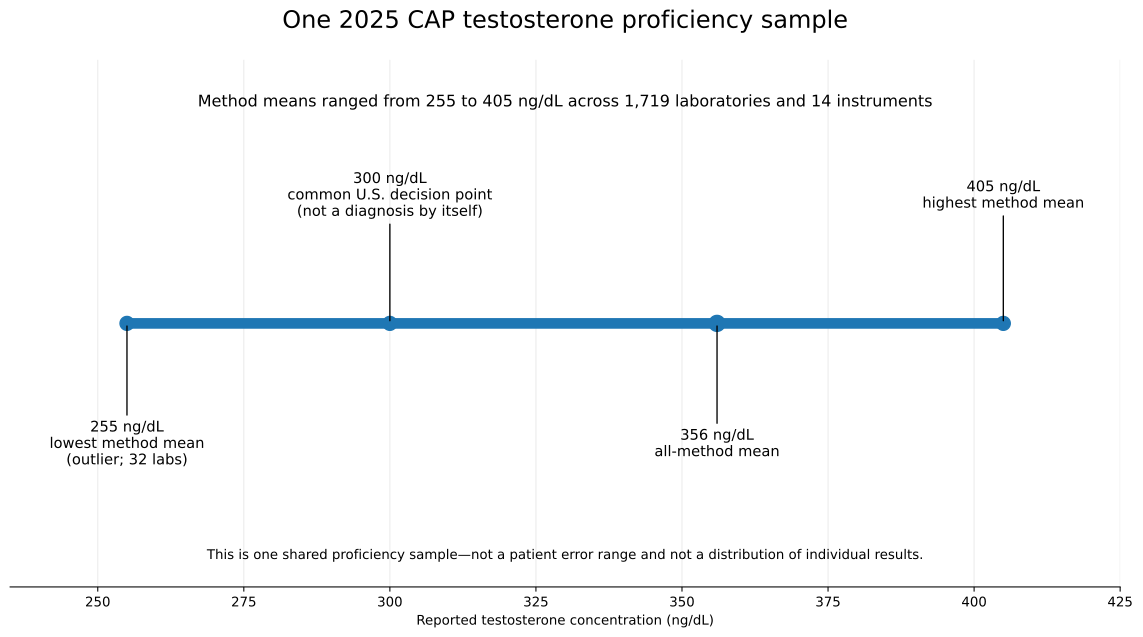
No single percentage can describe testosterone test accuracy. In adult men being checked for possible low testosterone, 30% of first-low results were normal on repeat in evidence cited by the Endocrine Society. Separately, one 2025 proficiency sample measured by 1,719 laboratories produced method means from 255 to 405 ng/dL—a 150 ng/dL span.
Key finding: In adult men being checked for possible low testosterone, 30% of first-low results were normal on repeat. In one 2025 CAP proficiency sample, method means ranged from 255 to 405 ng/dL across 1,719 laboratories. These findings measure different problems and must not be added.
“30% of men with an initial T concentration in the hypogonadal range have a normal T concentration on repeat measurement.”
— Endocrine Society clinical practice guideline
Here, hypogonadal range means a result low enough to raise concern for testosterone deficiency. ng/dL means nanograms per deciliter, the common U.S. unit used on this page. A proficiency sample is prepared test material sent to many labs so their methods can be compared.
The two headline numbers describe different problems. The 30% finding is about whether a first low result holds up when a person is tested again. The 150 ng/dL span is simple arithmetic—405 minus 255—from one shared proficiency-sample exercise. They are not the same kind of uncertainty, and they must not be added.
Bottom line: one testosterone result can be useful, but it is not a diagnosis by itself. The Endocrine Society, American Urological Association, and European Association of Urology all require symptoms or signs plus repeated low morning blood results. Their cutoffs and fasting language differ.
Related research: ADAM questionnaire accuracy.
By: TRT Provider Guide
Last verified and updated: September 3, 2026
Scope: Serum testosterone testing in adult men being evaluated for possible testosterone deficiency before treatment.
Medical note: This page is educational. It does not diagnose low testosterone or replace care from a qualified health professional. Testing during testosterone treatment uses formulation-specific timing and is outside the main scope of this report.
| Question | Best verified number | What it means | What it does not mean |
|---|---|---|---|
| Can the result change on repeat? | 30% of first-low results were normal on repeat. | A first low needs confirmation. | The lab was wrong 30% of the time. |
| Can lab method change the number? | 255–405 ng/dL method means across 1,719 labs and 14 instruments on one 2025 proficiency sample. | Method choice can cross 300 ng/dL. | Every assay can be off by 150 ng/dL. |
| Can time of day matter? | 20%–25% lower at 4 p.m. than 8 a.m. in men ages 30–40 in one 66-man study. | Morning and afternoon results may not be comparable. | Every afternoon test is 25% low. |
| Can food matter? | A mixed meal produced a 123 ng/dL mean nadir fall; 5 of 9 men (56%) briefly crossed below 300 ng/dL. | Fasting state can change classification. | Every meal lowers every man by 123 ng/dL. |
| Do major guidelines accept one number alone? | 0 of 3 reviewed bodies do; 3 of 3 require symptoms/signs plus repeat morning results. | Diagnosis is clinical plus biochemical. | The three bodies use identical cutoffs. |
Sources: ES 2018, ES 2026, AUA, EAU, Endotext, Diurnal study, and Feeding study. Each number keeps the limit of its source.
Citation details for this dated version: TRT Provider Guide. “Testosterone Test Accuracy: 2026 Data on Repeat Results and Lab Variation.” TRT Provider Guide Research. Last verified September 3, 2026. https://trtproviderguide.com/research/testosterone-test-accuracy/ Dataset: TRT Provider Guide Testosterone Test Accuracy Evidence Map, 2026, version 2026-09-03.
Download the 29-row evidence map (CSV) · Open the CAP range chart as SVG
Testosterone test accuracy: what the evidence shows—and what it does not show
The evidence shows that a testosterone result can cross a common low/normal line because of repeat variation, draw timing, food, or assay method. It does not give one universal “error rate,” and it does not prove that every changed result is a laboratory mistake.
Our evidence map found five directly documented threshold-crossing settings. This is an original grouping of unlike studies. It is useful because it puts the numerator, setting, and warning in the same row.
| Setting | Directly observed crossing | Evidence unit | Safe reading |
|---|---|---|---|
| Repeat test | 30% of first-low results were normal on repeat. | Guideline-cited repeated-measures evidence | Confirm a low; do not call this a lab error rate. |
| Afternoon draw | 17 men had at least one post-noon result <300 ng/dL but three normal morning results. | 66-man repeated-visit study | Use comparable morning draws. |
| Oral glucose | 5 of 47 men (11%) with complete measurements briefly fell below 300 ng/dL. | Controlled OGTT cohort; LC-MS/MS. | Record fasting state; do not apply the number to every drink or meal. |
| Mixed meal | 5 of 9 men (56%) briefly fell below 300 ng/dL. | Controlled mixed-meal cohort; LC-MS/MS. | The cohort was nine men; do not generalize the set meal to every meal. |
| Assay method | Method means ranged 255–405 ng/dL. | One College of American Pathologists proficiency sample; 1,719 labs, 14 instruments | This is a method range on one specimen, not a personal error range. |
Sources: TRT Provider Guide aggregation of ES 2018, Diurnal study, Feeding study, and the 2025 CAP sample reported in Endotext. These effects are not additive.
A testosterone test measures the concentration in one specimen at one time. A diagnosis asks a harder question: is the level persistently low, measured under sound conditions, and paired with relevant symptoms or signs? A value can be analytically sound for that tube of blood and still be a poor picture of the person’s usual level.
This report does show:
- A first low result may not stay low.
- Morning and afternoon results may differ enough to cross 300 ng/dL.
- Food can cause a short fall in a controlled setting.
- Acute illness and some medicines can lower the level.
- Different assay methods can disagree on the same proficiency material.
- Total testosterone can be hard to read when SHBG is abnormal.
- Free-testosterone methods are not interchangeable.
This report does not show:
- That testosterone laboratories are wrong 30% of the time.
- That every afternoon result is 25% too low.
- That every meal lowers testosterone by 123 ng/dL.
- That poor sleep always lowers testosterone by 15%.
- That every assay can be wrong by 150 ng/dL.
- That 300 ng/dL proves or rules out hypogonadism.
- That a person should change medicine, food, or sleep to “game” a test.
How did we build the Testosterone Test Accuracy Evidence Map?
We built a 29-row evidence map from 20 authoritative source records and checked every row on September 3, 2026. The map separates biological, collection, analytical, and interpretive uncertainty, then records the sample, method, result, threshold effect, and limit for each claim.
This is an original structured review, not a new blood-test experiment. We did not recruit patients, handle specimens, or rerun the assays. Our original work is the dated source audit, the common data structure, the cross-guideline comparison, the threshold-crossing map, and the transparent derived figures.
What sources were included?
A source had to do at least one of these jobs:
- Set current clinical testing guidance.
- Define a government accuracy or standardization program.
- Report original human data on repeat tests, time, food, or sleep.
- Report a current multi-laboratory comparison of one proficiency sample.
- Establish a reference range for total or free testosterone.
- Test how total testosterone and free testosterone can disagree.
- State a government or authoritative limit for direct-to-consumer or saliva testing.
Commercial clinic pages and test-kit sales pages were not used as proof for a health claim.
How were claims extracted and checked?
For each evidence row, we recorded the population or specimen, number of people or laboratories, test method, comparison, result, cutoff crossing, direction, source date, and main limit. Current statements were checked against the issuing organization, and study numbers were checked against the article abstract or full text when available.
| Method choice | Rule used in this report | Why it matters |
|---|---|---|
| Source order | Issuing body or government source → original human study → original data producer → current expert reference | Keeps current rules separate from study findings. |
| Claim extraction | Record population, count, method, comparison, result, cutoff crossing, date, and main limit | Makes each number quotable with its caveat. |
| Derived numbers | Only transparent arithmetic or counts: 405 − 255 = 150; 3/3 guidelines; 2/3 direct fasting instructions | A reader can reproduce every derived figure. |
| No pooled rate | Do not combine repeat, timing, food, sleep, or assay effects | The studies answer different questions. |
| Publication gate | Remove, soften, or hold any consequential claim that lacks a fitting source | Prevents an attractive but unsupported number from entering the page. |
Source: TRT Provider Guide research protocol for this evidence map, version 2026-09-03.
Which numbers did we calculate ourselves?
We made only three kinds of transparent calculation:
- 150 ng/dL method span: 405 − 255.
- 3 of 3 guideline consensus: all three reviewed bodies require symptoms or signs plus repeat morning measurements.
- 2 of 3 fasting wording: the Endocrine Society and EAU explicitly direct fasting diagnostic tests; the AUA says its panel does not insist on fasting.
We did not calculate a pooled “testosterone test accuracy percentage.” The source designs are too different for that number to be honest.
How accurate is a testosterone test?
A well-run serum test can measure testosterone accurately, but the final answer has four layers. The body can change, the draw can be collected under unlike conditions, the assay can have bias, and the result can be read against the wrong cutoff or reference range.
In laboratory language, accuracy means closeness to a reference value. Precision means getting similar results on repeats. Clinical interpretation asks whether the result helps identify a persistent condition in a real person. A page that mixes those three ideas into one percentage hides more than it explains.
We use the Four-Layer Accuracy Check below. It is an editorial framework, not a validated medical score.
| Layer | Question to ask | Evidence in this report | Best control |
|---|---|---|---|
| 1. Biological | Was the body at its usual level? | 30% repeat normalization; mixed sleep evidence; illness effects | Repeat when health is stable and record context. |
| 2. Collection | Was the sample taken under comparable conditions? | 20%–25% time effect; 123 ng/dL meal nadir in one protocol | Use guideline-directed morning timing and fasting where instructed. |
| 3. Analytical | How did the laboratory measure the sample? | 255–405 ng/dL method means on one proficiency sample | Use a reliable, standardized assay and keep the method consistent. |
| 4. Interpretive | Was the right result compared with the right rule? | 3/3 guideline bodies require symptoms plus repeat morning results | Use the assay range, symptoms, repeat tests, and free T when indicated. |
Source: TRT Provider Guide synthesis of the 29-row Evidence Map. The framework itself is original; the evidence values come from the cited sources.
The practical lesson is simple. A laboratory can measure two tubes correctly while the two tubes contain different testosterone concentrations. A result can also be repeatable within one method but shifted compared with another method. That is why “Was the test accurate?” needs a second question: accurate in which layer?
Can one low testosterone test be wrong?
Yes, one low result may not hold up. The Endocrine Society reports that 30% of men with an initial result in the hypogonadal range have a normal concentration on repeat testing. That does not mean 30% of laboratories made an error.
The change can come from normal day-to-day biology, time of draw, food, illness, medicine, or analytical variation. Sometimes several of those conditions differ at once. The first and second result may each be correct for the specimen collected that day.
A second repeated-sampling example adds useful context. Endotext summarizes a study of 169 middle-aged and older men who had eight testosterone measurements over 50 weeks. The first result had a correlation of r = 0.85 with the mean of seven later samples, yet Endotext reports that up to 15% were put in a low-or-normal group that did not reproduce. The correlation says one sample often tracks the longer pattern. The 15% finding says cutoff labels can still change.
A 2024 Healthy Man Study used validated LC-MS in 325 healthy men older than 40, with nine samples over three months. The study found stable estimates of within-person variability across time intervals and an increase tied to fasting. Its abstract does not give one simple fasting percentage, so this report does not invent one.
What should a repeat change be called?
Use precise words:
- Transiently low: the body’s measured level was lower for a time.
- Biological variation: the person’s level changed between draws.
- Pre-analytical difference: the collection time, food state, handling, or other condition changed before measurement.
- Analytical bias: the assay result was shifted from the reference value.
- Misclassification: a cutoff put the result in a group that did not hold up.
“False low” can be useful in plain speech, but it may hide the cause. A low value after a meal can be a real measurement of a short-lived lower concentration, not proof that the instrument failed.
How much does time of day change a testosterone result?
Time of day can change the result enough to cross a common cutoff. In one repeated-visit study of 66 men, 4 p.m. testosterone was 20%–25% lower than 8 a.m. testosterone in men ages 30–40; near age 70, the average gap was about 10%.
Each participant completed at least five of six visits, with three morning visits and three afternoon visits. That within-person design is stronger for this question than comparing one person’s morning result with another person’s afternoon result.
The clearest cutoff example involved 17 men. Each had at least one result below 300 ng/dL after noon, but all three of their pre-noon results were normal. This does not make every afternoon low invalid. It shows why a late result should not be compared casually with a morning-based rule.
The Endocrine Society calls for two separate fasting mornings. The AUA calls for two early-morning measurements on separate occasions. The EAU says to measure between 7:00 and 10:00 a.m. while fasting. For night-shift workers, the EAU says to test after adequate sleep and while fasting.
Do you need to fast before a testosterone test?
For a diagnostic low-testosterone check, the Endocrine Society and EAU explicitly say to use fasting morning samples. The evidence does not support one universal meal effect, but controlled studies show that glucose and food can pull total testosterone down for a time.
In a study of 60 healthy men ages 23–97 without prediabetes or diabetes, researchers measured total testosterone with LC-MS/MS after an overnight fast. One group had an oral glucose load. Another had a mixed meal.
- After glucose, the mean fall at the lowest point was 100 ng/dL. 5 of 47 men (11%) with complete measurements briefly fell below 300 ng/dL.
- After the mixed meal, the mean fall at the lowest point was 123 ng/dL. 5 of 9 men (56%) briefly fell below 300 ng/dL.
- Testosterone began falling about 20 minutes into the tests, with the average largest fall at 60 minutes.
Those are results from set research protocols. They do not prove that every breakfast lowers every person by the same amount. They do show why the fasting state should be known when a result sits near a decision line.
The 2024 Healthy Man Study also found that fasting increased testosterone across repeated LC-MS measurements in 325 healthy men, but its abstract does not provide a single effect size. That newer study supports the direction of the fasting effect without giving this page a new percentage to quote.
How many hours should you fast?
The Endocrine Society and EAU say fasting, but neither gives one universal hour count for every laboratory order. The AUA does not require fasting. Follow the written instructions from the ordering clinician or laboratory. Water and medicine instructions can vary, so do not guess or stop a medicine on your own.
Can sleep, illness, or medicine change a testosterone result?
Yes, each can change the result, but the strength of evidence is different. Acute illness and suppressive medicines are established clinical concerns; sleep has plausible effects, but the controlled human evidence is small and mixed.
What does the sleep evidence show?
A 2011 study gave 10 healthy young men a five-hour sleep opportunity each night for one week. Their daytime testosterone was 10%–15% lower after the short-sleep week. The finding is memorable, but ten people are not enough to make it a rule for all men.
A 2019 paper reported two randomized studies. One used 14 men in an inpatient comparison of five nights with four versus nine hours in bed. The other used 13 men in an outpatient six-week plan that reduced sleep by 1.5 hours. The authors did not find an adverse effect on plasma testosterone in those protocols.
A 2021 meta-analysis pooled 18 studies with 252 men. Short-term partial sleep deprivation did not have a significant overall effect, while total sleep deprivation lasting at least 24 hours reduced testosterone. The safest summary is not “bad sleep lowers testosterone 15%.” It is: severe sleep loss may lower testosterone, while shorter restriction has mixed results.
What does acute illness do?
Acute illness can temporarily suppress testosterone. The Endocrine Society advises against testing men for testosterone deficiency during an acute illness or while recovering, and current Endotext gives the same warning. A result taken while sick may be real for that day but poor evidence of the usual level.
Which medicines matter?
Guidance names opioids and glucocorticoids among medicines that can suppress testosterone. Other hormones, anabolic steroids, and certain drugs can also change production, binding proteins, or interpretation. The effect depends on the exact product, dose, timing, and person.
Tell the clinician and laboratory about prescribed medicines, nonprescription products, injected or topical hormones, anabolic steroids, and supplements. Do not stop a medicine simply to change a result. For biotin, the relevant question is whether the exact assay uses biotin-based technology, whether it is susceptible to interference, and what the laboratory instructs.
Can different laboratories get different results from the same sample?
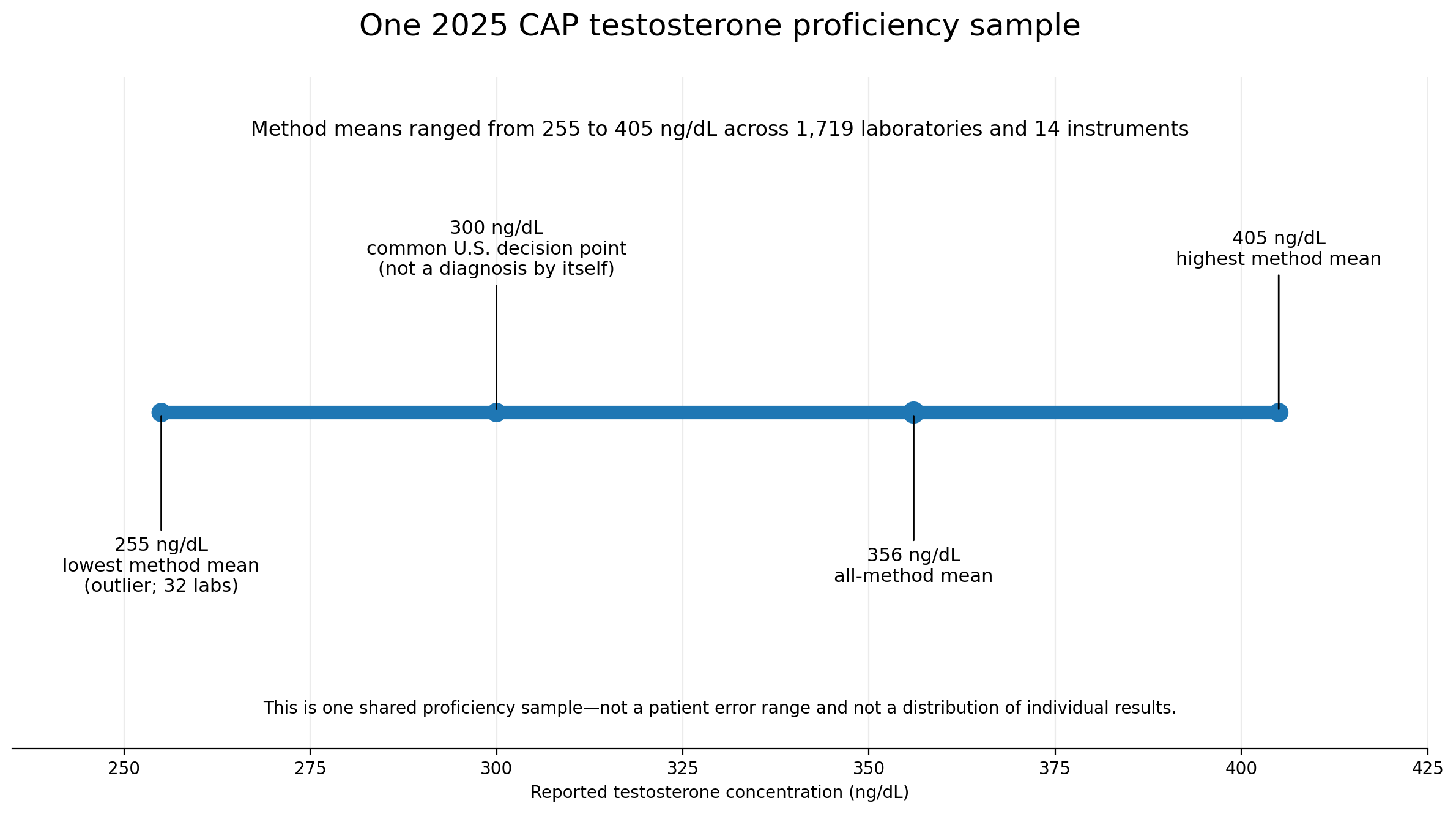
Yes. The clearest current snapshot in this report is one 2025 College of American Pathologists (CAP) proficiency sample measured by 1,719 laboratories on 14 instruments. Method means ranged from 255 to 405 ng/dL, a derived span of 150 ng/dL.
Endotext published the figure in its March 28, 2026 update. The material was a proficiency sample, which laboratories use to compare measurement performance. It was not a patient cohort, and it does not tell us how often any one patient result is wrong.
| Measure from the 2025 CAP sample | Verified value | How to read it |
|---|---|---|
| Participating laboratories | 1,719 | Large laboratory participation; still one sample. |
| Instruments | 14 | Method means can be compared on the same proficiency material. |
| All-method mean ± SD | 356 ± 46 ng/dL | A survey summary, not a patient reference range. |
| Lowest to highest method mean | 255–405 ng/dL | Crossed the common 300 ng/dL line. |
| Arithmetic span | 150 ng/dL | Derived as 405 − 255; not an error allowance. |
| Lowest-method context | 255 ng/dL; outlier method used by 32 labs | The endpoint should not be presented as typical. |
| Most-used method | 406 labs | Shows concentration of use, not superior accuracy. |
| Mass-spectrometry method | 40 labs (2.3%); 9% above all-method mean | One-sample direction; not a standing 9% correction. |
Source: Endotext, last updated March 28, 2026, reporting 2025 College of American Pathologists proficiency sample Y-14.
Source: Endotext’s report of CAP sample Y-14. Vector version.
The lowest endpoint needs special care. The 255 ng/dL mean came from an outlier method used by 32 laboratories. Removing that context would make the 150 ng/dL span sound more typical than the source allows.
We also do not publish the chapter’s stated between-method coefficient of variation as a headline statistic. The displayed all-method mean and standard deviation do not reproduce that percentage by simple division, and the underlying weighting needed to resolve it is not public in the figure text. The safer choice is to publish the directly reported mean, standard deviation, range, lab count, instrument count, and outlier context.
What does CDC-certified mean for a testosterone test?
CDC Hormone Standardization (HoSt) certification means an exact assay system met an accuracy-based performance criterion against the CDC reference method. For serum testosterone on the April 2026 list, the criterion was within ±6.4% mean bias from 2.50 to 1,000 ng/dL.
The word mean matters. CDC explains that mean bias estimates how well a method is calibrated on average. A method can be well calibrated and still give an inaccurate result on an individual sample.
| CDC HoSt fact | 2026 value | What it tells you | What it cannot tell you |
|---|---|---|---|
| Serum testosterone performance criterion | ±6.4% mean bias | Average calibration against the CDC reference method. | That every sample is within 6.4%. |
| Concentration range | 2.50–1,000 ng/dL | Range over which the listed criterion applies. | Performance outside that range. |
| Certification data | Four quarters × 10 blinded samples = 40 | Performance is checked over time and across single-donor sera. | A patient-specific probability of error. |
| Scope of certification | Specific method, reagents, calibrators, and instrument | The exact analytical system matters. | That every method used by the same company or lab is covered. |
Sources: CDC assay list, CDC FAQ, and CDC process; checked September 3, 2026.
A lab name alone is not enough to prove certification. CDC states that certification applies to the specific method, reagent lots, calibrator lots, and instrumentation evaluated. The useful question is: Was this exact analytical system certified for serum testosterone at the time of testing?
Is LC-MS/MS more accurate than an immunoassay?
LC-MS/MS is generally more selective and sensitive because it separates chemicals before measuring them. Yet for total testosterone in adult men, current Endotext says either a well-run platform immunoassay or mass spectrometry can be reasonable; the exact assay and its standardization still matter.
An immunoassay uses antibodies to estimate testosterone. LC-MS/MS means liquid chromatography–tandem mass spectrometry. It separates compounds and identifies them by their mass pattern, which helps reduce cross-reaction with similar steroids.
The EAU calls LC-MS/MS the most accurate method for sex-steroid evaluation, while also noting that standardized automated total-testosterone immunoassays can correlate well with LC-MS/MS. These statements fit together: the reference method may be stronger, but a validated platform can still be clinically useful in the adult male range.
Method labels do not replace quality data. A poorly controlled LC-MS/MS method can perform badly. A standardized immunoassay can perform well. At very low concentrations, such as many results in women and children, platform assays have greater limits; this report is not a guide to those populations.
For repeat tests, current Endotext calls it prudent to use the same method. That does not erase biological change. It removes one avoidable analytical difference.
How accurate are free testosterone tests?
Free-testosterone accuracy depends heavily on the method. Major guidance favors equilibrium dialysis or a validated calculation using accurate total testosterone, SHBG, and albumin; direct analog free-testosterone immunoassays are not recommended.
Free testosterone is the small fraction not bound to proteins. SHBG, or sex hormone-binding globulin, is one of the main proteins that carries testosterone in blood. A free-T result can help when total testosterone is near the low line or when SHBG is likely to be abnormal.
Which free-testosterone method is strongest?
Equilibrium dialysis is the reference method named by Endotext and the EAU. It physically separates unbound testosterone from protein-bound testosterone. It is more labor-intensive than routine platform testing.
A calculated result can also be useful. The calculation uses total testosterone, SHBG, and usually albumin. But it inherits error from those input tests and from the chosen equation. Endotext reports that, in one comparison among Belgian men, mean calculated free testosterone was 24% higher than equilibrium dialysis plus mass spectrometry. That is a method-specific example, not a universal correction factor.
The Endocrine Society says not to use direct analog-based free-testosterone immunoassays because they are inaccurate. The EAU gives the same practical warning about direct free-T immunoassays.
Method-specific reference ranges for directly measured free testosterone do exist, but there is not one fully harmonized range across methods. A paper in the March 2026 issue used equilibrium dialysis plus LC-MS/MS in 1,202 White men. In healthy, nonobese men ages 18–39, the measured range was 184–749 pmol/L. That is not one universal cutoff. Free-T ranges still depend on the method, age, BMI, and population. The result, method, unit, and reference interval must stay together.
Sources: ES 2018, EAU, Endotext, and Free-T ranges 2026.
When can SHBG make total testosterone misleading?
SHBG can make total testosterone look low or high compared with the free fraction. In one study of 3,672 men evaluated for hypogonadism, 61.7% of men with low total testosterone had normal calculated free testosterone.
That study used medical records from a veterans network from 1997 through 2007. It tested total testosterone, SHBG, albumin, and calculated free testosterone. The 61.7% figure is specific to that population, assay setup, calculation, and definition of low total T. It is not a universal mismatch rate.
Low SHBG can pull total testosterone down while free testosterone remains normal. Obesity, type 2 diabetes, hypothyroidism, nephrotic syndrome, glucocorticoids, some progestins, and androgenic steroids can lower SHBG. Aging, hyperthyroidism, hepatitis or cirrhosis, HIV, estrogens, and some anticonvulsants can raise it.
This is why guidance suggests checking free testosterone when total testosterone sits near the lower limit or when a condition that changes SHBG is present. It is not a reason to ignore total testosterone. It is a reason to use the right second measure.
Is 300 ng/dL always low testosterone?
No. A cutoff supports interpretation; it does not make the diagnosis alone. The three major bodies reviewed here agree on symptoms plus repeat morning results, but they use different threshold language and do not define the same population in the same way.
| Guideline body | Symptoms/signs required? | Repeat morning tests? | Fasting position | Number or threshold language |
|---|---|---|---|---|
| Endocrine Society | Yes | Yes—two separate mornings | Yes | 264 ng/dL is a harmonized lower limit for certain CDC-certified assays; a 2026 statement calls a value near 300 ng/dL a common clinical threshold. |
| American Urological Association | Yes | Yes—two separate early-morning measurements | Not required—the panel does not insist on fasting. | Below 300 ng/dL is a reasonable cutoff supporting diagnosis. |
| European Association of Urology | Yes | Yes—at least two separate occasions when the first TT is <12 nmol/L | Yes | 12 nmol/L (3.5 ng/mL, about 350 ng/dL) for late-onset hypogonadism. |
Sources: ES 2018, ES 2026, AUA, and EAU; checked September 3, 2026.
Why do 264, 300, and 350 all appear in credible sources?
The numbers answer different questions:
- 264 ng/dL is the 2.5th percentile from a harmonized reference population of healthy, nonobese men ages 19–39. The Endocrine Society says it can be used with CDC-certified assays.
- Near or below 300 ng/dL is common clinical threshold language in U.S. guidance. It is not a stand-alone diagnosis.
- 12 nmol/L, or about 350 ng/dL, is the EAU threshold for late-onset hypogonadism, paired with symptoms and repeated fasting morning results.
nmol/L means nanomoles per liter, a unit used in many countries.
The harmonized study used data from 9,054 men across four cohorts. Its defined reference sample included 1,185 healthy, nonobese men ages 19–39. The resulting 2.5th to 97.5th percentile interval was 264–916 ng/dL, and the median was 531 ng/dL.
That is a high-quality range with a narrow label. It is not one universal target for every man, every age, or every assay. For more detail on the people and percentiles behind common ranges, see the independent testosterone levels by age reference.
How accurate are at-home and saliva testosterone tests?
There is no single accuracy rate for all at-home testosterone tests. “At home” describes where collection happens, not the specimen, handling, assay, calibration, or confirmation process.
Home tests do not all use the same specimen or collection path. Collection, storage, shipping, assay method, and confirmation can differ. Those systems should not be treated as one test class.
The FDA says direct-to-consumer tests have different levels of supporting evidence. Some are reviewed by the FDA and some are not. They do not replace a health evaluation by a qualified professional. The FDA page does not provide a testosterone-kit error rate, so this report does not publish one.
For saliva, current Endotext says well-validated assays can be useful research tools, but salivary testosterone has not been recommended for clinical purposes. Major diagnostic guidance is built around serum blood testing.
A useful home-test audit asks:
- What specimen is collected?
- Was the draw time recorded?
- Was fasting required and followed?
- How was the sample stored and shipped?
- What exact assay measured it?
- Is the analytical system in an accuracy-based program?
- Does the report name the method and reference range?
- How is an unexpected result confirmed?
A home-collected sample can still be processed by a sound laboratory method. The point is not that all home tests are poor. The point is that the label alone cannot establish accuracy.
How should a low testosterone test be repeated?
Repeat the test on a separate morning under comparable conditions, following the ordering clinician’s instructions. Keep the same laboratory method when practical, and record enough context to tell whether the two draws were truly comparable.
The goal is not to create the highest possible number. The goal is to measure the person’s usual level under the conditions used by the guideline and laboratory.
| Record for each draw | Why it helps |
|---|---|
| Date and exact draw time | Shows whether the tests were taken at comparable points in the day. |
| Time of waking and work-shift schedule | Morning clock time may not match biological morning for a night-shift worker. |
| Hours since food or caloric drink | Makes the fasting state visible. |
| Sleep in the prior night and week | Adds context without assuming a fixed sleep effect. |
| Current illness and recent recovery | Flags a known source of temporary suppression. |
| Medicines, hormones, anabolic steroids, and supplements | Helps identify suppression or assay interference. |
| Total testosterone, unit, and lab reference range | Prevents unit and range mix-ups. |
| Assay or platform name, when reported | Shows whether the method changed. |
| SHBG, albumin, and free-T method, when ordered | Makes a free-T result reproducible and interpretable. |
Sources: TRT Provider Guide repeat-test record derived from ES 2018, ES 2026, AUA, EAU, and Endotext.
What about night-shift workers?
Clock time and biological morning may not match. The EAU says night-shift workers should be tested after adequate sleep and in a fasting state. The exact plan should come from the ordering clinician because work schedules and sleep timing differ.
How long should the gap be between tests?
The reviewed guidelines require measurements on separate occasions, but they do not set one universal gap for every person. A repeat after acute illness may need to wait until recovery. A repeat tied to a medicine or urgent endocrine concern may follow a different plan.
What if the person already takes testosterone?
Do not use the pre-treatment timing rules as a monitoring schedule. Injections, gels, patches, pellets, nasal products, and other forms have different peaks and troughs. Follow the prescriber’s formulation-specific blood-draw order.
What does the full Testosterone Test Accuracy Evidence Map contain?
Download the full 29-row evidence map as CSV
The Evidence Map contains 29 verified rows across four layers: biological, collection, analytical, and interpretive. Each row gives a number or rule, the evidence unit, the practical meaning, the main limit, and the source needed to reproduce it.
| ID | Layer | Verified evidence | Evidence unit | Practical meaning | Main limit | Source |
|---|---|---|---|---|---|---|
| E01 | Biological | 30% of first-low results were normal on repeat. | Men with an initial result in the hypogonadal range; count not stated in the guideline passage. | Confirms the need for another test. | Not a laboratory error rate. | ES 2018 |
| E02 | Biological | First result vs the mean of seven later samples: r = 0.85. | 169 middle-aged and older men with symptomatic benign prostatic hyperplasia who were otherwise healthy; eight measurements over 50 weeks. | One draw tracked the longer pattern fairly well. | Correlation does not mean identical results. | EndotextVermeulen 1992 |
| E03 | Biological | Up to 15% were put in a low-or-normal group that did not reproduce. | Same 169-man repeated-sampling study, summarized in Endotext. | Cutoff grouping can change over time. | The 15% figure is an Endotext summary, not a laboratory error rate. | EndotextVermeulen 1992 |
| E04 | Biological / collection | 325 men gave 9 samples over 3 months; fasting increased testosterone. | Healthy, asymptomatic men older than 40; validated LC-MS. | Large repeated-sampling evidence supports recording fasting state. | The abstract does not give one simple fasting effect size. | Healthy Man 2024 |
| E05 | Collection | At 4 p.m., levels were 20%–25% lower than at 8 a.m. in men ages 30–40. | 66 men ages 30–80; three morning and three afternoon visits. | Late testing can move the number a lot in younger adults. | Small study; the swing differed by age and person. | Diurnal study |
| E06 | Collection | Near age 70, the modeled 4 p.m. level was about 10% lower than at 8 a.m. | Same 66-man repeated-visit study. | Morning timing still mattered in older men. | An age-group average is not a personal forecast. | Diurnal study |
| E07 | Collection | 17 men had at least one post-noon result below 300 ng/dL, yet all three morning results were normal. | Subgroup from the 66-man time-of-day study. | A late low can cross back above a common cutoff in the morning. | Small subgroup. | Diurnal study |
| E08 | Collection | A glucose load caused a mean nadir fall of 100 ng/dL; 5 of 47 men (11%) with complete measurements briefly fell below 300 ng/dL. | Controlled OGTT cohort; LC-MS/MS. | Food state can change cutoff classification. | A 75-g glucose load is not every breakfast. | Feeding study |
| E09 | Collection | A mixed meal caused a mean nadir fall of 123 ng/dL; 5 of 9 men (56%) briefly fell below 300 ng/dL. | Controlled mixed-meal cohort; LC-MS/MS. | A nonfasting result may be temporarily lower. | One set meal in a nine-man cohort. | Feeding study |
| E10 | Biological | One week with a 5-hour sleep chance was tied to 10%–15% lower daytime testosterone. | 10 healthy young men. | Short sleep may matter. | Very small study; not a universal percentage. | Sleep 2011 |
| E11 | Biological | Two randomized studies found no adverse effect from the tested sleep-restriction plans. | 14 men in one study and 13 in the other. | The sleep evidence is not one-way. | Small studies in healthy young men. | Sleep 2019 |
| E12 | Biological | Across 18 studies and 252 men, short partial sleep loss had no significant overall effect; total sleep deprivation of at least 24 hours lowered testosterone. | Systematic review and meta-analysis. | Severity of sleep loss may matter. | Studies differed in design and sampling. | Sleep meta-analysis |
| E13 | Biological | Acute illness can temporarily lower testosterone; testing during acute illness is discouraged. | Guideline and current expert-reference synthesis. | A sick-day low may not be the usual level. | Size and duration depend on the illness. | ES 2018EAUEndotext |
| E14 | Biological / interpretive | Opioids, glucocorticoids, and other medicines can lower testosterone or alter interpretation. | Guideline synthesis; no single effect size. | The full medicine list belongs with the result. | Effect depends on drug, dose, timing, and person. | ES 2018AUAEAUEndotext |
| E15 | Analytical | One 2025 CAP proficiency sample was measured by 1,719 laboratories on 14 instruments; all-method mean 356 ± 46 ng/dL. | CAP data reported in the March 2026 Endotext update. | This is a large multi-laboratory method comparison on one proficiency sample. | One proficiency sample, not a population study. | Endotext |
| E16 | Analytical | Method means ranged 255–405 ng/dL: a derived 150 ng/dL span. | Same 2025 CAP proficiency sample. | Method choice crossed the common 300 ng/dL line. | The 150 figure is 405 − 255, not a universal error band. | Endotext |
| E17 | Analytical | The lowest method mean, 255 ng/dL, was an outlier method used by 32 labs. | Same 2025 CAP proficiency sample. | The low endpoint should not describe all methods. | An outlier can stretch a range. | Endotext |
| E18 | Analytical | The most-used method served 406 labs. Mass spectrometry served 40 labs (2.3%) and read 9% above the all-method mean on this sample. | Same 2025 CAP proficiency sample. | Method prevalence and direction can be reported without calling one result “true.” | The 9% result applies to this one sample. | Endotext |
| E19 | Analytical | CDC’s serum-testosterone criterion was ±6.4% mean bias over 2.50–1,000 ng/dL. | CDC HoSt certified-assay list updated April 2026. | Certification tests average calibration against a reference method. | Mean bias is not a guarantee for every sample. | CDC assay list |
| E20 | Analytical | Certification uses 4 quarters × 10 blinded serum samples = 40 samples. | CDC HoSt process. | Performance is checked across samples and time. | A program test is not the same as a patient-specific error rate. | CDC FAQCDC process |
| E21 | Analytical | CDC says a well-calibrated method can still be inaccurate on an individual sample. | CDC explanation of mean bias vs sample bias. | “Certified” does not mean “exact every time.” | Certification still improves control and comparability. | CDC FAQ |
| E22 | Interpretive | 3 of 3 reviewed guideline bodies require symptoms or signs plus repeated low morning results. | Endocrine Society, AUA, and EAU. | No reviewed body treats one number alone as the diagnosis. | The guidelines differ in scope and wording. | ES 2018ES 2026AUAEAU |
| E23 | Collection / interpretive | 2 of 3 reviewed bodies explicitly direct fasting diagnostic tests. | The Endocrine Society and EAU say fasting; the AUA says its panel does not insist on fasting. | Fasting language is not identical across guidelines. | This is a text audit, not a vote on which guideline is best. | ES 2018ES 2026AUAEAU |
| E24 | Interpretive | Common decision points differ: 264 ng/dL, near/below 300 ng/dL, and 12 nmol/L (about 350 ng/dL). | Endocrine Society, AUA, and EAU. | A cutoff has meaning only with its assay, population, symptoms, and guideline. | These numbers serve different clinical and reference purposes. | ES 2018ES 2026AUAEAU |
| E25 | Interpretive | Harmonized young-male total-testosterone reference interval: 264–916 ng/dL; median 531 ng/dL. | 9,054 men in four cohorts; reference sample of 1,185 healthy, nonobese men ages 19–39. | A strong reference range still describes a defined group. | It is not a universal range for every age, health state, or assay. | Harmonized range |
| E26 | Analytical / interpretive | Equilibrium dialysis is the reference free-T method; validated calculation is accepted; direct analog tests are not recommended. A paper in the March 2026 issue reported a measured free-T range of 184–749 pmol/L in healthy, nonobese men ages 18–39. | Guidelines, Endotext, and a 1,202-man equilibrium-dialysis plus LC-MS/MS study. | The words “free testosterone” are not enough—the method and reference population matter. | No one free-T cutoff applies to every method, age, BMI, or population. | ES 2018EAUEndotextFree-T ranges 2026 |
| E27 | Interpretive | In 3,672 men evaluated for hypogonadism, 61.7% of those with low total T had normal calculated free T. | Veterans-network chart study, 1997–2007. | SHBG-related mismatch can change the picture. | Specific population, thresholds, assays, and calculation; not a universal rate. | Anawalt 2012 |
| E28 | Collection / interpretive | No universal accuracy rate exists for home or saliva tests; Endotext says saliva is a research tool not recommended for clinical use, and FDA says DTC tests do not replace clinical evaluation. | Current Endotext and FDA consumer guidance. | Specimen, handling, assay, and confirmation path all matter. | FDA gives no testosterone-kit error rate. | EndotextFDA DTC |
| E29 | Analytical / collection | Biotin can cause falsely high or falsely low results in tests that use biotin/avidin technology; FDA specifically notes hormone tests. | FDA in vitro diagnostic guidance; no testosterone-specific frequency or fixed direction. | Supplement use and the exact assay technology belong with the result. | Not every testosterone assay uses biotin, and direction depends on the test principle. | FDA biotin |
Source: TRT Provider Guide Testosterone Test Accuracy Evidence Map, 2026, version 2026-09-03. Derived values are labeled; unlike studies were not pooled.
The map is built to prevent number stripping. Each finding stays beside its limit in the same row. For example, “255–405 ng/dL” sits beside “one proficiency sample” and “255 was an outlier method,” so the caveat is hard to lose.
Why does testosterone test accuracy matter in 2026?
The issue is current because laboratory standardization and clinical interpretation are still changing. A March 2026 Endotext update added the 2025 multi-laboratory proficiency snapshot, CDC refreshed its certified-assay information in April and May 2026, and the Endocrine Society issued a new testing statement on July 16, 2026.
Those updates point in the same direction: repeat the result, control the draw conditions, know the method, and do not diagnose from one number. They do not erase the differences among guidelines.
How will this page stay current?
A fresh date is meaningful only after the evidence is checked. We use the following public refresh rule.
| Element that can go stale | Public review cadence | Update trigger |
|---|---|---|
| CDC-certified assay list and criterion | Quarterly check | CDC changes the criterion, range, process, or listed systems. |
| Endocrine Society, AUA, and EAU guidance | Every 6 months and at any announced revision | A guideline or formal statement is replaced or amended. |
| CAP proficiency snapshot reported in Endotext | At least annually | A newer multi-laboratory proficiency comparison is published. |
| Repeatability, timing, food, and sleep studies | Quarterly literature search; full annual review | A study materially changes an estimate or resolves a conflict. |
| Evidence Map and schema | With every evidence change | A row, source, calculation, or date changes. |
Source: TRT Provider Guide research maintenance protocol, version 2026-09-03.
The “Last verified” date should change only after current guidelines, CDC pages, the CAP/Endotext snapshot, material studies, evidence rows, and schema have been checked together.
What are the limits of this research?
This report can explain how results vary, but it cannot predict one person’s next result or decide whether that person has testosterone deficiency. Some evidence blocks are large, while several memorable percentages come from small studies or one proficiency specimen.
| Evidence block | Size | Main limit |
|---|---|---|
| Repeat normalization | 30% finding; sample count not in the guideline passage | Group result, not a personal probability or lab error rate. |
| Time of day | 66 men; 17 in the threshold-crossing subgroup | Small study with age and person differences. |
| Food and glucose | 60 men total; threshold crossings used 47 complete OGTT records and 9 mixed-meal records | Controlled glucose and set-meal protocols; not every real-world meal. |
| Short sleep finding | 10 men | Very small sample and later conflicting trials. |
| Later sleep trials | 14 and 13 men | Small studies in healthy young men. |
| Sleep meta-analysis | 18 studies; 252 men | Mixed designs and sampling schedules. |
| CAP method comparison | 1,719 labs; 14 instruments; one sample | Strong multi-laboratory snapshot, weak basis for a universal error range. |
| SHBG mismatch study | 3,672 men | Veterans-network population and specific calculation/threshold choices. |
| Guideline audit | 3 bodies | A focused review, not every professional statement worldwide. |
Source: sample and laboratory counts shown in the linked evidence rows and full source list below.
Other limits matter too:
- This page focuses on adult male diagnostic testing before treatment.
- It does not evaluate every commercial kit, assay, or laboratory.
- It does not establish a new clinical cutoff.
- It does not pool unlike studies into a new accuracy rate.
- It does not prove which source caused a changed result in one person.
- It does not cover the lower testosterone concentrations typical in women and children.
- It does not replace evaluation for pituitary, testicular, medicine-related, weight-related, or other causes of low testosterone.
- Reference ranges depend on the method and the people used to build the range.
- Symptoms are important but not specific; many conditions can cause low energy, mood change, sexual symptoms, or reduced strength.
The evidence is strongest when the claim stays narrow. “In one 66-man study, 4 p.m. levels were 20%–25% lower in men ages 30–40” is defensible. “Afternoon testosterone tests are 25% wrong” is not.
Frequently asked questions about testosterone test accuracy
These answers cover the most common follow-up questions in plain language. They use the same scope and limits as the evidence above and should not be read as a personal diagnosis.
Can a testosterone blood test be wrong?
Yes. A result can be misleading because the body changed, the draw conditions changed, or the lab method had bias. A changed result does not prove that the laboratory made an error.
How much can testosterone vary from one test to another?
There is no single amount. The Endocrine Society reports that 30% of first-low results are normal on repeat, while separate studies found changes tied to time, food, and assay method. Those effects come from different designs and must not be added.
Is one low testosterone test enough for a diagnosis?
Usually no. The three major guidelines reviewed for this report require symptoms or signs plus repeated low morning testosterone results. The Endocrine Society and European Association of Urology also state that diagnostic draws should be fasting.
What is the best time of day for a testosterone test?
Morning is the standard time for a diagnostic total-testosterone draw. One 66-man study found that 4 p.m. levels were 20%–25% lower than 8 a.m. levels in men ages 30–40, with a smaller average gap near age 70.
Do you need to fast before a testosterone test?
For a diagnostic low-testosterone check, the Endocrine Society and European Association of Urology say to use fasting morning samples. The AUA says its panel does not insist on fasting. Follow the exact order from the clinician or laboratory because the guidelines do not all use the same rule.
Can eating make a testosterone result look low?
Yes, for a time. In one study of 60 healthy men across two protocols, a mixed meal produced a mean nadir fall of 123 ng/dL, and 5 of 9 men (56%) in that small cohort briefly fell below 300 ng/dL. That does not mean every meal has the same effect.
Can poor sleep cause a false-low testosterone result?
It may affect the result, but the evidence is mixed. One 10-man study found 10%–15% lower daytime testosterone after a week of short sleep, while two later small randomized studies did not find an adverse effect. A 2021 meta-analysis found no significant overall effect from short partial sleep loss but did find lower testosterone after total sleep deprivation lasting at least 24 hours.
Should repeat testosterone tests use the same lab?
Using the same laboratory and the same assay method can remove one avoidable source of difference. It cannot remove real day-to-day change in the body, so the draw time and health context should also be kept as similar as practical.
How long should you wait before repeating a low testosterone test?
The key guidelines reviewed here say to repeat on a separate occasion, but they do not set one universal waiting period for every case. The right timing depends on illness, medicine use, sleep schedule, urgency, and the clinician’s plan.
Is LC-MS/MS the most accurate testosterone test?
LC-MS/MS is more selective and sensitive, especially at low concentrations. For total testosterone in adult men, current Endotext also says a well-run platform immunoassay can be reasonable. The exact assay, calibration, and quality program matter more than the label alone.
What is the most accurate free testosterone test?
Equilibrium dialysis is the reference method named by major guidance. A validated calculation from accurate total testosterone, SHBG, and albumin can also be useful. Direct analog free-testosterone immunoassays are not recommended.
Why can two laboratories report different testosterone results?
Laboratories may use different instruments, reagents, calibrators, and reference ranges. In one 2025 proficiency sample reported by Endotext, method means ranged from 255 to 405 ng/dL across 1,719 laboratories and 14 instruments. That 150 ng/dL span came from one sample and is not a universal error range. (converting testosterone units)
Is 300 ng/dL always low testosterone?
No single cutoff works alone. The AUA uses below 300 ng/dL as a reasonable cutoff that supports diagnosis, the Endocrine Society cites a harmonized lower limit of 264 ng/dL for certain CDC-certified assays and calls a value near 300 a common clinical threshold, and the EAU uses 12 nmol/L, or about 350 ng/dL, for late-onset hypogonadism. All require clinical context.
Are at-home testosterone tests accurate?
There is no one accuracy rate for all home tests. Home-test kits do not all use the same specimen or collection path. Shipping, assay, and confirmation can also differ. An unexpected home result should be confirmed through the diagnostic process ordered by a qualified clinician.
Are saliva testosterone tests accurate?
Saliva testing can be useful in research, but current Endotext says it has not been recommended for clinical purposes. It should not be treated as interchangeable with the serum blood testing used in major diagnostic guidelines.
Can biotin affect a testosterone test?
Biotin can interfere with some hormone tests that use biotin-based laboratory technology, but the risk depends on the exact test system and dose. Tell the clinician and laboratory about supplements, and follow their instructions. Do not stop a prescribed product without medical advice.
Does acute illness affect testosterone test accuracy?
Yes. Acute illness can temporarily lower testosterone, so major guidance advises against diagnosing testosterone deficiency during an acute illness. A repeat test after recovery may better reflect the usual level.
Does this testing advice apply to someone already taking testosterone?
Not fully. This report focuses on adult men being tested before treatment for possible testosterone deficiency. Monitoring during testosterone therapy needs formulation-specific timing, so the draw should follow the prescriber’s order.
How to cite this page
The details below identify the page, dataset, publisher, and dated version. They are neutral attribution information, not a request for a citation.
TRT Provider Guide. “Testosterone Test Accuracy: 2026 Data on Repeat Results and Lab Variation.” TRT Provider Guide Research. Last verified September 3, 2026. https://trtproviderguide.com/research/testosterone-test-accuracy/
Dataset citation:
TRT Provider Guide. TRT Provider Guide Testosterone Test Accuracy Evidence Map, 2026. Version 2026-09-03. https://trtproviderguide.com/research/testosterone-test-accuracy/
Publisher: TRT Provider Guide
Research section: TRT Provider Guide Research
Canonical URL: https://trtproviderguide.com/research/testosterone-test-accuracy/
Dataset version: 2026-09-03
Sources
The source list uses issuing organizations, government programs, peer-reviewed human research, and the current Endotext chapter. Each citation supports the narrow claim attached to it; no source should be read as support for every statement on the page.
- Testosterone Therapy in Men With Hypogonadism: An Endocrine Society Clinical Practice Guideline
- Endocrine Society: Statement on Testosterone Replacement Therapy (July 16, 2026)
- American Urological Association: Testosterone Deficiency Guideline
- European Association of Urology: Male Hypogonadism Guideline
- Endotext: Laboratory Assessment of Testicular Function
- Representativeness of a Single Point Plasma Testosterone Level for the Long-Term Hormonal Milieu in Men
- Sex Steroids and Androgen Biomarkers in the Healthy Man Study: Within-Person Variability and Impact of Fasting
- The Effect of Diurnal Variation on Clinical Measurement of Serum Testosterone and Other Sex Hormone Levels in Men
- Oral Glucose Load and Mixed Meal Feeding Lowers Testosterone Levels in Healthy Eugonadal Men
- Effect of 1 Week of Sleep Restriction on Testosterone Levels in Young Healthy Men
- Sleep Restriction and Testosterone Concentrations in Young Healthy Males: Randomized Controlled Studies of Acute and Chronic Short Sleep
- Effect of Partial and Total Sleep Deprivation on Serum Testosterone in Healthy Males: A Systematic Review and Meta-Analysis
- CDC: Hormones Certified Assays and Participants
- CDC: HoSt Frequently Asked Questions
- CDC: Improving Performance Through the Hormone Standardization Program
- Harmonized Reference Ranges for Circulating Testosterone Levels in Men of Four Cohort Studies in the United States and Europe
- Performance of Total Testosterone Measurement to Predict Free Testosterone for the Biochemical Evaluation of Male Hypogonadism
- Age-Stratified Reference Ranges for Directly Measured Serum Free Testosterone in Community-Dwelling and Healthy Men
- FDA: Direct-to-Consumer Tests
- FDA: Testing for Biotin Interference in In Vitro Diagnostic Devices