Is Testosterone a Controlled Substance?
By: TRT Provider Guide
Last verified and updated: September 3, 2026
Editorial status: Research and source review; not clinician-reviewed.
Is testosterone a controlled substance? Yes. Testosterone is a Schedule III controlled substance under U.S. federal law. We verified the current federal rule on September 3, 2026. We also checked six representative DailyMed label records covering six ways testosterone is delivered. All 6 of 6 selected records were marked CIII, which is label shorthand for Schedule III.
Verified finding: As of September 3, 2026, federal law listed testosterone in Schedule III at 21 CFR § 1308.13(f)(84). In our six-format DailyMed audit, all 6 selected label records were marked CIII. Federal law allows no more than five refills and no fill or refill after six months.
A controlled substance is a drug or other substance placed in one of five federal schedules. Schedule III is one of those five schedules. The U.S. Drug Enforcement Administration, or DEA, administers the federal schedules.
The federal answer is simple. The part people miss is that federal scheduling, state scheduling, pharmacy transfers, prescription-monitoring reports, and online prescribing do not all follow one rule.
| Key fact | Verified answer |
|---|---|
| Federal status | Schedule III controlled substance |
| Exact federal listing | 21 CFR § 1308.13(f)(84) |
| Six-format label audit | 6 of 6 selected DailyMed records marked CIII |
| Federal refill ceiling | No more than five refills |
| Federal time ceiling | No fill or refill more than six months after the prescription was issued |
| Federal prescription routes | Paper, fax, compliant electronic, or oral |
| Current federal telemedicine window | January 1 through December 31, 2026, if all conditions are met |
| State examples verified | New York scheduling and California CURES reporting |
Source: 21 CFR § 1308.13, 21 CFR Part 1306, the fourth federal telemedicine extension, New York Public Health Law § 3306, California AB 82, and the six DailyMed records in Table 2. Verified September 3, 2026.
This page is educational. It is not medical or legal advice. It does not replace a product’s current prescribing information or advice from a licensed clinician, pharmacist, state regulator, or attorney.
Is testosterone a controlled substance in 2026?
Yes. The current federal rule lists testosterone by name in Schedule III. The rule is 21 CFR § 1308.13(f), and testosterone is numbered item 84.
The eCFR page opened for this review said Title 21 was current through September 1, 2026. We opened it on September 3, 2026. The eCFR is current and authoritative, but it is not the official legal edition of the CFR.
U.S. Testosterone Controlled-Substance Evidence Matrix, 2026
| ID | Question | Verified answer | Scope | Last checked |
|---|---|---|---|---|
| R01 | Is testosterone federally controlled? | Yes. It is Schedule III. | Federal | Sept. 3, 2026 |
| R02 | Where is testosterone listed? | 21 CFR § 1308.13(f)(84), entry 84 of 86 numbered anabolic-steroid entries. | Federal | Sept. 3, 2026 |
| R03 | Are related chemical forms and finished products covered? | Yes. The rule reaches testosterone salts, esters, ethers, materials, compounds, mixtures, and preparations unless a stated exception or another schedule applies. | Federal | Sept. 3, 2026 |
| R04 | What makes a prescription valid? | It must be for a legitimate medical purpose and issued by an authorized practitioner in the usual course of practice. | Federal | Sept. 3, 2026 |
| R05 | What is the refill ceiling? | No more than five refills. | Federal | Sept. 3, 2026 |
| R06 | What is the time ceiling? | No filling or refilling more than six months after issue. | Federal | Sept. 3, 2026 |
| R07 | Must the prescription be electronic? | Not under the federal rule alone. Paper, fax, compliant electronic, and oral prescriptions are allowed. | Federal | Sept. 3, 2026 |
| R08 | Can an electronic prescription move before the first fill? | One electronic transfer is allowed at the patient’s request if the federal conditions and state law allow it. | Federal | Sept. 3, 2026 |
| R09 | Can refill information move between pharmacies? | Usually once. Pharmacies sharing a real-time online database may transfer up to the lawful and authorized refill limit. | Federal | Sept. 3, 2026 |
| R10 | Can testosterone be prescribed by telemedicine without a prior in-person exam? | Under the temporary federal flexibility in force on the check date, yes through Dec. 31, 2026, if all other rules are met. | Temporary federal rule | Sept. 3, 2026 |
| R11 | Does every state use federal Schedule III? | No. New York lists anabolic steroids, including testosterone, in state Schedule II. | New York example | Sept. 3, 2026 |
| R12 | Is every testosterone prescription or fill reported to a state monitoring database? | No. California bars reporting a prescription for or the dispensing of testosterone to CURES under AB 82. | California example | Sept. 3, 2026 |
| R13 | Did the six-format label sample agree with the federal rule? | Yes. All 6 selected DailyMed records were marked CIII. | DailyMed audit | Sept. 3, 2026 |
Source: 21 CFR §§ 1300.01, 1306.04, 1306.08, 1306.21, 1306.22, 1306.25, and 1308.13; the fourth federal telemedicine extension; New York Public Health Law § 3306; California AB 82; and the six DailyMed records in Table 2.
Dataset name: U.S. Testosterone Controlled-Substance Evidence Dataset, 2026
Version: 1.0
Displayed evidence rows: 23 total — 13 current-rule and status rows, six label rows, and four legal-history rows
Verification date: September 3, 2026
Data file: Download the 23-row CSV dataset
The entry count in R02 needs one guardrail. The federal list is numbered from 1 through 86, and testosterone is number 84. That is not a count of every substance federal law may treat as an anabolic steroid. The federal definition can also reach some substances that are not named one by one.
What did the six-format testosterone label audit find?
We reviewed one representative DailyMed record for each of six distinct testosterone delivery formats. All 6 records—100% of this selected six-record sample—were marked CIII on September 3, 2026.
DailyMed is provided by the U.S. National Library of Medicine. “CIII” is the label marker for Schedule III.
Six representative testosterone delivery formats
| ID | Delivery format | Representative label | Active ingredient | Route shown | Status shown | DailyMed page updated |
|---|---|---|---|---|---|---|
| L01 | Intramuscular injection | Testosterone Cypionate Injection, USP | Testosterone cypionate | Intramuscular | CIII | Aug. 22, 2025 |
| L02 | Subcutaneous autoinjector | XYOSTED | Testosterone enanthate | Subcutaneous | CIII | July 1, 2025 |
| L03 | Skin gel | Testosterone Gel, 1.62%, metered | Testosterone | Transdermal | CIII | Nov. 4, 2025 |
| L04 | Nasal gel | Natesto | Testosterone | Nasal | CIII | July 22, 2025 |
| L05 | Oral capsule | JATENZO | Testosterone undecanoate | Oral | CIII | Sept. 30, 2025 |
| L06 | Implanted pellet | TESTOPEL | Testosterone | Subcutaneous | CIII | July 17, 2025 |
Result: 6 records marked CIII ÷ 6 records reviewed = 100% of this selected sample.
Source: The six linked DailyMed records in Table 2. The dates are the “Updated” dates shown on those DailyMed pages. All six pages were reopened September 3, 2026.
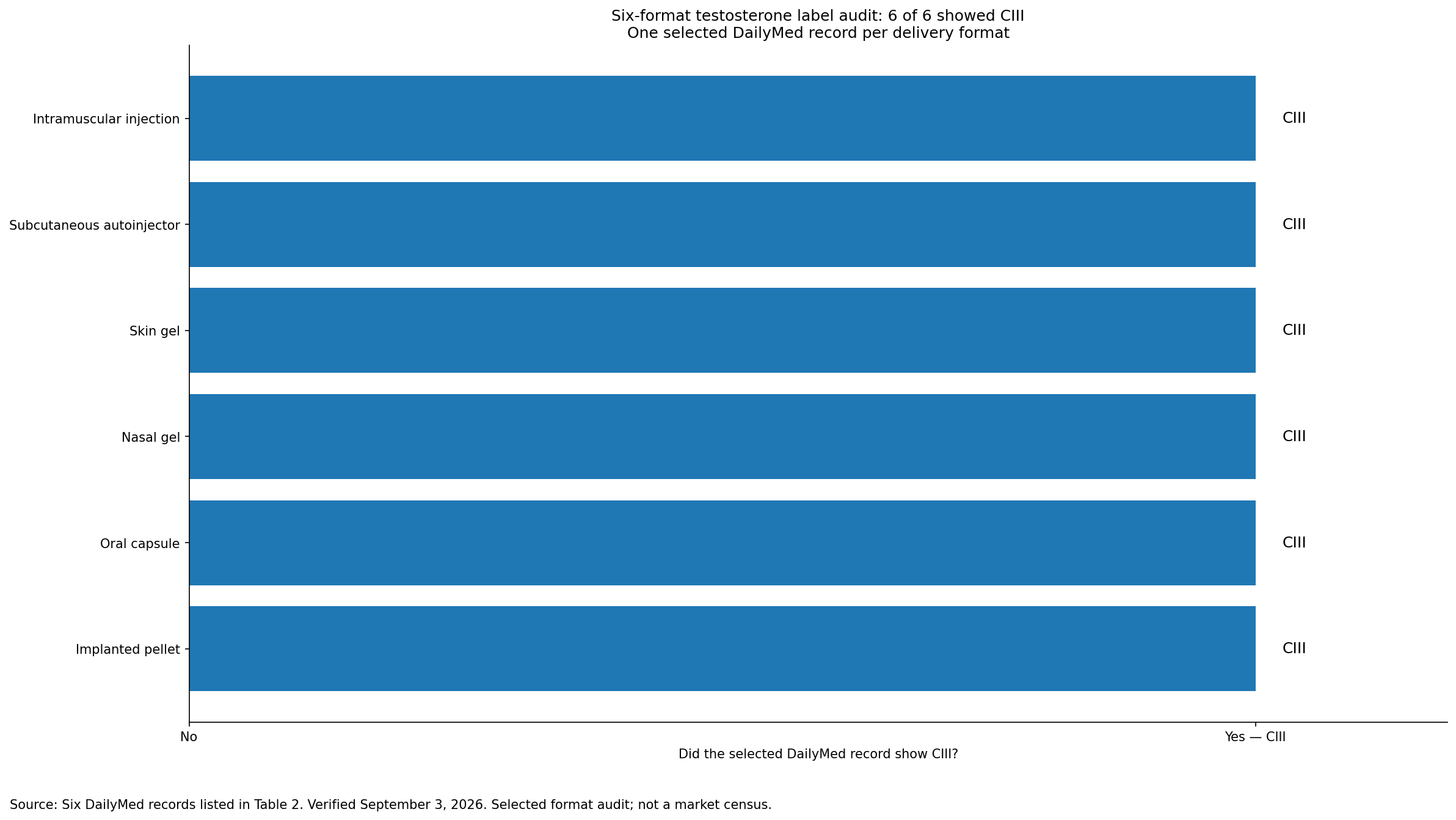
Figure file: Open the SVG version.
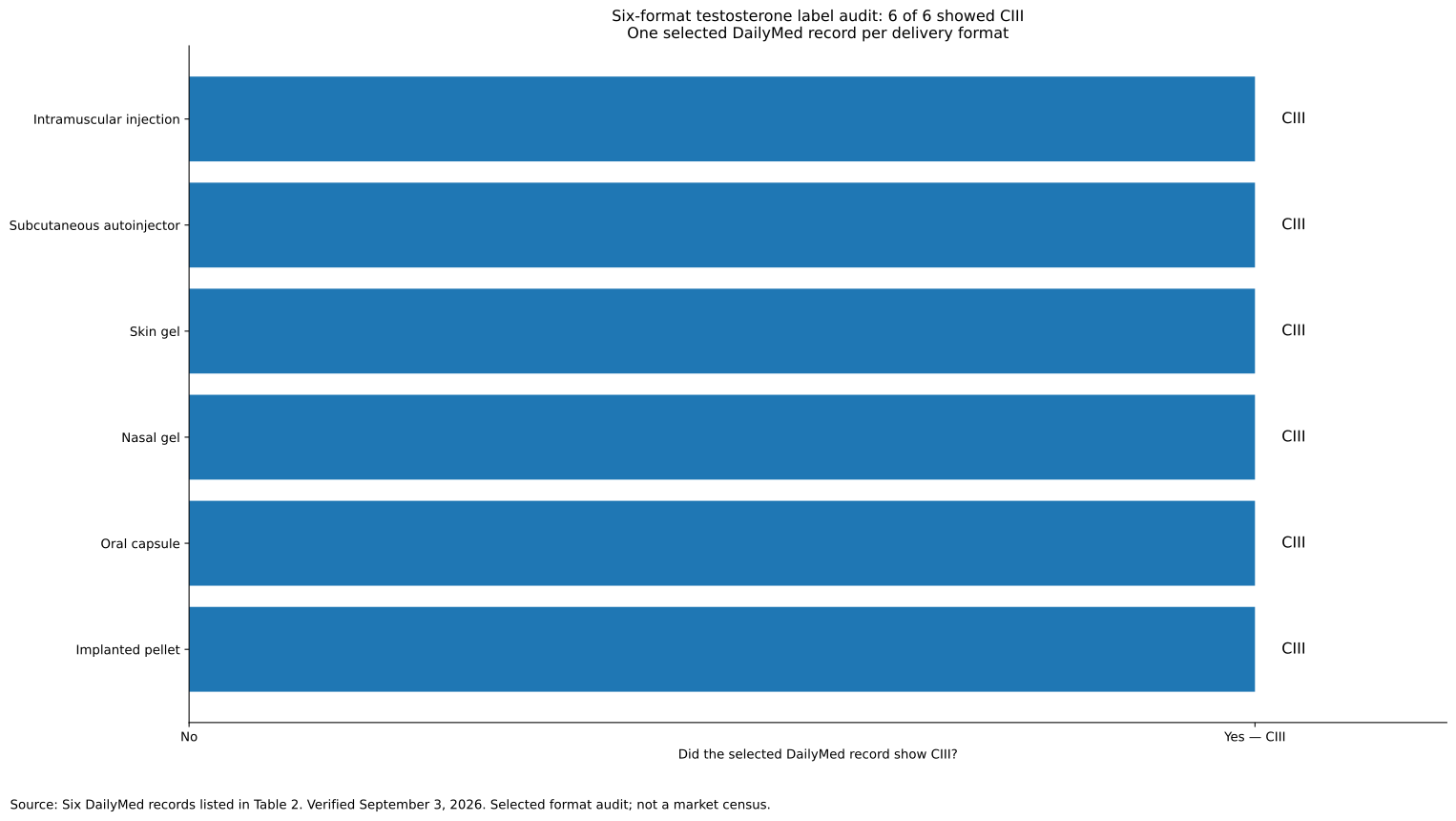
The useful finding is not that “some testosterone is controlled.” The six records show the same marker across injections, gels, an oral capsule, and a pellet. A change in how testosterone enters the body did not remove the controlled-substance marker in any record we checked.
This is a format audit, not a market census. We did not count every brand, generic label, strength, package, National Drug Code, compounded preparation, or old label in the United States.
DailyMed calls its pages “in-use” labeling. DailyMed also says those pages may not be identical to the most recent FDA-approved labeling and that NLM does not review each SPL record before publication. We used DailyMed only to record what each selected page displayed. We did not use this six-record audit to make an FDA approval claim.
What schedule is testosterone under federal law?
Testosterone is in Schedule III under U.S. federal law. The current rule lists it by name at 21 CFR § 1308.13(f)(84), inside the anabolic-steroid section.
A schedule sets legal controls. It is not a score of whether a medicine is “good” or “bad.”
| Federal check | Result |
|---|---|
| Schedule | III |
| Regulation | 21 CFR § 1308.13 |
| Subsection | (f), Anabolic steroids |
| Testosterone entry | (84) |
| Last numbered entry in that subsection | (86), trenbolone |
| Count rule | 86 numbered entries, but not the full possible universe covered by the broader definition |
| eCFR current-through date shown during review | September 1, 2026 |
| Page opened | September 3, 2026 |
Source: 21 CFR § 1308.13(f).
Why “84 of 86” needs a qualifier
The count is easy to repeat: testosterone is item 84, and the numbered list ends at 86. But the federal definition says anabolic steroids include, but are not limited to, the named substances. It can reach some other drugs or hormonal substances that meet the legal tests.
So the accurate statement is: testosterone is entry 84 of 86 numbered entries in the current federal anabolic-steroid list. It is not accurate to turn 86 into a complete count of every substance the federal definition may cover.
Which forms of testosterone are controlled substances?
Federal Schedule III coverage is not limited to testosterone shots. The rule covers testosterone and, unless an exception or another schedule applies, its salts, esters, ethers, materials, compounds, mixtures, and preparations.
An ester is a chemical form used in products such as testosterone cypionate, enanthate, and undecanoate. A different ester or delivery route can change how a medicine is used. It does not, by itself, remove the federal control.
| Form or example | Why the federal rule reaches it | Direct label check in this sample |
|---|---|---|
| Testosterone cypionate injection | Cypionate is a testosterone ester; the rule includes esters | CIII |
| Testosterone enanthate injection | Enanthate is a testosterone ester | CIII |
| Testosterone skin gel | The rule covers preparations containing testosterone | CIII |
| Testosterone nasal gel | The rule covers preparations containing testosterone | CIII |
| Testosterone undecanoate capsule | Undecanoate is a testosterone ester | CIII |
| Testosterone pellet for human use | It is a preparation containing testosterone | CIII |
| Compounded testosterone | Compounding does not, by itself, remove testosterone from the federal definition | Not part of the six-label sample |
Source: Federal scope from 21 CFR § 1308.13(f) and the definition in 21 CFR § 1300.01; label checks from the six DailyMed records in Table 2.
The federal definition has a narrow exception tied to certain FDA-approved implants made for cattle or other nonhuman species. That is not a broad exception for testosterone pellets used in people. The definition also says human prescribing, dispensing, or distribution of those animal-use substances is treated under the anabolic-steroid rules.
A compounded preparation does not become uncontrolled just because a compounding pharmacy made it. The federal rule reaches a material, compound, mixture, or preparation containing testosterone unless a stated exception or another schedule applies.
Why is testosterone a controlled substance?
Congress placed anabolic steroids under Schedule III in the Anabolic Steroids Control Act of 1990. The law was enacted on November 29, 1990. Its controls took effect 90 days later, on February 27, 1991.
Congress set the class. DEA administers the schedules and publishes the rules. Later laws changed the definition and added named substances, but they did not remove testosterone from Schedule III.
Four-date federal history
| ID | Date | What changed | Why it matters here |
|---|---|---|---|
| H01 | Nov. 29, 1990 | The Anabolic Steroids Control Act of 1990 became law | Congress added anabolic steroids to federal Schedule III |
| H02 | Feb. 27, 1991 | The 1990 controls took effect 90 days after enactment | Schedule III controls began applying to the class |
| H03 | Jan. 20, 2005 | The 2004 Act’s revised definition took effect 90 days after enactment | The definition focused on chemical and pharmacological relation to testosterone and excluded DHEA |
| H04 | Dec. 18, 2014 | The Designer Anabolic Steroid Control Act became law | The net result was 22 newly listed substances; a 2023 rule later moved and reorganized the regulatory list without changing their legal status |
Source: The amendment and effective-date notes in 21 U.S.C. § 812; Public Law 108-358; Public Law 113-260; and DEA’s 2023 implementing rule.
The 2014 law printed 25 clauses. DEA later explained why that did not mean 25 net new substances: two clauses used alternate names for substances already listed, and one substance appeared twice. The net addition was 22.
Federal law now defines an anabolic steroid as a drug or hormonal substance that is chemically and pharmacologically related to testosterone, subject to stated tests, exclusions, and designer-substance rules. The definition excludes estrogens, progestins, corticosteroids, and dehydroepiandrosterone, or DHEA.
What does Schedule III mean for a testosterone prescription?
At the federal level, a Schedule III prescription must have a legitimate medical purpose. It can have no more than five refills, and it cannot be filled or refilled more than six months after it was issued. Federal rules allow paper, fax, compliant electronic, or oral prescriptions.
These are ceilings, not promises. A prescriber may authorize fewer refills. A state or pharmacy rule may also be stricter.
| Federal prescription rule | Baseline for Schedule III testosterone | Plain meaning |
|---|---|---|
| Medical purpose | Required | The prescription must come from an authorized practitioner acting in the usual course of practice |
| Maximum refills | Five | Five is the most federal law allows on one prescription, not an automatic number |
| Maximum time | Six months after issue | The prescription cannot be filled or refilled after the federal six-month window |
| Paper prescription | Allowed federally | State law may still require electronic prescribing in some cases |
| Fax of signed paper | Allowed federally | It must be sent under the federal rule |
| Electronic prescription | Allowed if compliant | It must meet federal controlled-prescription rules |
| Oral prescription | Allowed federally | The pharmacist must promptly reduce it to writing with the required information |
Source: 21 CFR § 1306.04, 21 CFR § 1306.21, and 21 CFR § 1306.22.
Does federal law require every testosterone prescription to be electronic?
No. The federal Schedule III rule lists four routes: signed paper, fax of signed paper, a compliant electronic prescription, or an oral prescription that the pharmacist promptly writes down.
A separate state law may narrow those choices. “Federal law allows it” and “my state or pharmacy accepts it” are different questions.
What happens after five refills or six months?
The old prescription cannot be used for more fills once either ceiling is reached. An authorized practitioner must decide whether a new prescription is medically and legally proper.
The two limits run at the same time. A prescription with unused refills can still age out at six months. A prescription can also use all five refills before six months passes.
Can a testosterone prescription be transferred to another pharmacy?
Federal law can allow a testosterone prescription to move. The rule changes based on whether the prescription is still unfilled or already has refill history.
An electronic controlled prescription may be transferred once for the first fill. Schedule III refill information is generally transferable once unless the pharmacies share a real-time online database.
| Situation | Federal baseline | Key conditions |
|---|---|---|
| Electronic prescription before first fill | One transfer | Patient requests it; transfer stays electronic; pharmacists communicate directly; state law allows it |
| Refill information after an earlier fill | One transfer in most cases | Direct pharmacist-to-pharmacist transfer; required records; state law allows it |
| Pharmacies sharing a real-time online database | Transfers may continue up to lawful and authorized refill limits | Shared record and all federal information rules must be met |
Source: 21 CFR § 1306.08 and 21 CFR § 1306.25.
A federal rule that allows a transfer does not force every pharmacy system to complete one. State law, pharmacy technology, remaining refills, and the prescription’s age can still affect the result.
Can testosterone be prescribed online in 2026?
Yes. On September 3, 2026, a temporary federal rule allowed qualifying audio-video telemedicine prescribing of Schedule II through V controlled medicines without a prior in-person exam. That temporary window runs through December 31, 2026.
The rule does not make testosterone an over-the-counter drug. It does not remove the need for a legitimate medical purpose, an authorized and properly registered practitioner, or compliance with federal and state law.
| Current federal check | Verified fact |
|---|---|
| Rule type | Fourth temporary extension |
| Published | December 31, 2025 |
| Effective period | January 1 through December 31, 2026 |
| Schedules covered by the general audio-video flexibility | II through V |
| Prior in-person exam | Not required under the temporary flexibility when all conditions are met |
| Other law | Federal and state prescribing rules still apply |
| Recheck trigger | Any new DEA/HHS action, or December 31, 2026 |
Source: DEA and HHS, “Fourth Temporary Extension of COVID-19 Telemedicine Flexibilities for Prescription of Controlled Medications”, effective January 1 through December 31, 2026.
This is the most time-sensitive part of the page. A statement that is correct on September 3, 2026 may be wrong after December 31, 2026. Reopen the federal rule before using this answer for a later date.
Do state testosterone rules differ from federal law?
Yes. We verified two different kinds of state variation. New York uses state Schedule II for anabolic steroids, including testosterone. California bars testosterone prescriptions and dispensing from being reported to CURES under AB 82. Neither change removes the federal Schedule III baseline.
A prescription drug monitoring program, or PDMP, is a state database used to track certain controlled-drug prescribing or dispensing. A state’s schedule number and its PDMP rule are not the same legal question.
| Jurisdiction | Federal or state question | Verified rule | What not to infer |
|---|---|---|---|
| United States | Federal schedule | Testosterone is Schedule III | Federal law does not force every state to use the same state schedule number |
| New York | State schedule | Testosterone appears in New York’s Schedule II anabolic-steroid list as item 60 | New York’s state label does not change the federal schedule |
| California | State PDMP reporting | Effective Jan. 1, 2026, a prescription for or the dispensing of testosterone shall not be reported to DOJ, CURES, or its processing vendor | Lack of a CURES report does not make testosterone uncontrolled or prescription-free |
Source: 21 CFR § 1308.13(f)(84), New York Public Health Law § 3306, California AB 82, and the California DOJ CURES page.
These examples prove the narrow point that state rules can differ. They do not show what all 50 states do. A state-specific question should be checked against that state’s current statute, pharmacy board, medical board, PDMP agency, and e-prescribing law.
Is testosterone still a controlled substance in 2026?
Yes. On September 3, 2026, the eCFR still listed testosterone at 21 CFR § 1308.13(f)(84). The page said Title 21 was current through September 1, 2026.
A new medical use, label change, safety update, FDA panel, or FDA announcement does not, by itself, rewrite the federal controlled-substance schedule. The schedule must be checked in the current legal source.
Did FDA’s recent testosterone work change the schedule?
No. FDA’s recent work dealt with medical-use evidence and a possible new indication. Testosterone remained federally Schedule III on the verification date.
FDA held an expert panel on testosterone replacement therapy for men on December 10, 2025. On April 16, 2026, FDA encouraged sponsors of approved TRT products to contact the agency if they were interested in pursuing a possible new indication for low libido in men with idiopathic hypogonadism. FDA said any approval would still require substantial evidence of effectiveness and a finding that the benefits outweigh the risks.
| Currentness check | Date | Verified fact | What it means here |
|---|---|---|---|
| Current eCFR schedule | Current through Sept. 1, 2026; opened Sept. 3, 2026 | Testosterone remained at 21 CFR § 1308.13(f)(84) | Federal Schedule III status was still in force |
| FDA expert panel | Dec. 10, 2025 | FDA held an expert panel on testosterone replacement therapy for men | The panel did not change the federal schedule |
| FDA announcement | Apr. 16, 2026 | FDA described an initial step toward a possible new indication for some approved TRT products | A possible new indication is separate from controlled-substance scheduling |
| Federal telemedicine rule | Through Dec. 31, 2026 | Temporary online-prescribing conditions remained in force on the verification date | Prescribing conditions are a separate, time-limited issue |
Source: 21 CFR § 1308.13; FDA’s December 10, 2025 expert-panel page; FDA’s April 16, 2026 announcement; and the fourth federal telemedicine extension.
Is testosterone a narcotic or illegal?
Testosterone is controlled, but the federal Schedule III rule lists it as an anabolic steroid, not in the narcotic-drug subsection. It is not always illegal. Federal law treats unauthorized possession differently from possession obtained through a valid prescription or other lawful authority.
| Term | Accurate federal description | Common mistake |
|---|---|---|
| Controlled substance | Yes. Testosterone is federally Schedule III. | Thinking “controlled” means “banned in every use” |
| Anabolic steroid | Yes. Testosterone is listed in the anabolic-steroid subsection. | Thinking only bodybuilding products count |
| Narcotic | Testosterone is in 21 CFR § 1308.13(f), not the narcotic-drug subsection at § 1308.13(e). | Using “narcotic” as a loose name for every controlled drug |
| Lawful possession | Federal possession law has an exception for a substance obtained through a valid prescription or order, or as otherwise authorized. | Assuming a prescription allows sharing or resale |
| Unauthorized possession | It can violate federal or state law. | Assuming a medical use makes any source or possession lawful |
Source: 21 CFR § 1308.13(e)-(f) and 21 U.S.C. § 844.
A valid prescription does not authorize sharing it, selling it, or using someone else’s prescription.
What does this research show—and what does it not show?
This dataset answers the federal classification, several federal prescription rules, two clear state examples, and the displayed status of six selected DailyMed labels. It does not give a 50-state legal opinion, count every testosterone product, or decide whether treatment is right for one person.
| Research question | What we checked | What the result can support | What it cannot support |
|---|---|---|---|
| Federal classification | One current federal schedule and one current federal definition | Testosterone is federally Schedule III as of the verification date | A promise that the rule will never change |
| Numbered federal list | Entries 1 through 86 in 21 CFR § 1308.13(f) | Testosterone is entry 84 of 86 numbered entries | A count of every substance covered by the broader definition |
| Delivery formats | Six representative DailyMed records | All six selected records were marked CIII | “Every U.S. testosterone product was audited” |
| Prescription mechanics | Five federal rule sections | The federal refill, format, and transfer baselines described here | A promise that every state, pharmacy, or prescriber uses the full federal ceiling |
| State differences | New York scheduling and California reporting | State schedule numbers and reporting rules can differ | A 50-state comparison |
| Online prescribing | The federal rule effective Jan. 1 through Dec. 31, 2026 | The temporary federal baseline on Sept. 3, 2026 | The rule after Dec. 31, 2026 |
| Medical use | No patient chart or clinical review | No treatment conclusion | Diagnosis, dosing, risks, or personal medical advice |
Source: Scope recorded from the primary-source review on this page. The legal and label sources are named in each section.
The narrow wording matters. “6 of 6 selected records” is supported. “Every testosterone product was audited” is not. “New York differs from the federal schedule” is supported. “New York is the only different state” was not tested and is not claimed.
How was the dataset produced and verified?
We read current law first, then checked agency rules, state sources, and six primary label records. Each data row had to match a named source, a fixed scope, and a verification date.
Source order
We used five source groups, in this order:
- Current federal regulations in the Electronic Code of Federal Regulations, or eCFR.
- Enacted federal law and the U.S. Code.
- Federal Register rules and official DEA or FDA pages.
- State statutes and state agency pages.
- DailyMed drug-label records from the U.S. National Library of Medicine.
The eCFR is a current, authoritative version of the Code of Federal Regulations, but it is unofficial. Formal legal work should also check the official CFR edition on GovInfo and later legal developments.
Selection rule for the label audit
We chose one current representative record for each delivery format that was distinct in route or product form:
- intramuscular injection;
- subcutaneous autoinjector;
- skin gel;
- nasal gel;
- oral capsule; and
- implanted pellet.
We asked one yes-or-no question of each record: Does DailyMed show CIII or Schedule III?
We recorded the product name, ingredient, route, status marker, DailyMed update date, source URL, and our verification date.
The sample was not random. It was not weighted by sales, prescriptions, market share, or brand popularity. Its purpose was to test whether the controlled-status marker appeared across six different ways testosterone is delivered.
Reproduction steps
A reader can rebuild the main findings with these steps:
- Open the current version of 21 CFR § 1308.13.
- Go to subsection (f), the anabolic-steroid section.
- Confirm testosterone at item 84.
- Count the numbered entries through item 86.
- Read the broader anabolic-steroid definition in 21 CFR § 1300.01.
- Open 21 CFR §§ 1306.04, 1306.08, 1306.21, 1306.22, and 1306.25.
- Open the current federal telemedicine rule and note its end date.
- Open the New York and California sources.
- Open each of the six DailyMed records and record the status marker and update date.
- Calculate 6 ÷ 6 × 100.
Freshness and update rules
| Data element | Why it can change | Recheck schedule | Primary source to reopen |
|---|---|---|---|
| Federal schedule and definition | Federal rule change | At least quarterly and after any DEA scheduling notice | eCFR §§ 1308.13 and 1300.01 |
| Refill, prescription, and transfer rules | Federal rule change | At least quarterly | eCFR Part 1306 |
| Telemedicine rule | Current authority ends Dec. 31, 2026 | Monthly and right after a new DEA/HHS action | Federal Register and DEA |
| New York schedule | State law change | At least quarterly | New York Senate law page |
| California CURES rule | State law or agency guidance change | At least quarterly | California statute and DOJ CURES page |
| Six label records | Label revision, replacement, or removal | At least quarterly | DailyMed |
| Page verification date | Must reflect a real source review | Change only after the sources are reopened | All sources used |
Source: Update rules defined for this dataset, Version 1.0. The legal and label sources named in the table are listed below.
What are the limits of this research?
This is a dated U.S. federal reference with two state examples and a six-record label audit. Its numbers are useful because the scope is fixed: 23 displayed evidence rows, six label records, two state examples, and one verification date.
The limits are:
- Not a 50-state survey. New York and California show two kinds of state variation. We did not classify every state.
- Not an all-product census. The 6-of-6 result covers six selected DailyMed records, not every brand, generic, strength, package, NDC, compounded product, or old label.
- Not a random sample. The six records were chosen to cover six delivery formats.
- Not a market estimate. The dataset says nothing about prescription volume, sales, popularity, market share, or how often each form is used.
- Not an FDA approval audit. DailyMed “in-use” labeling can differ from the latest FDA-approved labeling. This audit records the status shown on the selected DailyMed pages.
- Not a medical review. We did not assess whether a person should use testosterone, which form is best, or what dose is proper.
- Not legal advice. A rule can depend on the state, date, prescriber, pharmacy, product, and facts of a case.
- Time-sensitive. The federal telemedicine flexibility is scheduled to end December 31, 2026 unless another action changes it.
- Source-status limit. The eCFR is current and authoritative but unofficial. Formal legal work should also check the official CFR edition and later legal developments.
The limits are part of the result. They keep “6 of 6 selected records” from turning into an unsupported claim about every product, and they keep two state examples from looking like a national state-law survey.
How should this page and dataset be cited?
The page and the original dataset have separate neutral citation formats. The dataset citation includes its version and verification date so later updates can be told apart.
Page citation
TRT Provider Guide. “Is Testosterone a Controlled Substance?” TRT Provider Guide. Last verified September 3, 2026. https://trtproviderguide.com/research/is-testosterone-a-controlled-substance/
Dataset citation
TRT Provider Guide. “U.S. Testosterone Controlled-Substance Evidence Dataset, 2026.” Version 1.0. Verified September 3, 2026. https://trtproviderguide.com/research/is-testosterone-a-controlled-substance/
Scope note for the 6-of-6 result
The dataset reviewed one representative DailyMed record for each of six delivery formats. All six selected records were marked CIII. The sample was not a census of every U.S. testosterone product.
What else do people ask about testosterone rules?
The federal answer stays the same across common forms: testosterone is Schedule III. The details below separate the drug’s federal status from refill limits, state rules, prescription format, and the temporary online-prescribing rule.
Is testosterone cypionate a controlled substance?
Yes. Testosterone cypionate is a testosterone ester, and the federal rule includes testosterone esters. The representative intramuscular testosterone cypionate label in this audit was marked CIII.
Is testosterone enanthate a controlled substance?
Yes. Testosterone enanthate is federally Schedule III as a testosterone ester. The XYOSTED subcutaneous testosterone enanthate record in this audit was marked CIII.
Is testosterone gel a controlled substance?
Yes. A gel containing testosterone is a Schedule III preparation under the federal rule. Both the skin-gel and nasal-gel records in this sample were marked CIII.
Are testosterone pellets controlled substances?
Yes. Human testosterone pellets are controlled. The TESTOPEL record in this audit was marked CIII.
Is oral testosterone a controlled substance?
Yes. The JATENZO testosterone undecanoate capsule record was marked CIII. Oral delivery did not remove the Schedule III marker.
Is compounded testosterone a controlled substance?
Yes, when the compounded preparation contains testosterone and no stated exception or different schedule applies. Compounding does not, by itself, remove testosterone from the federal definition.
Is TRT a controlled substance?
TRT means testosterone replacement therapy. The treatment plan is not itself a scheduled chemical, but the testosterone medicine used in TRT is federally Schedule III.
How many refills can a testosterone prescription have?
Federal law allows no more than five refills on one Schedule III prescription. The same prescription also cannot be filled or refilled more than six months after it was issued.
Does a testosterone prescription expire after six months?
For the federal Schedule III rule, the prescription cannot be filled or refilled more than six months after its issue date. A state, prescriber, or pharmacy may use a shorter limit.
Must a testosterone prescription be sent electronically?
Not under federal law alone. Federal rules allow paper, fax, compliant electronic, or oral Schedule III prescriptions. State law may require electronic prescribing in some cases.
Can testosterone be prescribed online without an in-person visit?
Under the temporary federal rule in force on September 3, 2026, a DEA-registered practitioner could prescribe Schedule II through V medicines through qualifying audio-video telemedicine without a prior in-person exam if all conditions were met. That temporary window runs through December 31, 2026.
Is testosterone a Schedule II drug?
Not under federal law. It is federally Schedule III. New York is a verified state example where anabolic steroids, including testosterone, appear in state Schedule II.
Is testosterone controlled in every state?
The federal Schedule III rule applies across the United States. States can add or change their own scheduling, prescribing, dispensing, and reporting rules. This page checked two state examples, not all 50 states.
Is DHEA controlled the same way as testosterone?
No under the federal anabolic-steroid definition used here. The definition expressly excludes dehydroepiandrosterone, or DHEA. Other product laws can still apply.
Can you buy testosterone over the counter in the United States?
No. Prescription testosterone cannot be bought over the counter in the United States. 21 CFR § 1306.21 says a pharmacist may dispense a Schedule III prescription drug only under a paper, faxed, electronic, or oral prescription. Each of the six human testosterone labels in this audit was marked as a prescription drug and CIII. A supplement that uses “testosterone” in its marketing is not the same thing as prescription testosterone. Check the exact ingredient and label.
Related research
- FDA-approved testosterone products: 2026 list, dates, and data
- TRT guidelines data: 10 guidance sets compared
- TRT side effects statistics: trial and FDA data
What primary sources support this page?
The page relies on current federal regulations, enacted law, federal and state agency material, state statutes, and primary drug-label records. The list below gives the exact source behind each claim group.
Primary federal sources
- 21 CFR § 1308.13 — Schedule III. Testosterone appears at subsection (f)(84). Opened September 3, 2026.
- 21 CFR § 1300.01 — Definitions. Defines anabolic steroid and states the scope, exclusions, and animal-implant rule.
- 21 CFR § 1306.04 — Purpose of issue of prescription. Legitimate medical purpose and usual course of practice.
- 21 CFR § 1306.08 — Electronic prescription transfer for initial filling. Conditions for one electronic transfer before the first fill.
- 21 CFR § 1306.21 — Requirement of prescription. Paper, fax, electronic, and oral Schedule III through V prescription routes.
- 21 CFR § 1306.22 — Refilling of prescriptions. Five-refill and six-month ceilings.
- 21 CFR § 1306.25 — Refill-information transfers. One-transfer rule and shared-database exception.
- Fourth Temporary Extension of COVID-19 Telemedicine Flexibilities for Prescription of Controlled Medications. Published December 31, 2025; effective January 1 through December 31, 2026.
- 21 U.S.C. § 844 — Penalties for simple possession. Distinguishes unauthorized possession from possession under a valid prescription, order, or other lawful authority.
- 21 U.S.C. § 812 — Schedules of controlled substances. Schedule III and amendment/effective-date notes used for the 1990 history.
Federal legal-history sources
- Anabolic Steroid Control Act of 2004, Public Law 108-358. Enacted October 22, 2004; revised definition effective 90 days later.
- Designer Anabolic Steroid Control Act of 2014, Public Law 113-260. Enacted December 18, 2014.
- DEA 2023 implementing rule. Explains the net addition of 22 substances and the later move and reorganization of the regulatory list.
State sources
- New York Public Health Law § 3306. State Schedule II anabolic-steroid list; testosterone is item 60.
- California AB 82. Bars reporting a prescription for or the dispensing of testosterone to DOJ, CURES, or its data-processing vendor.
- California DOJ CURES page and CURES FAQs. Agency implementation notes, including the January 1, 2026 effective date.
FDA context sources
- FDA Expert Panel on Testosterone Replacement Therapy for Men. Held December 10, 2025.
- FDA Takes Step Forward on Testosterone Therapy for Men. Announced April 16, 2026; describes an initial step toward a possible new indication and the evidence needed for approval.
DailyMed sources
- Testosterone Cypionate Injection, USP.
- XYOSTED.
- Testosterone Gel, 1.62%, metered.
- Natesto.
- JATENZO.
- TESTOPEL.
- About DailyMed. Explains “in-use” labeling and the difference between DailyMed content and the latest FDA-approved labeling.